5JNE | pdb_00005jne

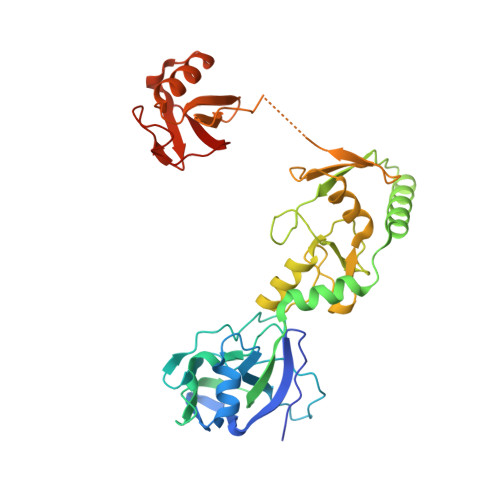
E2-SUMO-Siz1 E3-SUMO-PCNA complex


Experimental Data Snapshot

  • Method: X-RAY DIFFRACTION
  • Resolution: 2.85 Å
  • R-Value Free: 
    0.250 (Depositor), 0.251 (DCC) 
  • R-Value Work: 
    0.211 (Depositor), 0.213 (DCC) 
  • R-Value Observed: 
    0.213 (Depositor) 

Starting Models: experimental
View more details

wwPDB Validation 3D Report Full Report

Validation slider image for 5JNE

This is version 1.8 of the entry. See complete history

Literature

Capturing a substrate in an activated RING E3/E2-SUMO complex.

Streich, F.C.Lima, C.D.

(2016) Nature 536: 304-308

  • DOI: https://doi.org/10.1038/nature19071
  • Primary Citation Related Structures: 
    5JNE

  • PubMed Abstract: 

    Post-translational protein modification by ubiquitin (Ub) and ubiquitin-like (Ubl) proteins such as small ubiquitin-like modifier (SUMO) regulates processes including protein homeostasis, the DNA damage response, and the cell cycle. Proliferating cell nuclear antigen (PCNA) is modified by Ub or poly-Ub at lysine (Lys)164 after DNA damage to recruit repair factors. Yeast PCNA is modified by SUMO on Lys164 and Lys127 during S-phase to recruit the anti-recombinogenic helicase Srs2. Lys164 modification requires specialized E2/E3 enzyme pairs for SUMO or Ub conjugation. For SUMO, Lys164 modification is strictly dependent on the E3 ligase Siz1, suggesting the E3 alters E2 specificity to promote Lys164 modification. The structural basis for substrate interactions in activated E3/E2–Ub/Ubl complexes remains unclear. Here we report an engineered E2 protein and cross-linking strategies that trap an E3/E2–Ubl/substrate complex for structure determination, illustrating how an E3 can bypass E2 specificity to force-feed a substrate lysine into the E2 active site.

Macromolecule Content 

  • Total Structure Weight: 199.28 kDa 
  • Atom Count: 13,744 
  • Modeled Residue Count: 1,679 
  • Deposited Residue Count: 1,738 
  • Unique protein chains: 4

Macromolecules

Find similar proteins by:|  3D Structure
Entity ID: 1
MoleculeChains  Sequence LengthOrganismDetailsImage
E3 SUMO-protein ligase SIZ1,Ubiquitin-like protein SMT3
A, E
367Saccharomyces cerevisiae S288CMutation(s): 1 
Gene Names: SIZ1ULL1YDR409WSMT3YDR510WD9719.15
EC: 6.3.2 (PDB Primary Data), 2.3.2 (UniProt)
UniProt
Find proteins for Q04195 (Saccharomyces cerevisiae (strain ATCC 204508 / S288c))
Explore Q04195 
Go to UniProtKB:  Q04195
Find proteins for Q12306 (Saccharomyces cerevisiae (strain ATCC 204508 / S288c))
Explore Q12306 
Go to UniProtKB:  Q12306
Entity Groups
Sequence Clusters30% Identity50% Identity70% Identity90% Identity95% Identity100% Identity
UniProt GroupsQ04195Q12306
Sequence Annotations
Expand
Reference Sequence
Find similar proteins by:|  3D Structure
Entity ID: 2
MoleculeChains  Sequence LengthOrganismDetailsImage
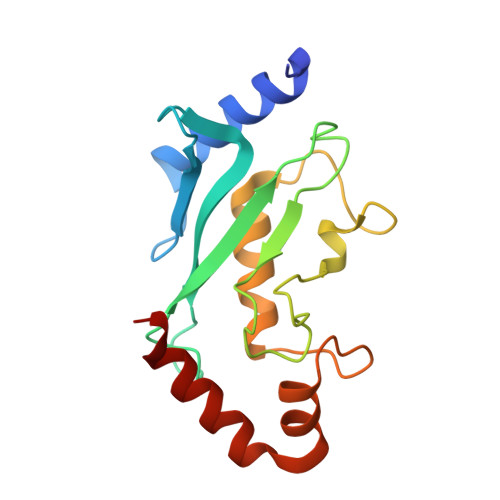
SUMO-conjugating enzyme UBC9
B, F
160Saccharomyces cerevisiae S288CMutation(s): 3 
Gene Names: UBC9YDL064W
EC: 6.3.2 (PDB Primary Data), 2.3.2 (UniProt)
UniProt
Find proteins for P50623 (Saccharomyces cerevisiae (strain ATCC 204508 / S288c))
Explore P50623 
Go to UniProtKB:  P50623
Entity Groups
Sequence Clusters30% Identity50% Identity70% Identity90% Identity95% Identity100% Identity
UniProt GroupP50623
Sequence Annotations
Expand
Reference Sequence
Find similar proteins by:|  3D Structure
Entity ID: 3
MoleculeChains  Sequence LengthOrganismDetailsImage
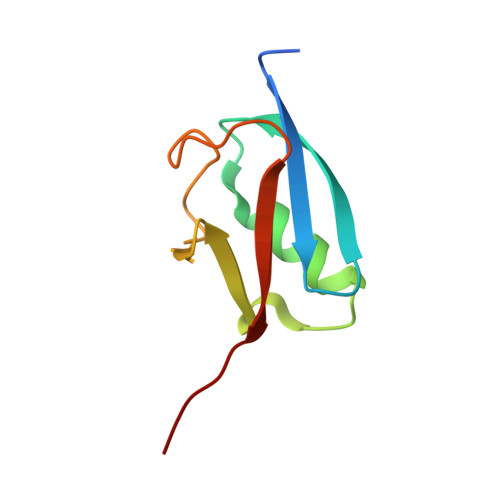
Ubiquitin-like protein SMT3
C, G
84Saccharomyces cerevisiae S288CMutation(s): 1 
Gene Names: SMT3YDR510WD9719.15
UniProt
Find proteins for Q12306 (Saccharomyces cerevisiae (strain ATCC 204508 / S288c))
Explore Q12306 
Go to UniProtKB:  Q12306
Entity Groups
Sequence Clusters30% Identity50% Identity70% Identity90% Identity95% Identity100% Identity
UniProt GroupQ12306
Sequence Annotations
Expand
Reference Sequence
Find similar proteins by:|  3D Structure
Entity ID: 4
MoleculeChains  Sequence LengthOrganismDetailsImage
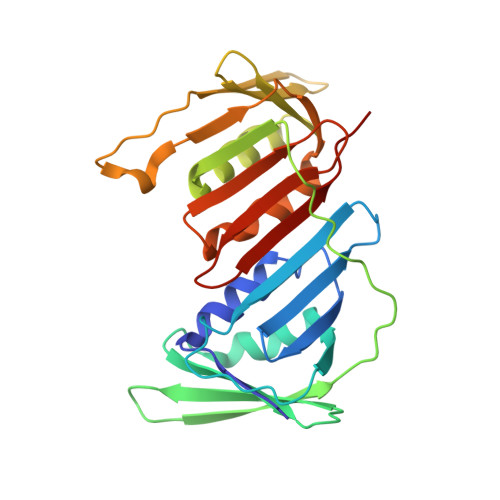
Proliferating cell nuclear antigen
D, H
258Saccharomyces cerevisiae S288CMutation(s): 5 
Gene Names: POL30YBR088CYBR0811
UniProt
Find proteins for P15873 (Saccharomyces cerevisiae (strain ATCC 204508 / S288c))
Explore P15873 
Go to UniProtKB:  P15873
Entity Groups
Sequence Clusters30% Identity50% Identity70% Identity90% Identity95% Identity100% Identity
UniProt GroupP15873
Sequence Annotations
Expand
Reference Sequence

Small Molecules

Ligands 3 Unique
IDChains Name / Formula / InChI Key2D Diagram3D Interactions
6LN

Query on 6LN


Download:Ideal Coordinates CCD File
M [auth B],
T [auth F]
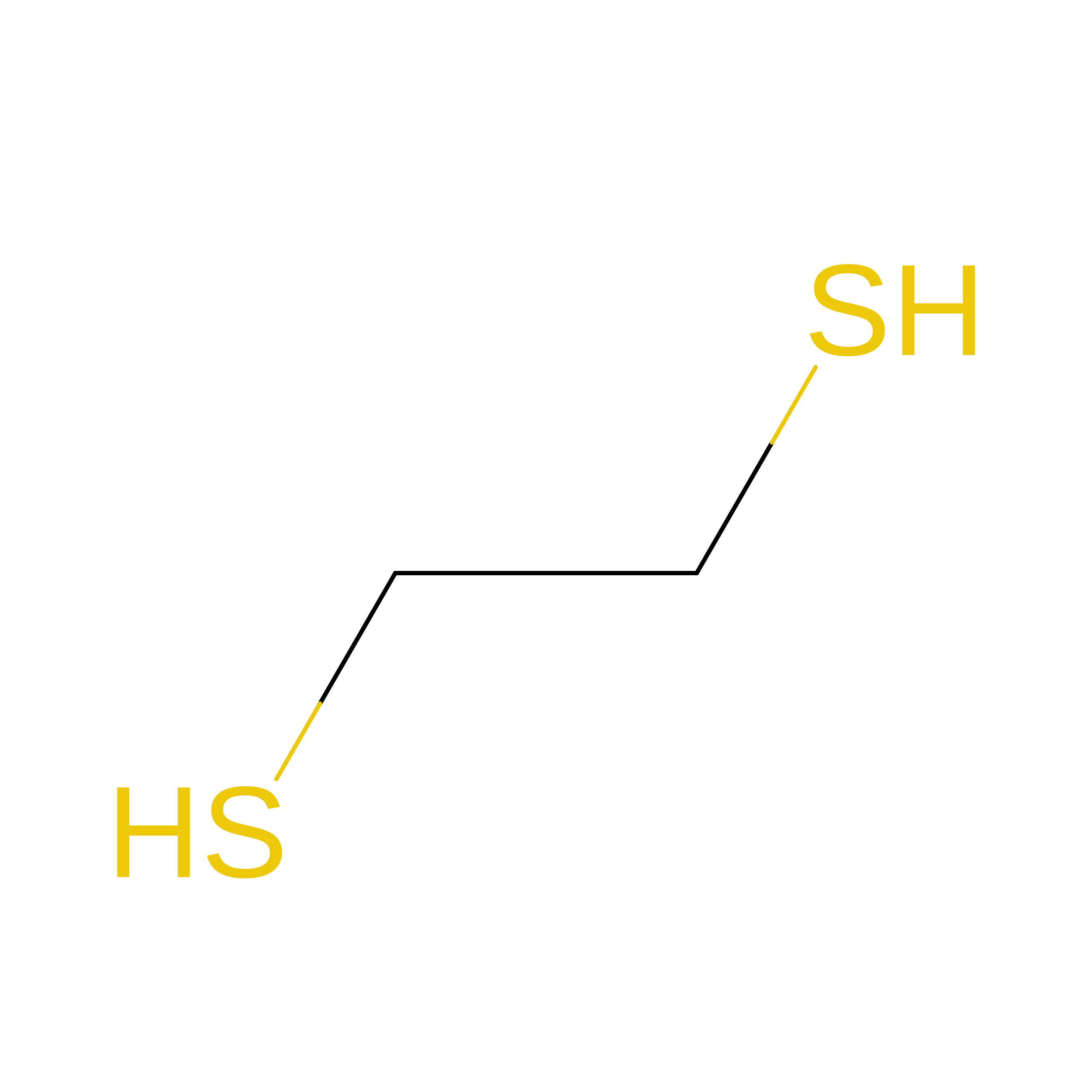
ethane-1,2-dithiol
C2 H6 S2
VYMPLPIFKRHAAC-UHFFFAOYSA-N
GOL

Query on GOL


Download:Ideal Coordinates CCD File
J [auth A]
K [auth A]
L [auth A]
N [auth D]
O [auth D]
J [auth A],
K [auth A],
L [auth A],
N [auth D],
O [auth D],
P [auth D],
R [auth E],
S [auth E],
U [auth H],
V [auth H]
GLYCEROL
C3 H8 O3
PEDCQBHIVMGVHV-UHFFFAOYSA-N
ZN

Query on ZN


Download:Ideal Coordinates CCD File
I [auth A],
Q [auth E]
ZINC ION
Zn
PTFCDOFLOPIGGS-UHFFFAOYSA-N

Experimental Data & Validation

Experimental Data

  • Method: X-RAY DIFFRACTION
  • Resolution: 2.85 Å
  • R-Value Free:  0.250 (Depositor), 0.251 (DCC) 
  • R-Value Work:  0.211 (Depositor), 0.213 (DCC) 
  • R-Value Observed: 0.213 (Depositor) 
Space Group: C 1 2 1
Unit Cell:
Length ( Å )Angle ( ˚ )
a = 93.421α = 90
b = 205.882β = 95.3
c = 142.501γ = 90
Software Package:
Software NamePurpose
PHENIXrefinement
HKL-2000data reduction
HKL-2000data scaling
PHENIXphasing

Structure Validation

View Full Validation Report


Entry History 

& Funding Information

Deposition Data


Funding OrganizationLocationGrant Number
National Institutes of Health/National Institute of General Medical Sciences (NIH/NIGMS)United StatesGM065872

Revision History  (Full details and data files)

  • Version 1.0: 2016-08-10
    Type: Initial release
  • Version 1.1: 2016-08-24
    Changes: Database references
  • Version 1.2: 2016-08-31
    Changes: Database references
  • Version 1.3: 2016-09-21
    Changes: Other
  • Version 1.4: 2017-09-20
    Changes: Author supporting evidence, Derived calculations
  • Version 1.5: 2019-12-25
    Changes: Author supporting evidence
  • Version 1.6: 2023-09-27
    Changes: Data collection, Database references, Derived calculations, Refinement description
  • Version 1.7: 2024-05-01
    Changes: Derived calculations
  • Version 1.8: 2024-10-09
    Changes: Structure summary