5IKB | pdb_00005ikb

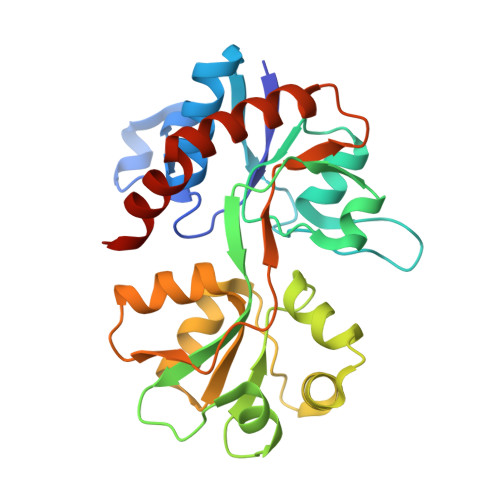
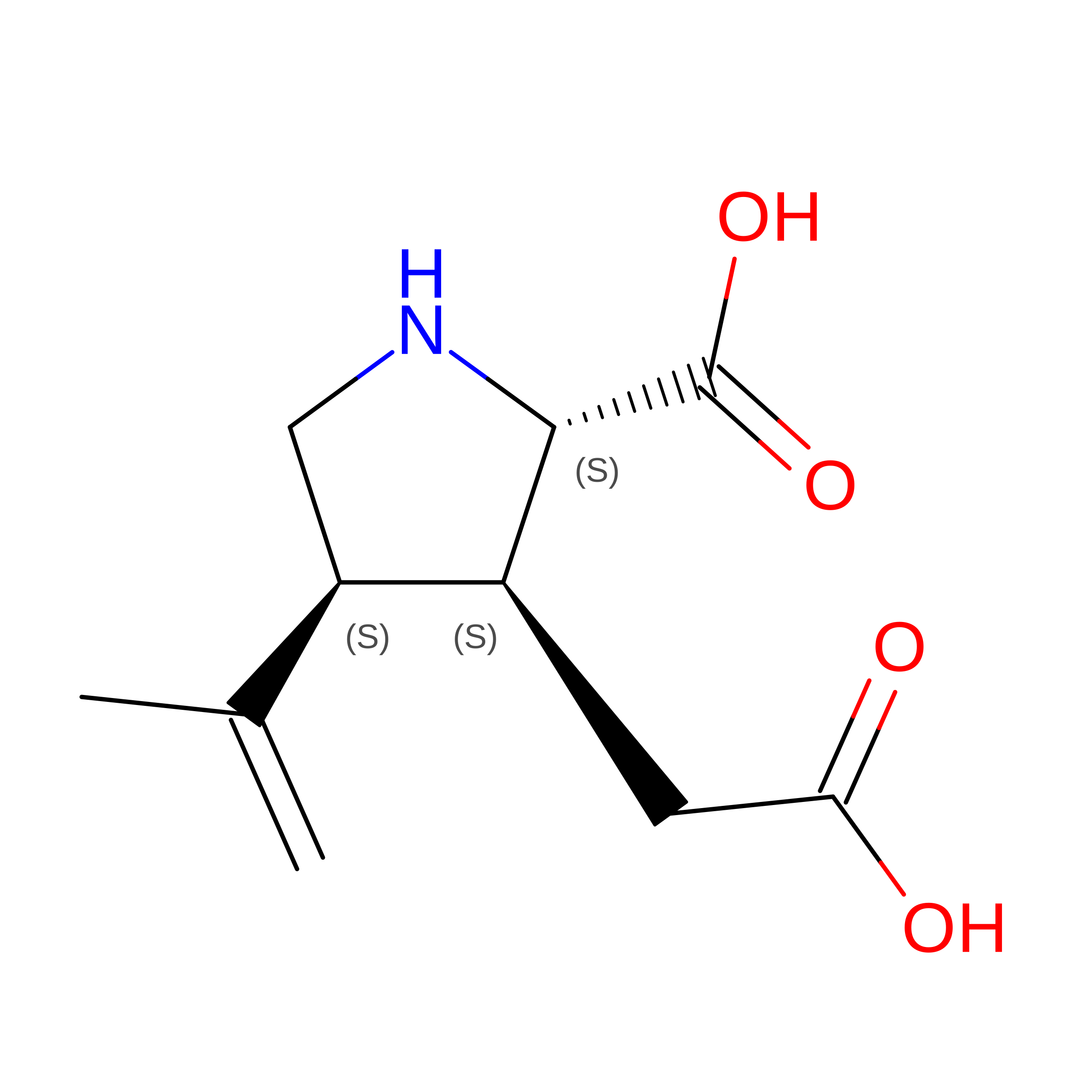
Crystal structure of the kainate receptor GluK4 ligand binding domain in complex with kainate


Experimental Data Snapshot

  • Method: X-RAY DIFFRACTION
  • Resolution: 2.05 Å
  • R-Value Free: 
    0.262 (Depositor), 0.238 (DCC) 
  • R-Value Work: 
    0.191 (Depositor) 
  • R-Value Observed: 
    0.195 (Depositor) 

Starting Model: experimental
View more details

wwPDB Validation 3D Report Full Report

Validation slider image for 5IKB

Ligand Structure Quality Assessment 


This is version 2.1 of the entry. See complete history

Literature

The Structure of a High-Affinity Kainate Receptor: GluK4 Ligand-Binding Domain Crystallized with Kainate.

Kristensen, O.Kristensen, L.B.Mollerud, S.Frydenvang, K.Pickering, D.S.Kastrup, J.S.

(2016) Structure 24: 1582-1589

  • DOI: https://doi.org/10.1016/j.str.2016.06.019
  • Primary Citation Related Structures: 
    5IKB

  • PubMed Abstract: 

    Ionotropic glutamate receptors play a key role in fast neurotransmission in the CNS and have been linked to several neurological diseases and disorders. One subfamily is the kainate receptors, which are grouped into low-affinity (GluK1-3) and high-affinity (GluK4-5) receptors based on their affinity for kainate. Although structures of the ligand-binding domain (LBD) of all low-affinity kainate receptors have been reported, no structures of the high-affinity receptor subunits are available. Here, we present the X-ray structure of GluK4-LBD with kainate at 2.05 Å resolution, together with thermofluor and radiolabel binding affinity data. Whereas binding-site residues in GluK4 are most similar to the AMPA receptor subfamily, the domain closure and D1-D2 interlobe contacts induced by kainate are similar to the low-affinity kainate receptor GluK1. These observations provide a likely explanation for the high binding affinity of kainate at GluK4-LBD.


  • Organizational Affiliation
    • Department of Drug Design and Pharmacology, Faculty of Health and Medical Sciences, University of Copenhagen, Jagtvej 162, 2100 Copenhagen Ø, Denmark.

Macromolecule Content 

  • Total Structure Weight: 29.57 kDa 
  • Atom Count: 2,292 
  • Modeled Residue Count: 249 
  • Deposited Residue Count: 257 
  • Unique protein chains: 1

Macromolecules

Find similar proteins by:|  3D Structure
Entity ID: 1
MoleculeChains  Sequence LengthOrganismDetailsImage
Glutamate receptor ionotropic, kainate 4,Glutamate receptor ionotropic, kainate 4257Rattus norvegicusMutation(s): 0 
Gene Names: Grik4
UniProt
Find proteins for Q01812 (Rattus norvegicus)
Explore Q01812 
Go to UniProtKB:  Q01812
Entity Groups
Sequence Clusters30% Identity50% Identity70% Identity90% Identity95% Identity100% Identity
UniProt GroupQ01812
Sequence Annotations
Expand
Reference Sequence

Experimental Data & Validation

Experimental Data

  • Method: X-RAY DIFFRACTION
  • Resolution: 2.05 Å
  • R-Value Free:  0.262 (Depositor), 0.238 (DCC) 
  • R-Value Work:  0.191 (Depositor) 
  • R-Value Observed: 0.195 (Depositor) 
Space Group: C 2 2 21
Unit Cell:
Length ( Å )Angle ( ˚ )
a = 44.5α = 90
b = 69.87β = 90
c = 162.76γ = 90
Software Package:
Software NamePurpose
REFMACrefinement
PHENIXrefinement
xia2data reduction
XDSdata reduction
PHASERphasing
Cootmodel building

Structure Validation

View Full Validation Report


Ligand Structure Quality Assessment 


Entry History 

& Funding Information

Deposition Data


Funding OrganizationLocationGrant Number
The Lundbeck FoundationDenmark--
E.C. (FP7)Biostruct-X

Revision History  (Full details and data files)

  • Version 1.0: 2016-08-24
    Type: Initial release
  • Version 1.1: 2016-09-14
    Changes: Database references
  • Version 1.2: 2017-08-09
    Changes: Database references
  • Version 2.0: 2019-03-27
    Changes: Atomic model, Data collection, Source and taxonomy
  • Version 2.1: 2024-01-10
    Changes: Data collection, Database references, Refinement description