5HK7 | pdb_00005hk7

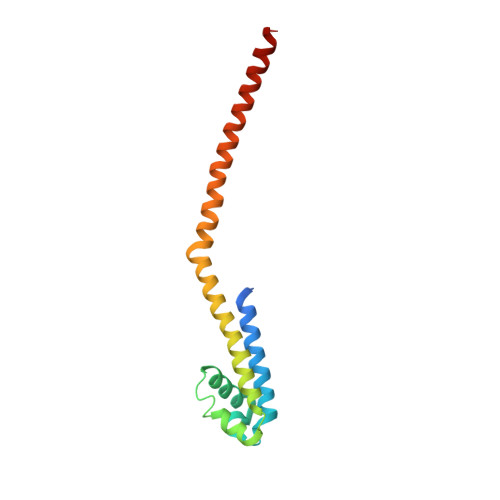
Bacterial sodium channel pore, 2.95 Angstrom resolution


Experimental Data Snapshot

  • Method: X-RAY DIFFRACTION
  • Resolution: 2.95 Å
  • R-Value Free: 
    0.236 (Depositor), 0.238 (DCC) 
  • R-Value Work: 
    0.205 (Depositor), 0.205 (DCC) 
  • R-Value Observed: 
    0.206 (Depositor) 

Starting Model: experimental
View more details

wwPDB Validation 3D Report Full Report

Validation slider image for 5HK7

Ligand Structure Quality Assessment 


This is version 1.1 of the entry. See complete history

Literature

Unfolding of a Temperature-Sensitive Domain Controls Voltage-Gated Channel Activation.

Arrigoni, C.Rohaim, A.Shaya, D.Findeisen, F.Stein, R.A.Nurva, S.R.Mishra, S.Mchaourab, H.S.Minor, D.L.

(2016) Cell 164: 922-936

  • DOI: https://doi.org/10.1016/j.cell.2016.02.001
  • Primary Citation Related Structures: 
    5HJ8, 5HK6, 5HK7, 5HKD, 5IWN, 5IWO

  • PubMed Abstract: 

    Voltage-gated ion channels (VGICs) are outfitted with diverse cytoplasmic domains that impact function. To examine how such elements may affect VGIC behavior, we addressed how the bacterial voltage-gated sodium channel (BacNa(V)) C-terminal cytoplasmic domain (CTD) affects function. Our studies show that the BacNa(V) CTD exerts a profound influence on gating through a temperature-dependent unfolding transition in a discrete cytoplasmic domain, the neck domain, proximal to the pore. Structural and functional studies establish that the BacNa(V) CTD comprises a bi-partite four-helix bundle that bears an unusual hydrophilic core whose integrity is central to the unfolding mechanism and that couples directly to the channel activation gate. Together, our findings define a general principle for how the widespread four-helix bundle cytoplasmic domain architecture can control VGIC responses, uncover a mechanism underlying the diverse BacNa(V) voltage dependencies, and demonstrate that a discrete domain can encode the temperature-dependent response of a channel.


  • Organizational Affiliation
    • Cardiovascular Research Institute, University of California, San Francisco, San Francisco, CA 94158, USA.

Macromolecule Content 

  • Total Structure Weight: 74.35 kDa 
  • Atom Count: 4,667 
  • Modeled Residue Count: 553 
  • Deposited Residue Count: 608 
  • Unique protein chains: 1

Macromolecules

Find similar proteins by:|  3D Structure
Entity ID: 1
MoleculeChains  Sequence LengthOrganismDetailsImage
Ion transport protein
A, B, C, D
152Alkalilimnicola ehrlichiiMutation(s): 0 
Gene Names: Mlg_0322
Membrane Entity: Yes 
UniProt
Find proteins for Q0ABW0 (Alkalilimnicola ehrlichii (strain ATCC BAA-1101 / DSM 17681 / MLHE-1))
Explore Q0ABW0 
Go to UniProtKB:  Q0ABW0
Entity Groups
Sequence Clusters30% Identity50% Identity70% Identity90% Identity95% Identity100% Identity
UniProt GroupQ0ABW0
Sequence Annotations
Expand
Reference Sequence

Small Molecules

Ligands 3 Unique
IDChains Name / Formula / InChI Key2D Diagram3D Interactions
VVA

Query on VVA


Download:Ideal Coordinates CCD File
F [auth A]
G [auth A]
I [auth B]
J [auth B]
K [auth B]
F [auth A],
G [auth A],
I [auth B],
J [auth B],
K [auth B],
M [auth C],
N [auth C],
O [auth C],
P [auth C],
R [auth D]
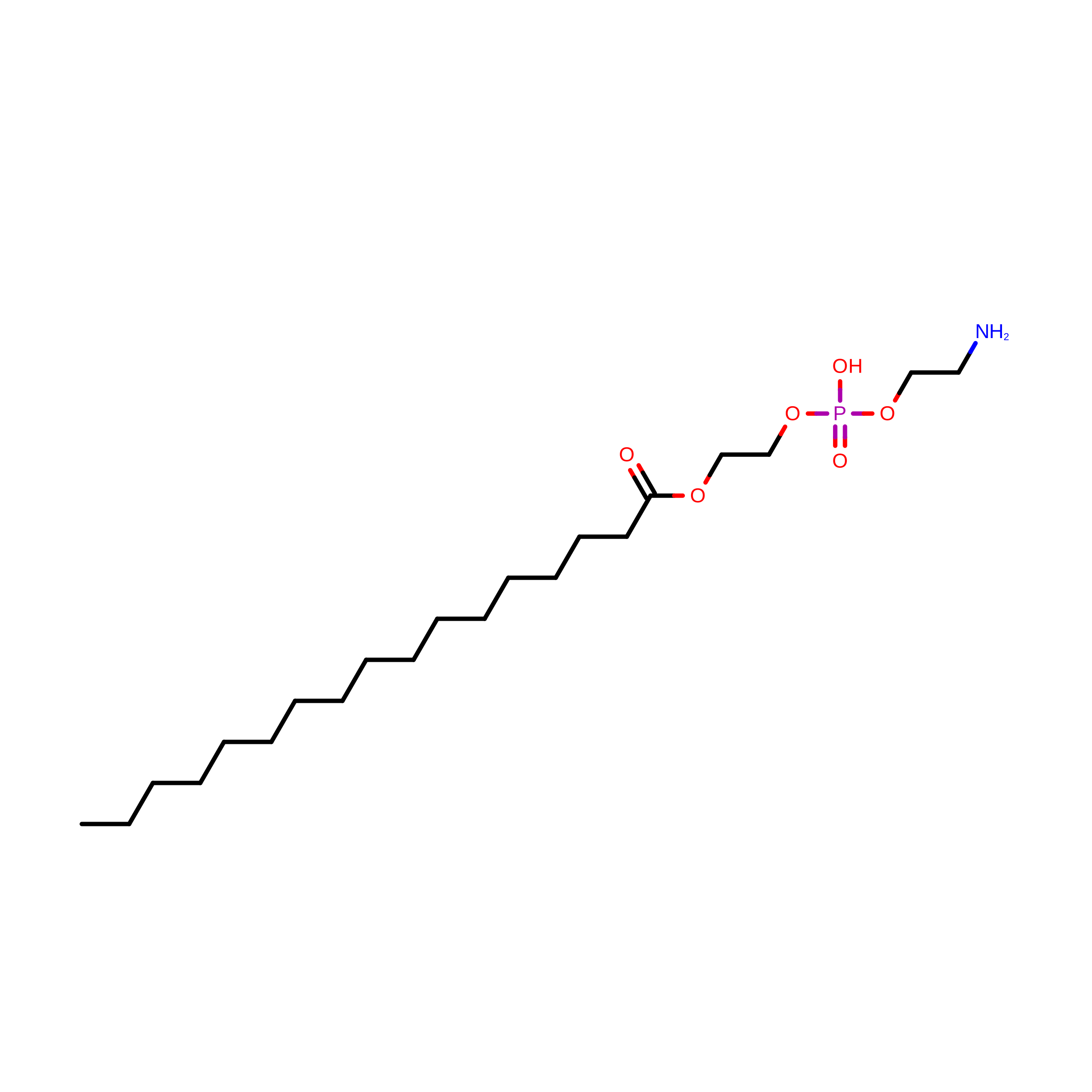
2-{[(S)-(2-aminoethoxy)(hydroxy)phosphoryl]oxy}ethyl heptadecanoate
C21 H44 N O6 P
KBKQEKNZSDBGFI-UHFFFAOYSA-N
CL

Query on CL


Download:Ideal Coordinates CCD File
E [auth A],
H [auth A]
CHLORIDE ION
Cl
VEXZGXHMUGYJMC-UHFFFAOYSA-M
NA

Query on NA


Download:Ideal Coordinates CCD File
L [auth B],
Q [auth C]
SODIUM ION
Na
FKNQFGJONOIPTF-UHFFFAOYSA-N

Experimental Data & Validation

Experimental Data

  • Method: X-RAY DIFFRACTION
  • Resolution: 2.95 Å
  • R-Value Free:  0.236 (Depositor), 0.238 (DCC) 
  • R-Value Work:  0.205 (Depositor), 0.205 (DCC) 
  • R-Value Observed: 0.206 (Depositor) 
Space Group: I 2 2 2
Unit Cell:
Length ( Å )Angle ( ˚ )
a = 153.51α = 90
b = 160.52β = 90
c = 166.37γ = 90
Software Package:
Software NamePurpose
REFMACrefinement
iMOSFLMdata reduction
SCALAdata scaling
PHASERphasing

Structure Validation

View Full Validation Report


Ligand Structure Quality Assessment 


Entry History 

Deposition Data

Revision History  (Full details and data files)

  • Version 1.0: 2016-03-09
    Type: Initial release
  • Version 1.1: 2023-09-27
    Changes: Data collection, Database references, Derived calculations, Refinement description