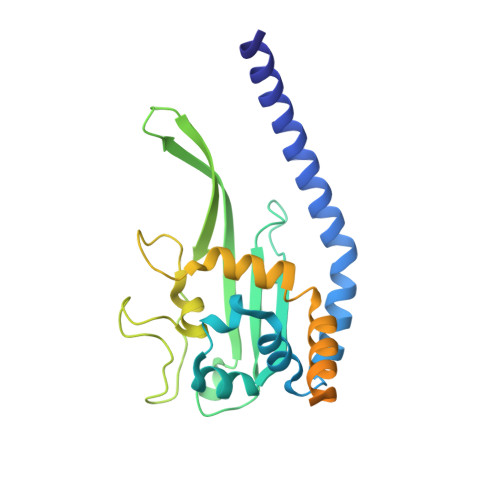
5GPL | pdb_00005gpl

Crystal structure of Ccp1


Experimental Data Snapshot

  • Method: X-RAY DIFFRACTION
  • Resolution: 2.10 Å
  • R-Value Free: 
    0.236 (Depositor) 
  • R-Value Work: 
    0.193 (Depositor) 
  • R-Value Observed: 
    0.195 (Depositor) 

Starting Model: experimental
View more details

wwPDB Validation 3D Report Full Report

Validation slider image for 5GPL

This is version 1.1 of the entry. See complete history

Literature

Ccp1 Homodimer Mediates Chromatin Integrity by Antagonizing CENP-A Loading

Dong, Q.Yin, F.X.Gao, F.Shen, Y.Zhang, F.Li, Y.He, H.Gonzalez, M.Yang, J.Zhang, S.Su, M.Chen, Y.H.Li, F.

(2016) Mol Cell 64: 79-91

  • DOI: https://doi.org/10.1016/j.molcel.2016.08.022
  • Primary Citation Related Structures: 
    5GPK, 5GPL

  • PubMed Abstract: 

    CENP-A is a centromere-specific histone 3 variant essential for centromere specification. CENP-A partially replaces canonical histone H3 at the centromeres. How the particular CENP-A/H3 ratio at centromeres is precisely maintained is unknown. It also remains unclear how CENP-A is excluded from non-centromeric chromatin. Here, we identify Ccp1, an uncharacterized NAP family protein in fission yeast that antagonizes CENP-A loading at both centromeric and non-centromeric regions. Like the CENP-A loading factor HJURP, Ccp1 interacts with CENP-A and is recruited to centromeres at the end of mitosis in a Mis16-dependent manner. These data indicate that factors with opposing CENP-A loading activities are recruited to centromeres. Furthermore, Ccp1 also cooperates with H2A.Z to evict CENP-A assembled in euchromatin. Structural analyses indicate that Ccp1 forms a homodimer that is required for its anti-CENP-A loading activity. Our study establishes mechanisms for maintenance of CENP-A homeostasis at centromeres and the prevention of ectopic assembly of centromeres.


  • Organizational Affiliation
    • Department of Biology, New York University, New York, NY 10003, USA.

Macromolecule Content 

  • Total Structure Weight: 64.71 kDa 
  • Atom Count: 3,736 
  • Modeled Residue Count: 412 
  • Deposited Residue Count: 548 
  • Unique protein chains: 1

Macromolecules

Find similar proteins by:|  3D Structure
Entity ID: 1
MoleculeChains  Sequence LengthOrganismDetailsImage
Putative nucleosome assembly protein C36B7.08c
A, B
274Schizosaccharomyces pombe 972h-Mutation(s): 0 
Gene Names: SPBC36B7.08c
UniProt
Find proteins for Q9HGN2 (Schizosaccharomyces pombe (strain 972 / ATCC 24843))
Explore Q9HGN2 
Go to UniProtKB:  Q9HGN2
Entity Groups
Sequence Clusters30% Identity50% Identity70% Identity90% Identity95% Identity100% Identity
UniProt GroupQ9HGN2
Sequence Annotations
Expand
Reference Sequence

Experimental Data & Validation

Experimental Data

  • Method: X-RAY DIFFRACTION
  • Resolution: 2.10 Å
  • R-Value Free:  0.236 (Depositor) 
  • R-Value Work:  0.193 (Depositor) 
  • R-Value Observed: 0.195 (Depositor) 
Space Group: P 41 2 2
Unit Cell:
Length ( Å )Angle ( ˚ )
a = 86.662α = 90
b = 86.662β = 90
c = 158.771γ = 90
Software Package:
Software NamePurpose
PHENIXrefinement
HKL-2000data reduction
HKL-2000data scaling
PHENIXphasing

Structure Validation

View Full Validation Report


Entry History 

Deposition Data

Revision History  (Full details and data files)

  • Version 1.0: 2016-11-30
    Type: Initial release
  • Version 1.1: 2023-11-08
    Changes: Data collection, Database references, Refinement description