5GM3 | pdb_00005gm3

Crystal structure of FI-CMCase from Aspergillus aculeatus F-50


Experimental Data Snapshot

  • Method: X-RAY DIFFRACTION
  • Resolution: 1.59 Å
  • R-Value Free: 
    0.190 (Depositor), 0.199 (DCC) 
  • R-Value Work: 
    0.157 (Depositor), 0.169 (DCC) 
  • R-Value Observed: 
    0.159 (Depositor) 

Starting Model: experimental
View more details

wwPDB Validation 3D Report Full Report

Validation slider image for 5GM3

This is version 1.2 of the entry. See complete history

Literature

Crystal structure and genetic modifications of FI-CMCase from Aspergillus aculeatus F-50

Huang, J.W.Liu, W.Lai, H.L.Cheng, Y.S.Zheng, Y.Li, Q.Sun, H.Kuo, C.J.Guo, R.T.Chen, C.C.

(2016) Biochem Biophys Res Commun 478: 565-572

  • DOI: https://doi.org/10.1016/j.bbrc.2016.07.101
  • Primary Citation Related Structures: 
    5GM3, 5GM4, 5GM5

  • PubMed Abstract: 

    Cellulose is the major component of the plant cell wall and the most abundant renewable biomass on earth, and its decomposition has proven to be very useful in many commercial applications. Endo-1,4-β-d-glucanase (EC 3.2.1.4; endoglucanase), which catalyzes the random hydrolysis of 1,4-β-glycosidic bonds of the cellulose main chain to cleave cellulose into smaller fragments, is the key cellulolytic enzyme. An endoglucanase isolated from Aspergillus aculeatus F-50 (FI-CMCase), which is classified into the glycoside hydrolase (GH) family 12, was demonstrated to be effectively expressed in the industrial strain Pichia pastoris. Here, the crystal structure and complex structures of P. pastoris-expressed FI-CMCase were solved to high resolution. The overall structure is analyzed and compared to other GH12 members. In addition, the substrate-surrounding residues were engineered to search for variants with improved enzymatic activity. Among 14 mutants constructed, one with two-fold increase in protein expression was identified, which possesses a potential to be further developed as a commercial enzyme product.


  • Organizational Affiliation
    • AsiaPac Biotechnology Co., Ltd, Dongguan 523808, China.

Macromolecule Content 

  • Total Structure Weight: 48.63 kDa 
  • Atom Count: 3,975 
  • Modeled Residue Count: 437 
  • Deposited Residue Count: 438 
  • Unique protein chains: 1

Macromolecules

Find similar proteins by:|  3D Structure
Entity ID: 1
MoleculeChains  Sequence LengthOrganismDetailsImage
Endoglucanase-1
A, B
219Aspergillus aculeatusMutation(s): 0 
EC: 3.2.1.4
UniProt
Find proteins for P22669 (Aspergillus aculeatus)
Explore P22669 
Go to UniProtKB:  P22669
Entity Groups
Sequence Clusters30% Identity50% Identity70% Identity90% Identity95% Identity100% Identity
UniProt GroupP22669
Sequence Annotations
Expand
Reference Sequence

Small Molecules

Ligands 2 Unique
IDChains Name / Formula / InChI Key2D Diagram3D Interactions
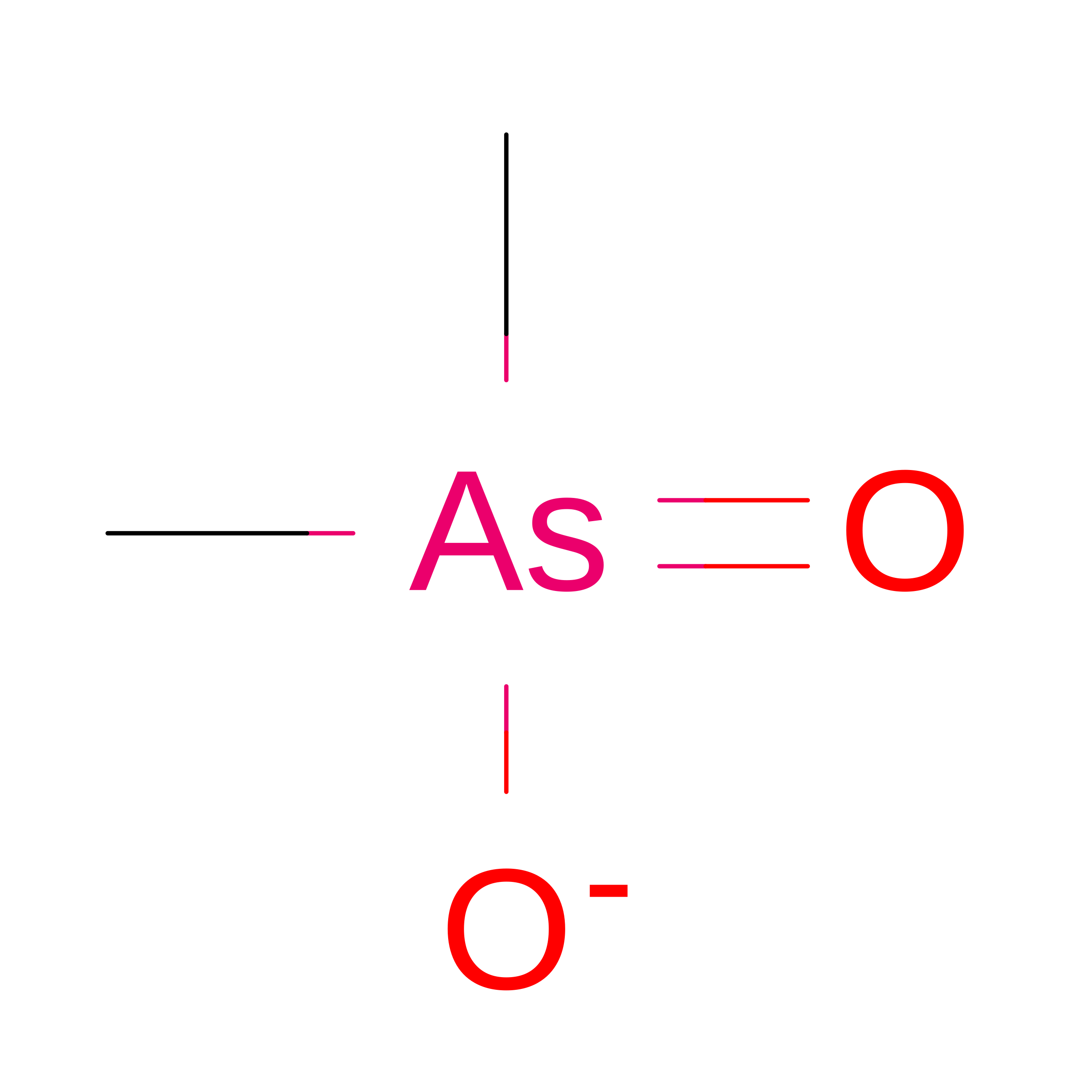
CAC

Query on CAC


Download:Ideal Coordinates CCD File
H [auth A],
I [auth A],
M [auth B],
N [auth B]
CACODYLATE ION
C2 H6 As O2
OGGXGZAMXPVRFZ-UHFFFAOYSA-M
ZN

Query on ZN


Download:Ideal Coordinates CCD File
C [auth A]
D [auth A]
E [auth A]
F [auth A]
G [auth A]
C [auth A],
D [auth A],
E [auth A],
F [auth A],
G [auth A],
J [auth B],
K [auth B],
L [auth B]
ZINC ION
Zn
PTFCDOFLOPIGGS-UHFFFAOYSA-N

Experimental Data & Validation

Experimental Data

  • Method: X-RAY DIFFRACTION
  • Resolution: 1.59 Å
  • R-Value Free:  0.190 (Depositor), 0.199 (DCC) 
  • R-Value Work:  0.157 (Depositor), 0.169 (DCC) 
  • R-Value Observed: 0.159 (Depositor) 
Space Group: C 2 2 21
Unit Cell:
Length ( Å )Angle ( ˚ )
a = 74.215α = 90
b = 75.089β = 90
c = 188.385γ = 90
Software Package:
Software NamePurpose
HKL-2000data scaling
REFMACrefinement
PDB_EXTRACTdata extraction
HKL-2000data reduction
PHASERphasing

Structure Validation

View Full Validation Report


Entry History 

Deposition Data

Revision History  (Full details and data files)

  • Version 1.0: 2017-05-17
    Type: Initial release
  • Version 1.1: 2023-11-08
    Changes: Data collection, Database references, Derived calculations, Refinement description
  • Version 1.2: 2024-11-13
    Changes: Structure summary