Download Mendeley
Sulfur Denitrosylation by an Engineered Trx-Like Dsbg Enzyme Identifies Nucleophilic Cysteine Hydrogen Bonds as Key Functional Determinant.
Lafaye, C., Van Molle, I., Tamu Dufe, V., Wahni, K., Boudier, A., Leroy, P., Collet, J., Messens, J.(2016) J Biol Chem 291: 15020
- PubMed: 27226614 Search on PubMedSearch on PubMed Central
- DOI: https://doi.org/10.1074/jbc.M116.729426
- Primary Citation Related Structures:
5G1K, 5G1L - PubMed Abstract:
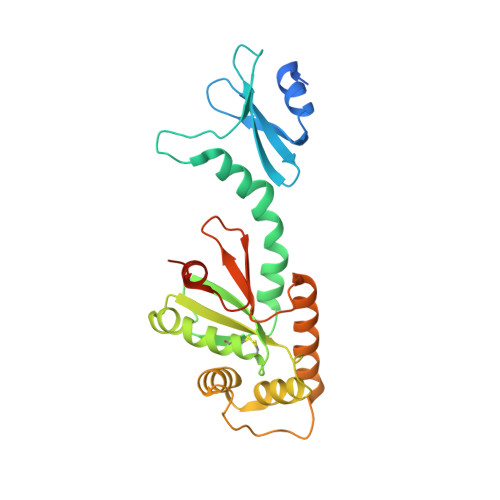
Exposure of bacteria to NO results in the nitrosylation of cysteine thiols in proteins and low molecular weight thiols such as GSH. The cells possess enzymatic systems that catalyze the denitrosylation of these modified sulfurs. An important player in these systems is thioredoxin (Trx), a ubiquitous, cytoplasmic oxidoreductase that can denitrosylate proteins in vivo and S-nitrosoglutathione (GSNO) in vitro However, a periplasmic or extracellular denitrosylase has not been identified, raising the question of how extracytoplasmic proteins are repaired after nitrosative damage. In this study, we tested whether DsbG and DsbC, two Trx family proteins that function in reducing pathways in the Escherichia coli periplasm, also possess denitrosylating activity. Both DsbG and DsbC are poorly reactive toward GSNO. Moreover, DsbG is unable to denitrosylate its specific substrate protein, YbiS. Remarkably, by borrowing the CGPC active site of E. coli Trx-1 in combination with a T200M point mutation, we transformed DsbG into an enzyme highly reactive toward GSNO and YbiS. The pKa of the nucleophilic cysteine, as well as the redox and thermodynamic properties of the engineered DsbG are dramatically changed and become similar to those of E. coli Trx-1. X-ray structural insights suggest that this results from a loss of two direct hydrogen bonds to the nucleophilic cysteine sulfur in the DsbG mutant. Our results highlight the plasticity of the Trx structural fold and reveal that the subtle change of the number of hydrogen bonds in the active site of Trx-like proteins is the key factor that thermodynamically controls reactivity toward nitrosylated compounds.
- From the de Duve Institute, Université Catholique de Louvain, B-1200 Brussels, Belgium, WELBIO, B-1200 Brussels, Belgium, the Brussels Center for Redox Biology, B-1050 Brussels, Belgium.
Organizational Affiliation: