5FTJ | pdb_00005ftj

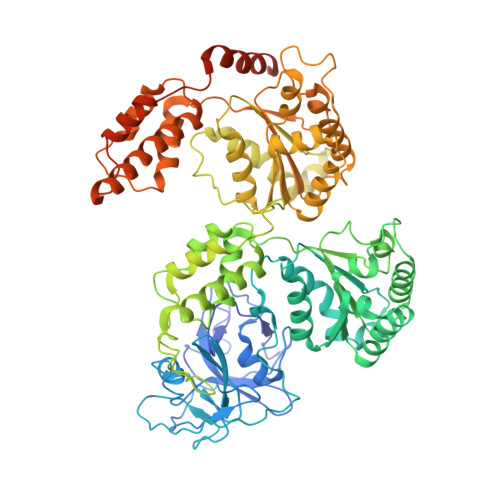
Cryo-EM structure of human p97 bound to UPCDC30245 inhibitor


Experimental Data Snapshot

  • Method: ELECTRON MICROSCOPY
  • Resolution: 2.30 Å
  • Aggregation State: PARTICLE 
  • Reconstruction Method: SINGLE PARTICLE 

wwPDB Validation 3D Report Full Report

Validation slider image for 5FTJ

This is version 1.6 of the entry. See complete history

Literature

2.3 A Resolution Cryo-Em Structure of Human P97 and Mechanism of Allosteric Inhibition

Banerjee, S.Bartesaghi, A.Merk, A.Rao, P.Bulfer, S.L.Yan, Y.Green, N.Mroczkowski, B.Neitz, R.J.Wipf, P.Falconieri, V.Deshaies, R.J.Milne, J.L.S.Huryn, D.Arkin, M.Subramaniam, S.

(2016) Science 351: 871

  • DOI: https://doi.org/10.1126/science.aad7974
  • Primary Citation Related Structures: 
    5FTJ, 5FTK, 5FTL, 5FTM, 5FTN

  • PubMed Abstract: 

    p97 is a hexameric AAA+ adenosine triphosphatase (ATPase) that is an attractive target for cancer drug development. We report cryo-electron microscopy (cryo-EM) structures for adenosine diphosphate (ADP)-bound, full-length, hexameric wild-type p97 in the presence and absence of an allosteric inhibitor at resolutions of 2.3 and 2.4 angstroms, respectively. We also report cryo-EM structures (at resolutions of ~3.3, 3.2, and 3.3 angstroms, respectively) for three distinct, coexisting functional states of p97 with occupancies of zero, one, or two molecules of adenosine 5'-O-(3-thiotriphosphate) (ATPγS) per protomer. A large corkscrew-like change in molecular architecture, coupled with upward displacement of the N-terminal domain, is observed only when ATPγS is bound to both the D1 and D2 domains of the protomer. These cryo-EM structures establish the sequence of nucleotide-driven structural changes in p97 at atomic resolution. They also enable elucidation of the binding mode of an allosteric small-molecule inhibitor to p97 and illustrate how inhibitor binding at the interface between the D1 and D2 domains prevents propagation of the conformational changes necessary for p97 function.


  • Organizational Affiliation
    • Laboratory of Cell Biology, National Cancer Institute, Bethesda, MD 20892, USA.

Macromolecule Content 

  • Total Structure Weight: 544.53 kDa 
  • Atom Count: 34,602 
  • Modeled Residue Count: 4,338 
  • Deposited Residue Count: 4,836 
  • Unique protein chains: 1

Macromolecules

Find similar proteins by:|  3D Structure
Entity ID: 1
MoleculeChains  Sequence LengthOrganismDetailsImage
TRANSITIONAL ENDOPLASMIC RETICULUM ATPASE
A, B, C, D, E
A, B, C, D, E, F
806Homo sapiensMutation(s): 0 
EC: 3.6.4.6
UniProt & NIH Common Fund Data Resources
Find proteins for P55072 (Homo sapiens)
Explore P55072 
Go to UniProtKB:  P55072
PHAROS:  P55072
GTEx:  ENSG00000165280 
Entity Groups
Sequence Clusters30% Identity50% Identity70% Identity90% Identity95% Identity100% Identity
UniProt GroupP55072
Sequence Annotations
Expand
Reference Sequence

Small Molecules

Ligands 2 Unique
IDChains Name / Formula / InChI Key2D Diagram3D Interactions
OJA

Query on OJA


Download:Ideal Coordinates CCD File
I [auth A]
L [auth B]
O [auth C]
R [auth D]
U [auth E]
I [auth A],
L [auth B],
O [auth C],
R [auth D],
U [auth E],
X [auth F]
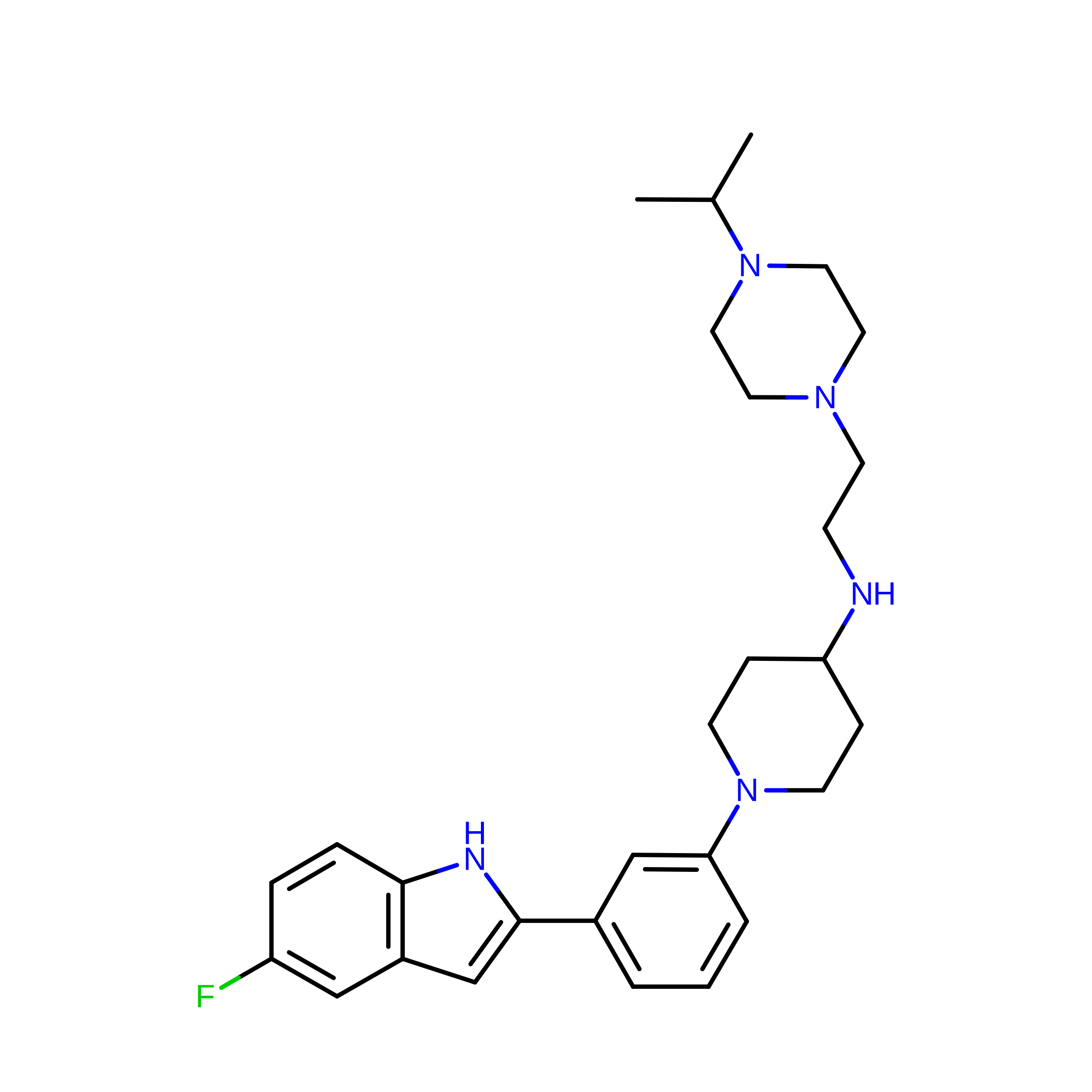
1-(3-(5-FLUORO-1H-INDOL-2-YL)PHENYL)PIPERIDIN-4-YL)(2-(4-ISOPROPYL-PIPERAZIN1-YL)ETHYL)-CARBAMATE
C28 H38 F N5
LZHXZCVDLATFAR-UHFFFAOYSA-N
ADP

Query on ADP


Download:Ideal Coordinates CCD File
G [auth A]
H [auth A]
J [auth B]
K [auth B]
M [auth C]
G [auth A],
H [auth A],
J [auth B],
K [auth B],
M [auth C],
N [auth C],
P [auth D],
Q [auth D],
S [auth E],
T [auth E],
V [auth F],
W [auth F]
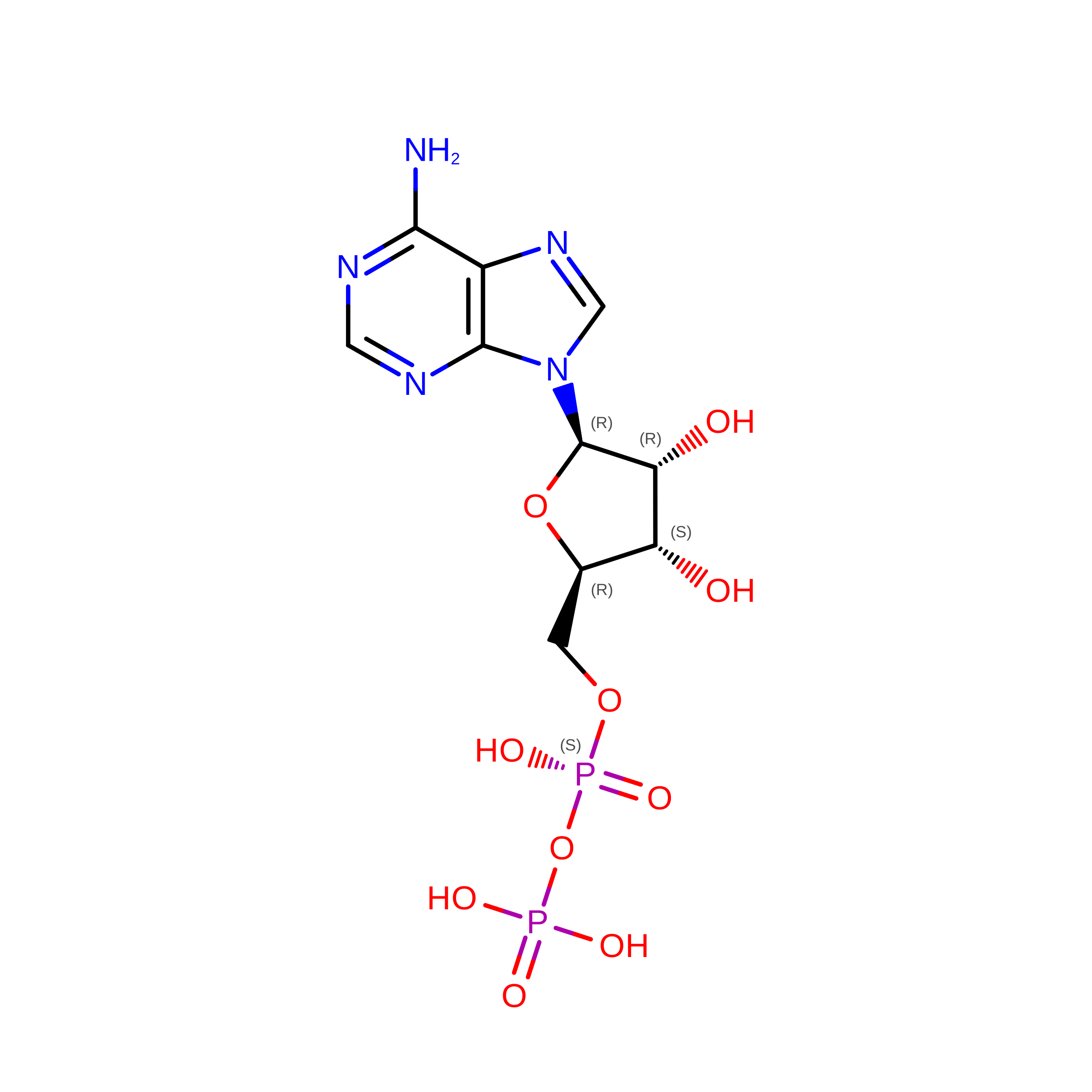
ADENOSINE-5'-DIPHOSPHATE
C10 H15 N5 O10 P2
XTWYTFMLZFPYCI-KQYNXXCUSA-N

Experimental Data & Validation

Experimental Data

  • Method: ELECTRON MICROSCOPY
  • Resolution: 2.30 Å
  • Aggregation State: PARTICLE 
  • Reconstruction Method: SINGLE PARTICLE 
EM Software:
TaskSoftware PackageVersion
RECONSTRUCTIONFREALIGN

Structure Validation

View Full Validation Report


Entry History 

Revision History  (Full details and data files)

  • Version 1.0: 2016-01-27
    Type: Initial release
  • Version 1.1: 2016-02-10
    Changes: Database references, Other
  • Version 1.2: 2016-02-17
    Changes: Atomic model, Derived calculations
  • Version 1.3: 2016-03-09
    Changes: Database references
  • Version 1.4: 2017-08-30
    Changes: Data collection
  • Version 1.5: 2018-10-03
    Changes: Data collection
  • Version 1.6: 2024-05-08
    Changes: Data collection, Database references, Derived calculations