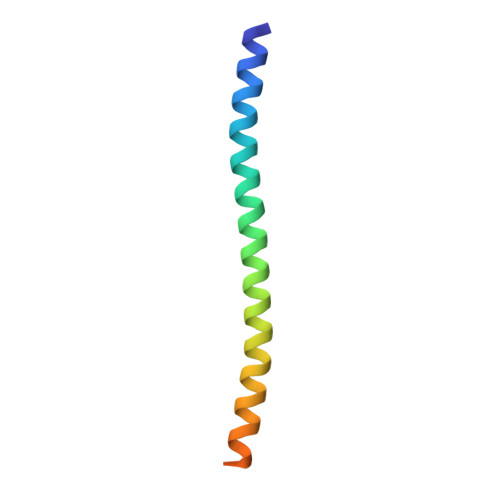
5FCN | pdb_00005fcn

microtubule binding domain of human CEP135


Experimental Data Snapshot

  • Method: X-RAY DIFFRACTION
  • Resolution: 1.80 Å
  • R-Value Free: 
    0.238 (Depositor), 0.245 (DCC) 
  • R-Value Work: 
    0.216 (Depositor), 0.220 (DCC) 
  • R-Value Observed: 
    0.217 (Depositor) 

Starting Model: experimental
View more details

wwPDB Validation 3D Report Full Report

Validation slider image for 5FCN

This is version 1.4 of the entry. See complete history

Literature

The Human Centriolar Protein CEP135 Contains a Two-Stranded Coiled-Coil Domain Critical for Microtubule Binding.

Kraatz, S.Guichard, P.Obbineni, J.M.Olieric, N.Hatzopoulos, G.N.Hilbert, M.Sen, I.Missimer, J.Gonczy, P.Steinmetz, M.O.

(2016) Structure 24: 1358-1371

  • DOI: https://doi.org/10.1016/j.str.2016.06.011
  • Primary Citation Related Structures: 
    5FCM, 5FCN

  • PubMed Abstract: 

    Centrioles are microtubule-based structures that play important roles notably in cell division and cilium biogenesis. CEP135/Bld10p family members are evolutionarily conserved microtubule-binding proteins important for centriole formation. Here, we analyzed in detail the microtubule-binding activity of human CEP135 (HsCEP135). X-ray crystallography and small-angle X-ray scattering in combination with molecular modeling revealed that the 158 N-terminal residues of HsCEP135 (HsCEP135-N) form a parallel two-stranded coiled-coil structure. Biochemical, cryo-electron, and fluorescence microscopy analyses revealed that in vitro HsCEP135-N interacts with tubulin, protofilaments, and microtubules and induces the formation of microtubule bundles. We further identified a 13 amino acid segment spanning residues 96-108, which represents a major microtubule-binding site in HsCEP135-N. Within this segment, we identified a cluster of three lysine residues that contribute to the microtubule bundling activity of HsCEP135-N. Our results provide the first structural information on CEP135/Bld10p proteins and offer insights into their microtubule-binding mechanism.


  • Organizational Affiliation
    • Laboratory of Biomolecular Research, Department of Biology and Chemistry, Paul Scherrer Institut, 5232 Villigen, Switzerland.

Macromolecule Content 

  • Total Structure Weight: 15.46 kDa 
  • Atom Count: 1,058 
  • Modeled Residue Count: 107 
  • Deposited Residue Count: 130 
  • Unique protein chains: 1

Macromolecules

Find similar proteins by:|  3D Structure
Entity ID: 1
MoleculeChains  Sequence LengthOrganismDetailsImage
Centrosomal protein of 135 kDaA [auth B],
B [auth A]
65Homo sapiensMutation(s): 0 
Gene Names: CEP135CEP4KIAA0635
UniProt & NIH Common Fund Data Resources
Find proteins for Q66GS9 (Homo sapiens)
Explore Q66GS9 
Go to UniProtKB:  Q66GS9
PHAROS:  Q66GS9
GTEx:  ENSG00000174799 
Entity Groups
Sequence Clusters30% Identity50% Identity70% Identity90% Identity95% Identity100% Identity
UniProt GroupQ66GS9
Sequence Annotations
Expand
Reference Sequence

Experimental Data & Validation

Experimental Data

  • Method: X-RAY DIFFRACTION
  • Resolution: 1.80 Å
  • R-Value Free:  0.238 (Depositor), 0.245 (DCC) 
  • R-Value Work:  0.216 (Depositor), 0.220 (DCC) 
  • R-Value Observed: 0.217 (Depositor) 
Space Group: I 41 2 2
Unit Cell:
Length ( Å )Angle ( ˚ )
a = 78.85α = 90
b = 78.85β = 90
c = 95.92γ = 90
Software Package:
Software NamePurpose
PHENIXrefinement
XDSdata reduction
XSCALEdata scaling
PHASERphasing

Structure Validation

View Full Validation Report


Entry History 

& Funding Information

Deposition Data


Funding OrganizationLocationGrant Number
Swiss National Science FoundationSwitzerland310030B_138659

Revision History  (Full details and data files)

  • Version 1.0: 2016-07-20
    Type: Initial release
  • Version 1.1: 2016-08-10
    Changes: Database references
  • Version 1.2: 2017-10-18
    Changes: Database references
  • Version 1.3: 2024-01-10
    Changes: Data collection, Database references, Refinement description
  • Version 1.4: 2024-11-13
    Changes: Structure summary