5FCG | pdb_00005fcg

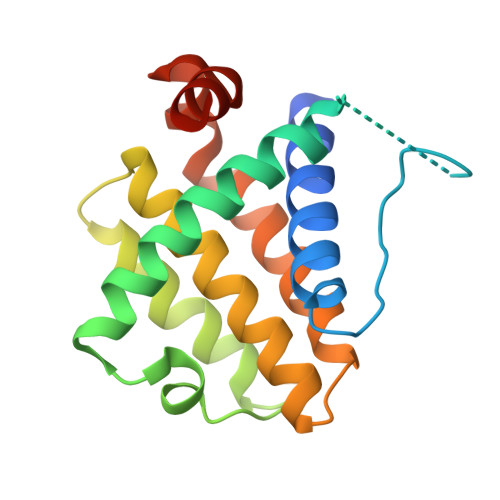
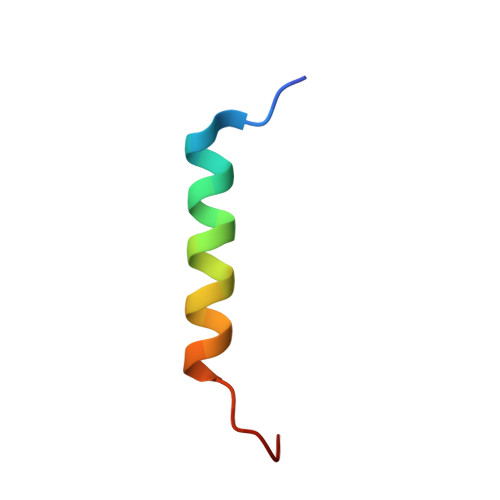
Crystal structure of Bcl-2 in complex with HBx-BH3 motif


Experimental Data Snapshot

  • Method: X-RAY DIFFRACTION
  • Resolution: 2.10 Å
  • R-Value Free: 
    0.276 (Depositor), 0.279 (DCC) 
  • R-Value Work: 
    0.255 (Depositor), 0.260 (DCC) 
  • R-Value Observed: 
    0.256 (Depositor) 

Starting Model: experimental
View more details

wwPDB Validation 3D Report Full Report

Validation slider image for 5FCG

This is version 1.2 of the entry. See complete history

Literature

Structural and biochemical analysis of Bcl-2 interaction with the hepatitis B virus protein HBx

Jiang, T.Y.Liu, M.H.Wu, J.P.Shi, Y.G.

(2016) Proc Natl Acad Sci U S A 

  • DOI: https://doi.org/10.1073/pnas.1525616113
  • Primary Citation Related Structures: 
    5FCG

  • PubMed Abstract: 

    HBx is a hepatitis B virus protein that is required for viral infectivity and replication. Anti-apoptotic Bcl-2 family members are thought to be among the important host targets of HBx. However, the structure and function of HBx are poorly understood and the molecular mechanism of HBx-induced carcinogenesis remains unknown. In this study, we report biochemical and structural characterization of HBx. The recombinant HBx protein contains metal ions, in particular iron and zinc. A BH3-like motif in HBx (residues 110-135) binds Bcl-2 with a dissociation constant of ∼193 μM, which is drastically lower than that for a canonical BH3 motif from Bim or Bad. Structural analysis reveals that, similar to other BH3 motifs, the BH3-like motif of HBx adopts an amphipathic α-helix and binds the conserved BH3-binding groove on Bcl-2. Unlike the helical Bim or Bad BH3 motif, the C-terminal portion of the bound HBx BH3-like motif has an extended conformation and makes considerably fewer interactions with Bcl-2. These observations suggest that HBx may modulate Bcl-2 function in a way that is different from that of the classical BH3-only proteins.


  • Organizational Affiliation
    • Ministry of Education Key Laboratory of Protein Science, Tsinghua-Peking Joint Center for Life Sciences, Beijing Advanced Innovation Center for Structural Biology, School of Life Sciences, Tsinghua University, Beijing 100084, China.

Macromolecule Content 

  • Total Structure Weight: 22.6 kDa 
  • Atom Count: 1,553 
  • Modeled Residue Count: 176 
  • Deposited Residue Count: 194 
  • Unique protein chains: 2

Macromolecules

Find similar proteins by:|  3D Structure
Entity ID: 1
MoleculeChains  Sequence LengthOrganismDetailsImage
Apoptosis regulator Bcl-2168Homo sapiensMutation(s): 0 
UniProt & NIH Common Fund Data Resources
Find proteins for P10415 (Homo sapiens)
Explore P10415 
Go to UniProtKB:  P10415
PHAROS:  P10415
GTEx:  ENSG00000171791 
Entity Groups
Sequence Clusters30% Identity50% Identity70% Identity90% Identity95% Identity100% Identity
UniProt GroupP10415
Sequence Annotations
Expand
Reference Sequence
Find similar proteins by:|  3D Structure
Entity ID: 2
MoleculeChains  Sequence LengthOrganismDetailsImage
Protein XB [auth C]26Hepatitis B virusMutation(s): 0 
UniProt
Find proteins for Q99HR6 (Hepatitis B virus genotype F2 (isolate Argentina/sa16/2000))
Explore Q99HR6 
Go to UniProtKB:  Q99HR6
Entity Groups
Sequence Clusters30% Identity50% Identity70% Identity90% Identity95% Identity100% Identity
UniProt GroupQ99HR6
Sequence Annotations
Expand
Reference Sequence

Experimental Data & Validation

Experimental Data

  • Method: X-RAY DIFFRACTION
  • Resolution: 2.10 Å
  • R-Value Free:  0.276 (Depositor), 0.279 (DCC) 
  • R-Value Work:  0.255 (Depositor), 0.260 (DCC) 
  • R-Value Observed: 0.256 (Depositor) 
Space Group: P 21 21 2
Unit Cell:
Length ( Å )Angle ( ˚ )
a = 63.777α = 90
b = 82.99β = 90
c = 33.487γ = 90
Software Package:
Software NamePurpose
PHENIXrefinement
HKL-2000data processing
HKL-2000data scaling

Structure Validation

View Full Validation Report


Entry History 

Deposition Data

Revision History  (Full details and data files)

  • Version 1.0: 2016-02-10
    Type: Initial release
  • Version 1.1: 2016-02-24
    Changes: Database references, Other
  • Version 1.2: 2023-11-08
    Changes: Data collection, Database references, Derived calculations, Refinement description