5CQS | pdb_00005cqs

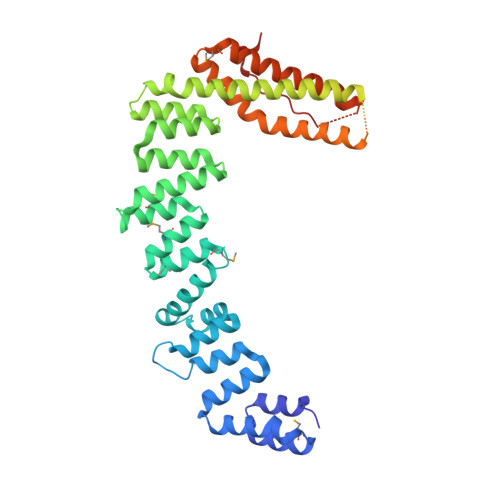
Dimerization of Elp1 is essential for Elongator complex assembly


Experimental Data Snapshot

  • Method: X-RAY DIFFRACTION
  • Resolution: 2.70 Å
  • R-Value Free: 
    0.256 (Depositor), 0.237 (DCC) 
  • R-Value Work: 
    0.234 (Depositor), 0.241 (DCC) 
  • R-Value Observed: 
    0.236 (Depositor) 

wwPDB Validation 3D Report Full Report

Validation slider image for 5CQS

This is version 1.4 of the entry. See complete history

Literature

Dimerization of elongator protein 1 is essential for Elongator complex assembly.

Xu, H.Lin, Z.Li, F.Diao, W.Dong, C.Zhou, H.Xie, X.Wang, Z.Shen, Y.Long, J.

(2015) Proc Natl Acad Sci U S A 112: 10697-10702

  • DOI: https://doi.org/10.1073/pnas.1502597112
  • Primary Citation Related Structures: 
    5CQR, 5CQS

  • PubMed Abstract: 

    The evolutionarily conserved Elongator complex, which is composed of six subunits elongator protein 1 (Elp1 to -6), plays vital roles in gene regulation. The molecular hallmark of familial dysautonomia (FD) is the splicing mutation of Elp1 [also known as IκB kinase complex-associated protein (IKAP)] in the nervous system that is believed to be the primary cause of the devastating symptoms of this disease. Here, we demonstrate that disease-related mutations in Elp1 affect Elongator assembly, and we have determined the structure of the C-terminal portion of human Elp1 (Elp1-CT), which is sufficient for full-length Elp1 dimerization, as well as the structure of the cognate dimerization domain of yeast Elp1 (yElp1-DD). Our study reveals that the formation of the Elp1 dimer contributes to its stability in vitro and in vivo and is required for the assembly of both the human and yeast Elongator complexes. Functional studies suggest that Elp1 dimerization is essential for yeast viability. Collectively, our results identify the evolutionarily conserved dimerization domain of Elp1 and suggest that the pathological mechanisms underlying the onset and progression of Elp1 mutation-related disease may result from impaired Elongator activities.


  • Organizational Affiliation
    • State Key Laboratory of Medicinal Chemical Biology, Nankai University, Tianjin 300071, China; College of Life Sciences, Nankai University, Tianjin 300071, China;

Macromolecule Content 

  • Total Structure Weight: 200.91 kDa 
  • Atom Count: 9,999 
  • Modeled Residue Count: 1,285 
  • Deposited Residue Count: 1,740 
  • Unique protein chains: 1

Macromolecules

Find similar proteins by:|  3D Structure
Entity ID: 1
MoleculeChains  Sequence LengthOrganismDetailsImage
Elongator complex protein 1
A, B, C, D
435Saccharomyces cerevisiae S288CMutation(s): 0 
Gene Names: IKI3ELP1TOT1YLR384CL3502.7
UniProt
Find proteins for Q06706 (Saccharomyces cerevisiae (strain ATCC 204508 / S288c))
Explore Q06706 
Go to UniProtKB:  Q06706
Entity Groups
Sequence Clusters30% Identity50% Identity70% Identity90% Identity95% Identity100% Identity
UniProt GroupQ06706
Sequence Annotations
Expand
Reference Sequence

Small Molecules

Modified Residues  1 Unique
IDChains TypeFormula2D DiagramParent
MSE
Query on MSE
A, B, C, D
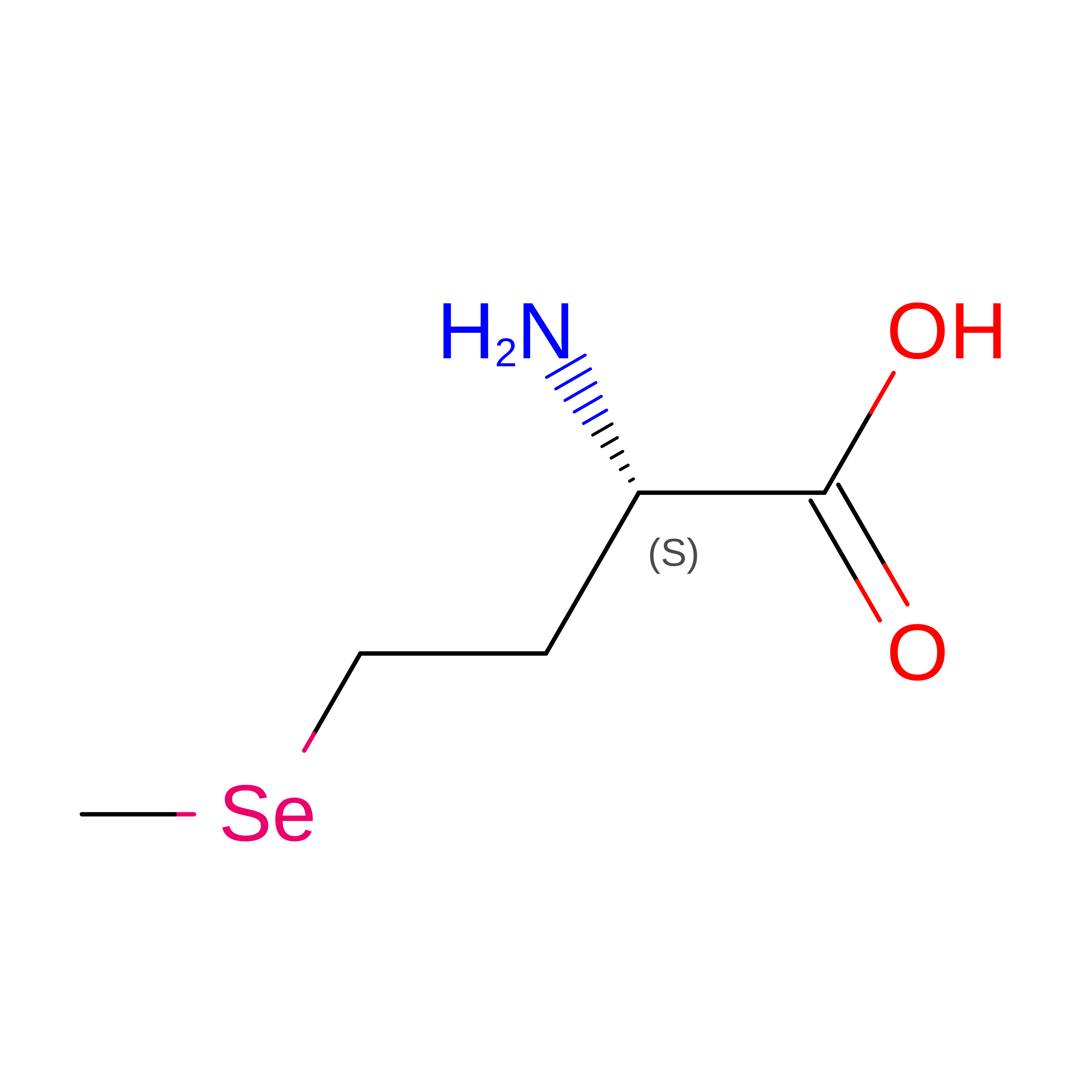
L-PEPTIDE LINKINGC5 H11 N O2 SeMET

Experimental Data & Validation

Experimental Data

  • Method: X-RAY DIFFRACTION
  • Resolution: 2.70 Å
  • R-Value Free:  0.256 (Depositor), 0.237 (DCC) 
  • R-Value Work:  0.234 (Depositor), 0.241 (DCC) 
  • R-Value Observed: 0.236 (Depositor) 
Space Group: C 1 2 1
Unit Cell:
Length ( Å )Angle ( ˚ )
a = 127.754α = 90
b = 157.744β = 93.09
c = 139.264γ = 90
Software Package:
Software NamePurpose
PHENIXrefinement
HKL-2000data reduction
HKL-2000data scaling
PHASESphasing

Structure Validation

View Full Validation Report


Entry History 

Deposition Data

Revision History  (Full details and data files)

  • Version 1.0: 2015-08-19
    Type: Initial release
  • Version 1.1: 2015-10-14
    Changes: Database references
  • Version 1.2: 2015-12-16
    Changes: Experimental preparation
  • Version 1.3: 2020-02-19
    Changes: Data collection, Derived calculations
  • Version 1.4: 2024-11-13
    Changes: Data collection, Database references, Structure summary