5BQN | pdb_00005bqn

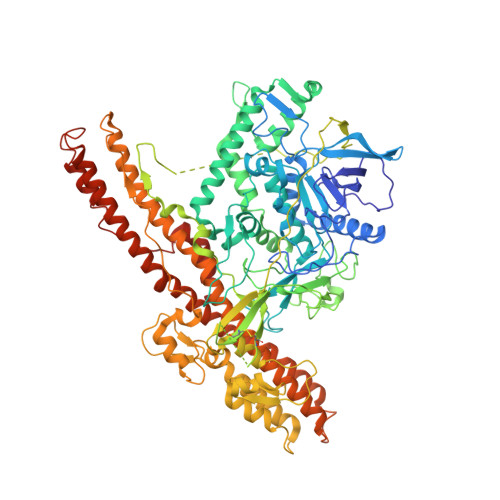
Crystal structure of the LHn fragment of botulinum neurotoxin type D, mutant H233Y E230Q


Experimental Data Snapshot

  • Method: X-RAY DIFFRACTION
  • Resolution: 2.30 Å
  • R-Value Free: 
    0.247 (Depositor), 0.250 (DCC) 
  • R-Value Work: 
    0.220 (Depositor), 0.225 (DCC) 
  • R-Value Observed: 
    0.221 (Depositor) 

Starting Model: experimental
View more details

wwPDB Validation 3D Report Full Report

Validation slider image for 5BQN

This is version 1.3 of the entry. See complete history

Literature

Structural analysis of Clostridium botulinum neurotoxin type D as a platform for the development of targeted secretion inhibitors.

Masuyer, G.Davies, J.R.Moore, K.Chaddock, J.A.Ravi Acharya, K.

(2015) Sci Rep 5: 13397-13397

  • DOI: https://doi.org/10.1038/srep13397
  • Primary Citation Related Structures: 
    5BQM, 5BQN

  • PubMed Abstract: 

    The botulinum neurotoxin type D is one of seven highly potent toxins produced by Clostridium botulinum which inhibit neurotransmission at cholinergic nerve terminals. A functional fragment derived from the toxin, LHn, consisting of the catalytic and translocation domains, has been heralded as a platform for the development of targeted secretion inhibitors. These secretion inhibitors are aimed at retargeting the toxin towards a specific cell type to inhibit vesicular secretion. Here we report crystal structures of LHn from serotype D at 2.3 Å, and that of SXN101959 at 3.1 Å resolution. SXN101959, a derivative that combines LHn from serotype D with a fragment of the growth hormone releasing hormone, has previously revealed promising results in inhibiting growth hormone release in pituitary somatotrophs. These structures offer for the first time insights into the translocation domain interaction with the catalytic domain in serotype D. Furthermore, structural information from small-angle X-ray scattering of LHn/D is compared among serotypes A, B, and D. Taken together, these results demonstrate the robustness of the 'LHn fold' across serotypes and its use in engineering additional polypeptide components with added functionality. Our study demonstrates the suitability of botulinum neurotoxin, and serotype D in particular, as a basis for engineering novel secretion inhibitors.


  • Organizational Affiliation
    • Department of Biology and Biochemistry, University of Bath, Claverton Down, Bath BA2 7AY, UK.

Macromolecule Content 

  • Total Structure Weight: 102.09 kDa 
  • Atom Count: 6,920 
  • Modeled Residue Count: 838 
  • Deposited Residue Count: 885 
  • Unique protein chains: 1

Macromolecules

Find similar proteins by:|  3D Structure
Entity ID: 1
MoleculeChains  Sequence LengthOrganismDetailsImage
Botulinum neurotoxin type D,Botulinum neurotoxin type D885Clostridium botulinumMutation(s): 0 
Gene Names: botD
EC: 3.4.24.69
UniProt
Find proteins for P19321 (Clostridium botulinum D phage)
Explore P19321 
Go to UniProtKB:  P19321
Entity Groups
Sequence Clusters30% Identity50% Identity70% Identity90% Identity95% Identity100% Identity
UniProt GroupP19321
Sequence Annotations
Expand
Reference Sequence

Small Molecules

Ligands 1 Unique
IDChains Name / Formula / InChI Key2D Diagram3D Interactions
EPE

Query on EPE


Download:Ideal Coordinates CCD File
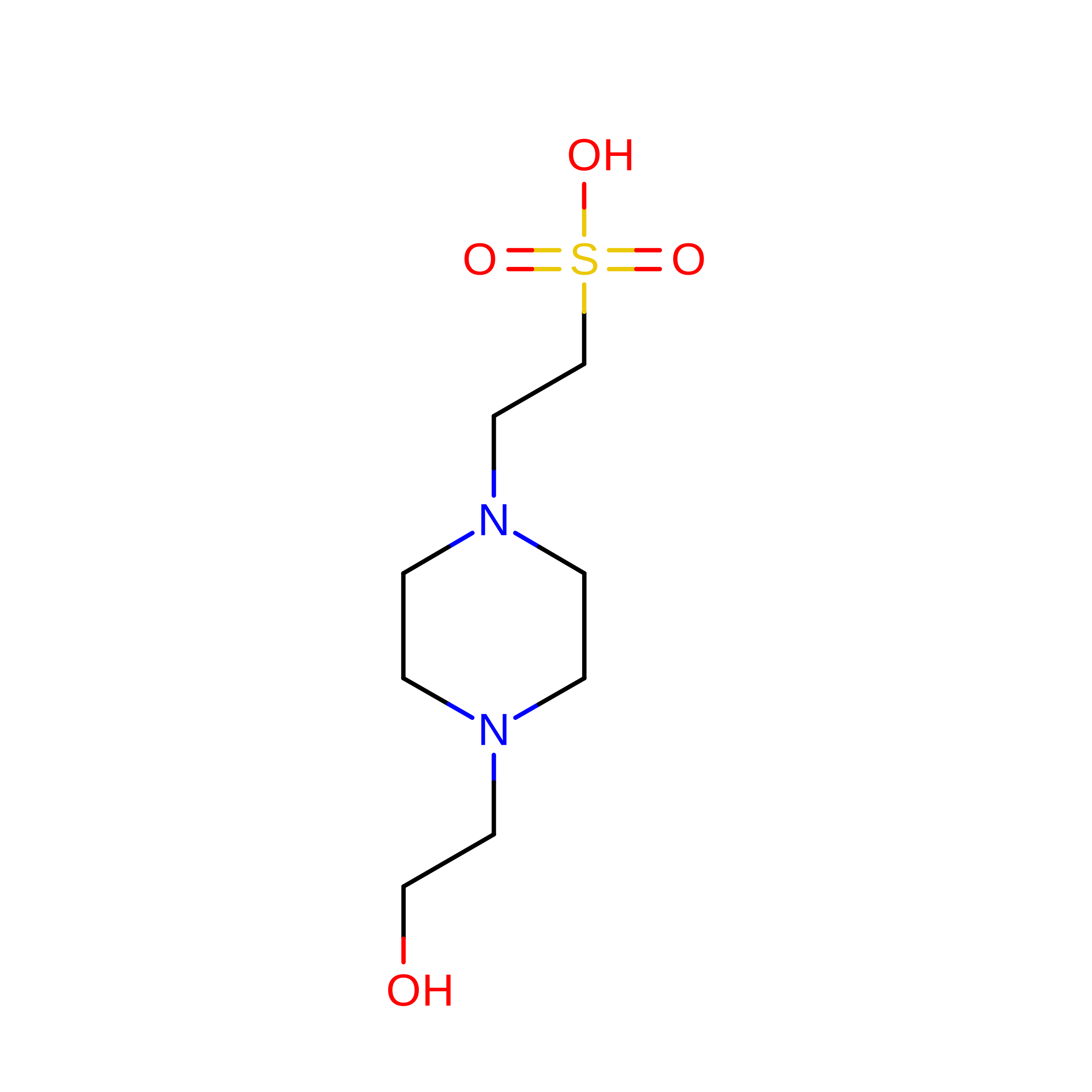
B [auth A]4-(2-HYDROXYETHYL)-1-PIPERAZINE ETHANESULFONIC ACID
C8 H18 N2 O4 S
JKMHFZQWWAIEOD-UHFFFAOYSA-N

Experimental Data & Validation

Experimental Data

  • Method: X-RAY DIFFRACTION
  • Resolution: 2.30 Å
  • R-Value Free:  0.247 (Depositor), 0.250 (DCC) 
  • R-Value Work:  0.220 (Depositor), 0.225 (DCC) 
  • R-Value Observed: 0.221 (Depositor) 
Space Group: P 64 2 2
Unit Cell:
Length ( Å )Angle ( ˚ )
a = 173.545α = 90
b = 173.545β = 90
c = 222.191γ = 120
Software Package:
Software NamePurpose
REFMACrefinement
Aimlessdata scaling
PHASERphasing

Structure Validation

View Full Validation Report


Entry History 

Deposition Data

Revision History  (Full details and data files)

  • Version 1.0: 2015-08-19
    Type: Initial release
  • Version 1.1: 2015-09-09
    Changes: Database references
  • Version 1.2: 2024-01-10
    Changes: Data collection, Database references, Refinement description
  • Version 1.3: 2024-11-20
    Changes: Structure summary