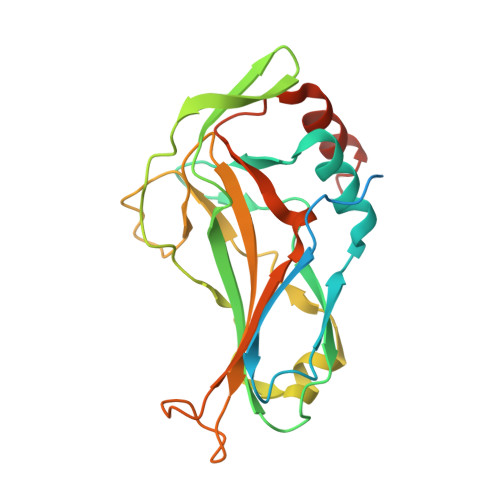
5BQD | pdb_00005bqd

Crystal Structure of TBX5 (1-239) Dimer


Experimental Data Snapshot

  • Method: X-RAY DIFFRACTION
  • Resolution: 2.58 Å
  • R-Value Free: 
    0.289 (Depositor), 0.292 (DCC) 
  • R-Value Work: 
    0.246 (Depositor), 0.253 (DCC) 
  • R-Value Observed: 
    0.250 (Depositor) 

wwPDB Validation 3D Report Full Report

Validation slider image for 5BQD

This is version 1.3 of the entry. See complete history

Literature

Intermolecular Interactions of Cardiac Transcription Factors NKX2.5 and TBX5.

Pradhan, L.Gopal, S.Li, S.Ashur, S.Suryanarayanan, S.Kasahara, H.Nam, H.J.

(2016) Biochemistry 55: 1702-1710

  • DOI: https://doi.org/10.1021/acs.biochem.6b00171
  • Primary Citation Related Structures: 
    4S0H, 5BQD

  • PubMed Abstract: 

    Heart development in mammalian systems is controlled by combinatorial interactions of master cardiac transcription factors such as TBX5 and NKX2.5. They bind to promoters/enhancers of downstream targets as homo- or heteromultimeric complexes. They physically interact and synergistically regulate their target genes. To elucidate the molecular basis of the intermolecular interactions, a heterodimer and a homodimer of NKX2.5 and TBX5 were studied using X-ray crystallography. Here we report a crystal structure of human NKX2.5 and TBX5 DNA binding domains in a complex with a 19 bp target DNA and a crystal structure of TBX5 homodimer. The ternary complex structure of NKX2.5 and TBX5 with the target DNA shows physical interactions between the two proteins through Lys158 (NKX2.5), Asp140 (TBX5), and Pro142 (TBX5), residues that are highly conserved in TBX and NKX families across species. Extensive homodimeric interactions were observed between the TBX5 proteins in both crystal structures. In particular, in the crystal structure of TBX5 protein that includes the N-terminal and DNA binding domains, intermolecular interactions were mediated by the N-terminal domain of the protein. The N-terminal domain of TBX5 was predicted to be "intrinsically unstructured", and in one of the two molecules in an asymmetric unit, the N-terminal domain assumes a β-strand conformation bridging two β-sheets from the two molecules. The structures reported here may represent general mechanisms for combinatorial interactions among transcription factors regulating developmental processes.


  • Organizational Affiliation
    • Department of Bioengineering, University of Texas at Dallas , Richardson, Texas 75080, United States.

Macromolecule Content 

  • Total Structure Weight: 53.67 kDa 
  • Atom Count: 3,039 
  • Modeled Residue Count: 373 
  • Deposited Residue Count: 478 
  • Unique protein chains: 1

Macromolecules

Find similar proteins by:|  3D Structure
Entity ID: 1
MoleculeChains  Sequence LengthOrganismDetailsImage
T-box transcription factor TBX5
A, B
239Homo sapiensMutation(s): 0 
Gene Names: TBX5
UniProt & NIH Common Fund Data Resources
Find proteins for Q99593 (Homo sapiens)
Explore Q99593 
Go to UniProtKB:  Q99593
PHAROS:  Q99593
GTEx:  ENSG00000089225 
Entity Groups
Sequence Clusters30% Identity50% Identity70% Identity90% Identity95% Identity100% Identity
UniProt GroupQ99593
Sequence Annotations
Expand
Reference Sequence

Experimental Data & Validation

Experimental Data

  • Method: X-RAY DIFFRACTION
  • Resolution: 2.58 Å
  • R-Value Free:  0.289 (Depositor), 0.292 (DCC) 
  • R-Value Work:  0.246 (Depositor), 0.253 (DCC) 
  • R-Value Observed: 0.250 (Depositor) 
Space Group: P 61 2 2
Unit Cell:
Length ( Å )Angle ( ˚ )
a = 81.455α = 90
b = 81.455β = 90
c = 341.022γ = 120
Software Package:
Software NamePurpose
PHENIXrefinement
HKL-2000data reduction
HKL-2000data scaling
PHENIXphasing

Structure Validation

View Full Validation Report


Entry History 

& Funding Information

Deposition Data


Funding OrganizationLocationGrant Number
American Heart AssociationUnited States13BGIA13960001

Revision History  (Full details and data files)

  • Version 1.0: 2016-03-16
    Type: Initial release
  • Version 1.1: 2016-04-06
    Changes: Database references
  • Version 1.2: 2017-09-20
    Changes: Author supporting evidence, Database references, Derived calculations
  • Version 1.3: 2024-03-06
    Changes: Data collection, Database references, Derived calculations