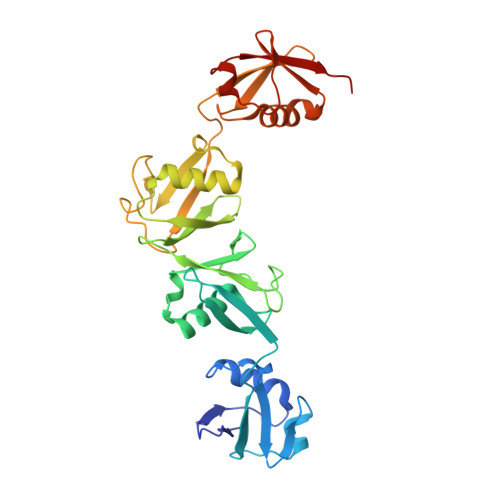
5B83 | pdb_00005b83

Crystal structure of Optineurin UBAN in complex with linear ubiquitin


Experimental Data Snapshot

  • Method: X-RAY DIFFRACTION
  • Resolution: 2.69 Å
  • R-Value Free: 
    0.254 (Depositor), 0.239 (DCC) 
  • R-Value Work: 
    0.201 (Depositor) 
  • R-Value Observed: 
    0.204 (Depositor) 

Starting Model: experimental
View more details

wwPDB Validation 3D Report Full Report

Validation slider image for 5B83

This is version 1.2 of the entry. See complete history

Literature

Linear ubiquitination is involved in the pathogenesis of optineurin-associated amyotrophic lateral sclerosis

Nakazawa, S.Oikawa, D.Ishii, R.Ayaki, T.Takahashi, H.Takeda, H.Ishitani, R.Kamei, K.Takeyoshi, I.Kawakami, H.Iwai, K.Hatada, I.Sawasaki, T.Ito, H.Nureki, O.Tokunaga, F.

(2016) Nat Commun 7: 12547-12547

  • DOI: https://doi.org/10.1038/ncomms12547
  • Primary Citation Related Structures: 
    5B83

  • PubMed Abstract: 

    Optineurin (OPTN) mutations cause neurodegenerative diseases, including amyotrophic lateral sclerosis (ALS) and glaucoma. Although the ALS-associated E478G mutation in the UBAN domain of OPTN reportedly abolishes its NF-κB suppressive activity, the precise molecular basis in ALS pathogenesis still remains unclear. Here we report that the OPTN-UBAN domain is crucial for NF-κB suppression. Our crystal structure analysis reveals that OPTN-UBAN binds linear ubiquitin with homology to NEMO. TNF-α-mediated NF-κB activation is enhanced in OPTN-knockout cells, through increased ubiquitination and association of TNF receptor (TNFR) complex I components. Furthermore, OPTN binds caspase 8, and OPTN deficiency accelerates TNF-α-induced apoptosis by enhancing complex II formation. Immunohistochemical analyses of motor neurons from OPTN-associated ALS patients reveal that linear ubiquitin and activated NF-κB are partially co-localized with cytoplasmic inclusions, and that activation of caspases is elevated. Taken together, OPTN regulates both NF-κB activation and apoptosis via linear ubiquitin binding, and the loss of this ability may lead to ALS.


  • Organizational Affiliation
    • Laboratory of Molecular Cell Biology, Institute for Molecular and Cellular Regulation, Gunma University, 3-39-15 Showa-machi, Maebashi, Gunma 371-8512, Japan.

Macromolecule Content 

  • Total Structure Weight: 114.97 kDa 
  • Atom Count: 6,702 
  • Modeled Residue Count: 831 
  • Deposited Residue Count: 1,016 
  • Unique protein chains: 2

Macromolecules

Find similar proteins by:|  3D Structure
Entity ID: 1
MoleculeChains  Sequence LengthOrganismDetailsImage
tetra ubiquitin
A, D
304Homo sapiensMutation(s): 0 
Gene Names: UBC
UniProt & NIH Common Fund Data Resources
Find proteins for P0CG48 (Homo sapiens)
Explore P0CG48 
Go to UniProtKB:  P0CG48
PHAROS:  P0CG48
GTEx:  ENSG00000150991 
Entity Groups
Sequence Clusters30% Identity50% Identity70% Identity90% Identity95% Identity100% Identity
UniProt GroupP0CG48
Sequence Annotations
Expand
Reference Sequence
Find similar proteins by:|  3D Structure
Entity ID: 2
MoleculeChains  Sequence LengthOrganismDetailsImage
Optineurin
B, C, E, F
102Homo sapiensMutation(s): 0 
Gene Names: OPTNFIP2GLC1EHIP7HYPLNRP
UniProt & NIH Common Fund Data Resources
Find proteins for Q96CV9 (Homo sapiens)
Explore Q96CV9 
Go to UniProtKB:  Q96CV9
PHAROS:  Q96CV9
GTEx:  ENSG00000123240 
Entity Groups
Sequence Clusters30% Identity50% Identity70% Identity90% Identity95% Identity100% Identity
UniProt GroupQ96CV9
Sequence Annotations
Expand
Reference Sequence

Experimental Data & Validation

Experimental Data

  • Method: X-RAY DIFFRACTION
  • Resolution: 2.69 Å
  • R-Value Free:  0.254 (Depositor), 0.239 (DCC) 
  • R-Value Work:  0.201 (Depositor) 
  • R-Value Observed: 0.204 (Depositor) 
Space Group: P 21 21 21
Unit Cell:
Length ( Å )Angle ( ˚ )
a = 71.327α = 90
b = 82.038β = 90
c = 244.853γ = 90
Software Package:
Software NamePurpose
PHENIXrefinement
XDSdata reduction
Aimlessdata scaling
PHASERphasing
MOLREPphasing

Structure Validation

View Full Validation Report


Entry History 

Deposition Data

Revision History  (Full details and data files)

  • Version 1.0: 2016-09-07
    Type: Initial release
  • Version 1.1: 2020-02-26
    Changes: Data collection, Derived calculations
  • Version 1.2: 2023-11-08
    Changes: Data collection, Database references, Refinement description