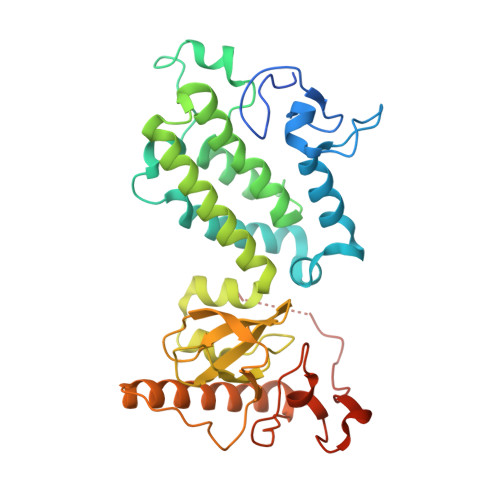
5B73 | pdb_00005b73

Crystal structure of human ZMYND8 PHD-Bromo-PWWP domain


Experimental Data Snapshot

  • Method: X-RAY DIFFRACTION
  • Resolution: 1.80 Å
  • R-Value Free: 
    0.224 (Depositor), 0.224 (DCC) 
  • R-Value Work: 
    0.187 (Depositor), 0.197 (DCC) 
  • R-Value Observed: 
    0.189 (Depositor) 

wwPDB Validation 3D Report Full Report

Validation slider image for 5B73

This is version 1.1 of the entry. See complete history

Literature

ZMYND8 Reads the Dual Histone Mark H3K4me1-H3K14ac to Antagonize the Expression of Metastasis-Linked Genes

Li, N.Li, Y.Lv, J.Zheng, X.Wen, H.Shen, H.Zhu, G.Chen, T.Y.Dhar, S.S.Kan, P.Y.Wang, Z.Shiekhattar, R.Shi, X.Lan, F.Chen, K.Li, W.Li, H.Lee, M.G.

(2016) Mol Cell 63: 470-484

  • DOI: https://doi.org/10.1016/j.molcel.2016.06.035
  • Primary Citation Related Structures: 
    5B73

  • PubMed Abstract: 

    Histone acetylation, including acetylated H3K14 (H3K14ac), is generally linked to gene activation. Monomethylated histone H3 lysine 4 (H3K4me1), together with other gene-activating marks, denotes active genes. In contrast to usual gene-activating functions of H3K14ac and H3K4me1, we here show that the dual histone modification mark H3K4me1-H3K14ac is recognized by ZMYND8 (also called RACK7) and can function to counteract gene expression. We identified ZMYND8 as a transcriptional corepressor of the H3K4 demethylase JARID1D. ZMYND8 antagonized the expression of metastasis-linked genes, and its knockdown increased the cellular invasiveness in vitro and in vivo. The plant homeodomain (PHD) and Bromodomain cassette in ZMYND8 mediated the combinatorial recognition of H3K4me1-H3K14ac and H3K4me0-H3K14ac by ZMYND8. These findings uncover an unexpected role for the signature H3K4me1-H3K14ac in attenuating gene expression and reveal a metastasis-suppressive epigenetic mechanism in which ZMYND8's PHD-Bromo cassette couples H3K4me1-H3K14ac with downregulation of metastasis-linked genes.


  • Organizational Affiliation
    • Department of Molecular and Cellular Oncology, The University of Texas MD Anderson Cancer Center, 1515 Holcombe Boulevard, Houston, TX 77030, USA.

Macromolecule Content 

  • Total Structure Weight: 39.26 kDa 
  • Atom Count: 2,712 
  • Modeled Residue Count: 313 
  • Deposited Residue Count: 339 
  • Unique protein chains: 1

Macromolecules

Find similar proteins by:|  3D Structure
Entity ID: 1
MoleculeChains  Sequence LengthOrganismDetailsImage
Protein kinase C-binding protein 1339Homo sapiensMutation(s): 0 
Gene Names: ZMYND8
UniProt & NIH Common Fund Data Resources
Find proteins for Q9ULU4 (Homo sapiens)
Explore Q9ULU4 
Go to UniProtKB:  Q9ULU4
PHAROS:  Q9ULU4
GTEx:  ENSG00000101040 
Entity Groups
Sequence Clusters30% Identity50% Identity70% Identity90% Identity95% Identity100% Identity
UniProt GroupQ9ULU4
Sequence Annotations
Expand
Reference Sequence

Experimental Data & Validation

Experimental Data

  • Method: X-RAY DIFFRACTION
  • Resolution: 1.80 Å
  • R-Value Free:  0.224 (Depositor), 0.224 (DCC) 
  • R-Value Work:  0.187 (Depositor), 0.197 (DCC) 
  • R-Value Observed: 0.189 (Depositor) 
Space Group: P 21 21 21
Unit Cell:
Length ( Å )Angle ( ˚ )
a = 67.083α = 90
b = 67.999β = 90
c = 70.309γ = 90
Software Package:
Software NamePurpose
PHENIXrefinement
HKL-2000data processing
Cootmodel building
PHASERphasing

Structure Validation

View Full Validation Report


Entry History 

Deposition Data

Revision History  (Full details and data files)

  • Version 1.0: 2016-11-02
    Type: Initial release
  • Version 1.1: 2024-03-20
    Changes: Data collection, Database references, Derived calculations