5ANA | pdb_00005ana

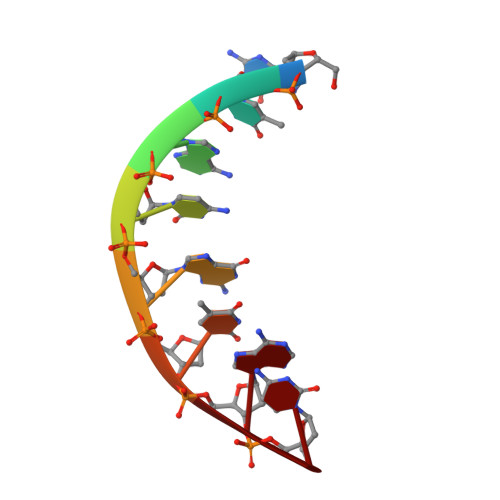
THE CRYSTAL STRUCTURE OF D(GTACGTAC) AT 2.25 ANGSTROMS RESOLUTION. ARE THE A-DNA'S ALWAYS UNWOUND APPROXIMATELY 10 DEGREES AT THE C-G STEPS

  • Classification: DNA
  • Mutation(s): No 

  • Deposited: 1989-10-31 Released: 1990-04-15 
  • Deposition Author(s): Takusagawa, F.

Experimental Data Snapshot

  • Method: X-RAY DIFFRACTION
  • Resolution: 2.25 Å
  • R-Value Observed: 
    0.184 (Depositor) 

wwPDB Validation 3D Report Full Report

Validation slider image for 5ANA

This is version 1.3 of the entry. See complete history

Literature

The crystal structure of d(GTACGTAC) at 2.25 A resolution: are the A-DNA's always unwound approximately 10 degrees at the C-G steps

Takusagawa, F.

(1990) J Biomol Struct Dyn 7: 795-809

  • DOI: https://doi.org/10.1080/07391102.1990.10508524
  • Primary Citation Related Structures: 
    5ANA

  • PubMed Abstract: 

    The structure of the self-complementary octamer d(GTACGTAC) has been analyzed by a single crystal X-ray diffraction method at 2.25 A resolution. The crystallographic R factor was 0.184 for all 1233 reflections at this resolution. In spite of the alternating purine-pyrimidine sequence, d(GTACGTAC) adopts the A-form conformation rather than the left-handed Z-form. The average helix twist and the mean rise per base pair are 32.1 degrees and 3.18 A, respectively. The d(GTACGTAC) helix is characterized by a wide open major groove and small base-pair tilt (9.7 degrees). The partial unwinding of the helix is observed only at the central pyrimidine-purine C-G step, but not at the other pyrimidine-purine T-A steps. Based on this study and six other X-ray studies, we propose a hypothesis that the A-DNA's are always unwound approximately 10 degrees at the C-G steps. Significant differences in base-pair stacking modes are seen between the purine-pyrimidine step and the pyrimidine-purine step. All deoxyribose rings adopt the C3'-endo conformation. All backbone torsion angles fall into the range expected for the A-DNA form, except for the nucleotide G5, whose alpha and gamma torsion angles adopt the trans, trans conformation instead of the common gauche-, gauche+ conformation.


  • Organizational Affiliation
    • Department of Chemistry, University of Kansas, Lawrence 66045.

Macromolecule Content 

  • Total Structure Weight: 2.45 kDa 
  • Atom Count: 214 
  • Modeled Residue Count: 8 
  • Deposited Residue Count: 8 
  • Unique nucleic acid chains: 1

Macromolecules

Find similar nucleic acids by:  Sequence
Entity ID: 1
MoleculeChains LengthOrganismImage
DNA (5'-D(*GP*TP*AP*CP*GP*TP*AP*C)-3')8N/A
Sequence Annotations
Expand
Reference Sequence

Small Molecules

Ligands 1 Unique
IDChains Name / Formula / InChI Key2D Diagram3D Interactions
MG

Query on MG


Download:Ideal Coordinates CCD File
B [auth A]MAGNESIUM ION
Mg
JLVVSXFLKOJNIY-UHFFFAOYSA-N

Experimental Data & Validation

Experimental Data

  • Method: X-RAY DIFFRACTION
  • Resolution: 2.25 Å
  • R-Value Observed: 0.184 (Depositor) 
Space Group: P 43 21 2
Unit Cell:
Length ( Å )Angle ( ˚ )
a = 42.32α = 90
b = 42.32β = 90
c = 25.044γ = 90
Software Package:
Software NamePurpose
CORELSrefinement

Structure Validation

View Full Validation Report


Entry History 

Deposition Data

Revision History  (Full details and data files)

  • Version 1.0: 1990-04-15
    Type: Initial release
  • Version 1.1: 2008-05-22
    Changes: Version format compliance
  • Version 1.2: 2011-07-13
    Changes: Version format compliance
  • Version 1.3: 2024-03-06
    Changes: Data collection, Database references, Derived calculations