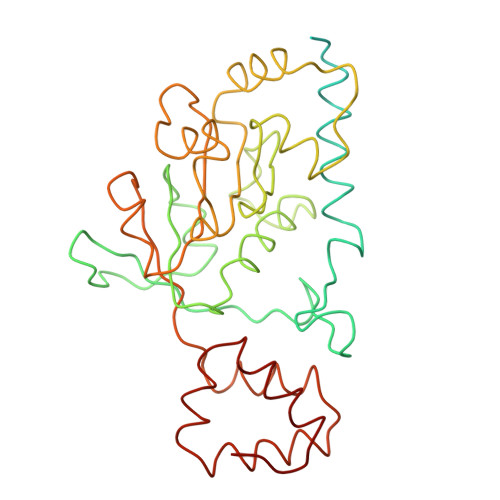
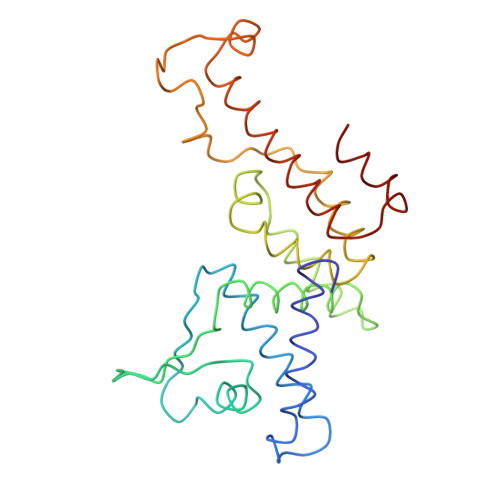
5AJ2 | pdb_00005aj2

Cryo electron tomography of the Naip5-Nlrc4 inflammasome


Experimental Data Snapshot

  • Method: ELECTRON MICROSCOPY
  • Resolution: 40.0 Å
  • Aggregation State: HELICAL ARRAY 
  • Reconstruction Method: TOMOGRAPHY 

Starting Model: experimental
View more details

wwPDB Validation 3D Report Full Report

Validation slider image for 5AJ2

This is version 1.3 of the entry. See complete history

Literature

Cryoelectron Tomography of the Naip5/Nlrc4 Inflammasome: Implications for Nlr Activation.

Diebolder, C.A.Halff, E.F.Koster, A.J.Huizinga, E.G.Koning, R.I.

(2015) Structure 23: 2349

  • DOI: https://doi.org/10.1016/j.str.2015.10.001
  • Primary Citation Related Structures: 
    5AJ2

  • PubMed Abstract: 

    Inflammasomes are high molecular weight protein complexes that play a crucial role in innate immunity by activating caspase-1. Inflammasome formation is initiated when molecules originating from invading microorganisms activate nucleotide-binding domain and leucine-rich repeat-containing receptors (NLRs) and induce NLR multimerization. Little is known about the conformational changes involved in NLR activation and the structural organization of NLR multimers. Here, we show by cryoelectron tomography that flagellin-induced NAIP5/NLRC4 multimers form right- and left-handed helical polymers with a diameter of 28 nm and a pitch of 6.5 nm. Subtomogram averaging produced an electron density map at 4 nm resolution, which was used for rigid body fitting of NLR subdomains derived from the crystal structure of dormant NLRC4. The resulting structural model of inflammasome-incorporated NLRC4 indicates that a prominent rotation of the LRR domain of NLRC4 is necessary for multimer formation, providing unprecedented insight into the conformational changes that accompany NLR activation.


  • Organizational Affiliation
    • Department of Molecular Cell Biology, Leiden University Medical Center, P.O. Box 9600, 2300 RC Leiden, the Netherlands; Crystal and Structural Chemistry, Department of Chemistry, Faculty of Science, Bijvoet Center for Biomolecular Research, Utrecht University, 3584 CH Utrecht, the Netherlands.

Macromolecule Content 

  • Total Structure Weight: 117.05 kDa 
  • Atom Count: 904 
  • Modeled Residue Count: 904 
  • Deposited Residue Count: 1,025 
  • Unique protein chains: 3

Macromolecules

Find similar proteins by:|  3D Structure
Entity ID: 1
MoleculeChains  Sequence LengthOrganismDetailsImage
NLR FAMILY CARD DOMAIN-CONTAINING PROTEIN 4355Mus musculusMutation(s): 0 
UniProt
Find proteins for Q3UP24 (Mus musculus)
Explore Q3UP24 
Go to UniProtKB:  Q3UP24
Entity Groups
Sequence Clusters30% Identity50% Identity70% Identity90% Identity95% Identity100% Identity
UniProt GroupQ3UP24
Sequence Annotations
Expand
Reference Sequence
Find similar proteins by:|  3D Structure
Entity ID: 2
MoleculeChains  Sequence LengthOrganismDetailsImage
NLR FAMILY CARD DOMAIN-CONTAINING PROTEIN 4225Mus musculusMutation(s): 0 
UniProt
Find proteins for Q3UP24 (Mus musculus)
Explore Q3UP24 
Go to UniProtKB:  Q3UP24
Entity Groups
Sequence Clusters30% Identity50% Identity70% Identity90% Identity95% Identity100% Identity
UniProt GroupQ3UP24
Sequence Annotations
Expand
Reference Sequence
Find similar proteins by:|  3D Structure
Entity ID: 3
MoleculeChains  Sequence LengthOrganismDetailsImage
NLR FAMILY CARD DOMAIN-CONTAINING PROTEIN 4445Mus musculusMutation(s): 0 
UniProt
Find proteins for Q3UP24 (Mus musculus)
Explore Q3UP24 
Go to UniProtKB:  Q3UP24
Entity Groups
Sequence Clusters30% Identity50% Identity70% Identity90% Identity95% Identity100% Identity
UniProt GroupQ3UP24
Sequence Annotations
Expand
Reference Sequence

Experimental Data & Validation

Experimental Data

  • Method: ELECTRON MICROSCOPY
  • Resolution: 40.0 Å
  • Aggregation State: HELICAL ARRAY 
  • Reconstruction Method: TOMOGRAPHY 
EM Software:
TaskSoftware PackageVersion
RECONSTRUCTIONIMOD
RECONSTRUCTIONPEET

Structure Validation

View Full Validation Report


Entry History 

Deposition Data

Revision History  (Full details and data files)

  • Version 1.0: 2015-11-11
    Type: Initial release
  • Version 1.1: 2016-05-18
    Changes: Database references
  • Version 1.2: 2017-08-23
    Changes: Data collection
  • Version 1.3: 2024-05-08
    Changes: Data collection, Database references, Refinement description