4TIM | pdb_00004tim

CRYSTALLOGRAPHIC AND MOLECULAR MODELING STUDIES ON TRYPANOSOMAL TRIOSEPHOSPHATE ISOMERASE: A CRITICAL ASSESSMENT OF THE PREDICTED AND OBSERVED STRUCTURES OF THE COMPLEX WITH 2-PHOSPHOGLYCERATE


Experimental Data Snapshot

  • Method: X-RAY DIFFRACTION
  • Resolution: 2.40 Å
  • R-Value Observed: 
    0.149 (Depositor) 

wwPDB Validation 3D Report Full Report

Validation slider image for 4TIM

This is version 1.3 of the entry. See complete history

Literature

Crystallographic and molecular modeling studies on trypanosomal triosephosphate isomerase: a critical assessment of the predicted and observed structures of the complex with 2-phosphoglycerate.

Noble, M.E.Verlinde, C.L.Groendijk, H.Kalk, K.H.Wierenga, R.K.Hol, W.G.

(1991) J Med Chem 34: 2709-2718

  • DOI: https://doi.org/10.1021/jm00113a007
  • Primary Citation Related Structures: 
    4TIM

  • PubMed Abstract: 

    In the continuation of a project aimed at the rational design of drugs against diseases caused by trypanosomes, the crystal structure of trypanosomal triosephosphate isomerase in complex with the active site inhibitor 2-phosphoglycerate has been determined. Two alternative modeling protocols have been attempted to predict the mode of binding of this ligand. In the first protocol, certain key interactions were restrained in the modeling procedure. In the second protocol, a full search of ligand conformational space was performed. In both cases the protein scaffold was kept static. Both protocols produced models which were reasonably close to the observed structure (rms difference less than 2.0 A). Nevertheless, some essential features were missed by each of the protocols. The crystallographic structure of the 2-PGA TIM complex shows that the ligand binds fully within the active site of TIM, with partners for all but one of the ligand's strongly hydrogen bonding groups. Several of the interactions between the ligand and the active site of TIM are seen to be common to all of the complexes so far structurally characterized between trypanosomal triosephosphate isomerase and competitive inhibitors. Such key interactions appear to be the best guide in the prediction of the binding mode of a new inhibitor.


  • Organizational Affiliation
    • European Molecular Biology Laboratory, Heidelberg, Germany.

Macromolecule Content 

  • Total Structure Weight: 53.92 kDa 
  • Atom Count: 3,907 
  • Modeled Residue Count: 498 
  • Deposited Residue Count: 500 
  • Unique protein chains: 1

Macromolecules

Find similar proteins by:|  3D Structure
Entity ID: 1
MoleculeChains  Sequence LengthOrganismDetailsImage
TRIOSEPHOSPHATE ISOMERASE
A, B
250Trypanosoma brucei bruceiMutation(s): 0 
EC: 5.3.1.1
UniProt
Find proteins for P04789 (Trypanosoma brucei brucei)
Explore P04789 
Go to UniProtKB:  P04789
Entity Groups
Sequence Clusters30% Identity50% Identity70% Identity90% Identity95% Identity100% Identity
UniProt GroupP04789
Sequence Annotations
Expand
Reference Sequence

Small Molecules

Ligands 1 Unique
IDChains Name / Formula / InChI Key2D Diagram3D Interactions
2PG

Query on 2PG


Download:Ideal Coordinates CCD File
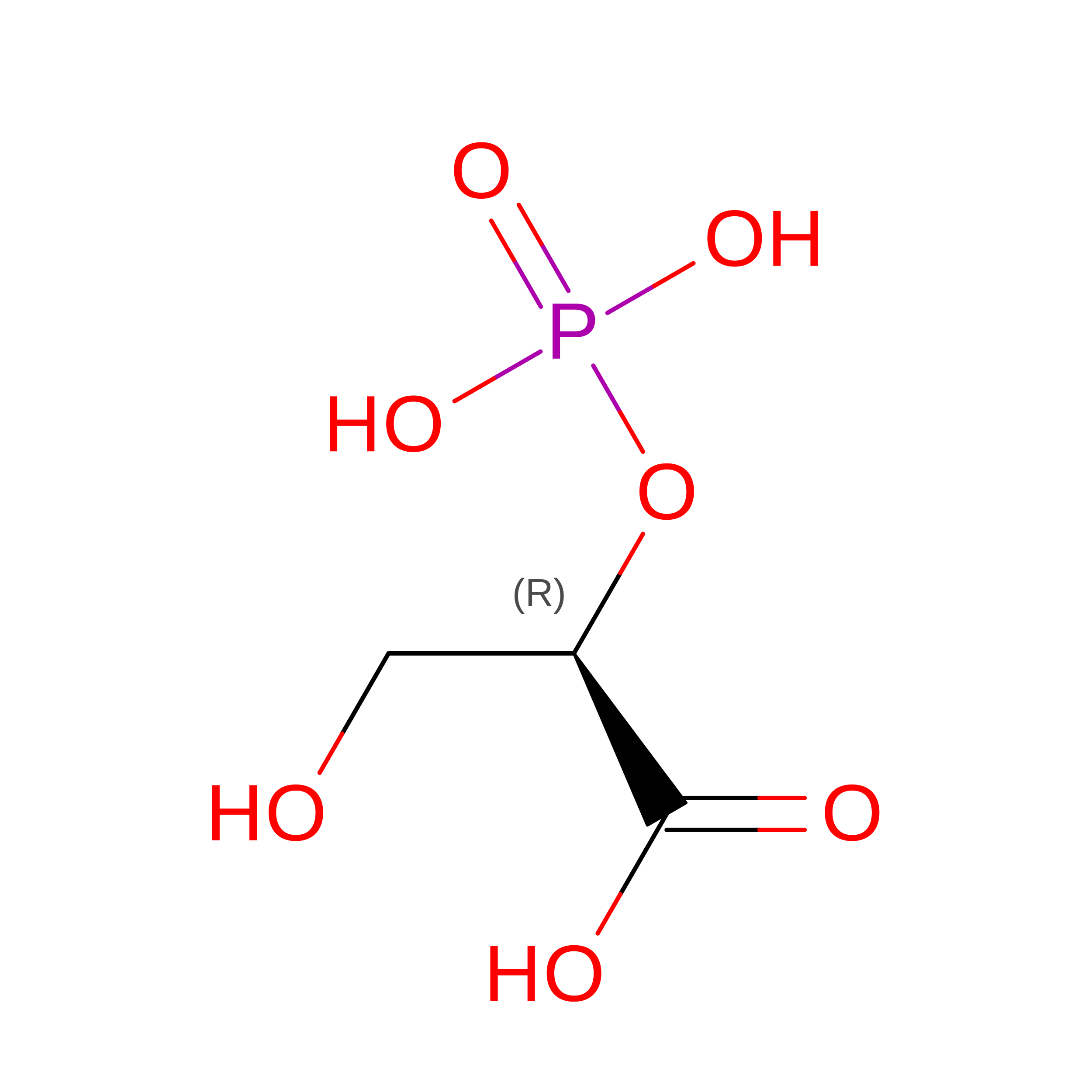
C [auth B]2-PHOSPHOGLYCERIC ACID
C3 H7 O7 P
GXIURPTVHJPJLF-UWTATZPHSA-N

Experimental Data & Validation

Experimental Data

  • Method: X-RAY DIFFRACTION
  • Resolution: 2.40 Å
  • R-Value Observed: 0.149 (Depositor) 
Space Group: P 21 21 21
Unit Cell:
Length ( Å )Angle ( ˚ )
a = 112.59α = 90
b = 97.29β = 90
c = 46.7γ = 90
Software Package:
Software NamePurpose
TNTrefinement

Structure Validation

View Full Validation Report


Entry History 

Deposition Data

Revision History  (Full details and data files)

  • Version 1.0: 1992-10-15
    Type: Initial release
  • Version 1.1: 2008-03-25
    Changes: Version format compliance
  • Version 1.2: 2011-07-13
    Changes: Version format compliance
  • Version 1.3: 2024-02-28
    Changes: Data collection, Database references, Derived calculations, Other