4TF4 | pdb_00004tf4

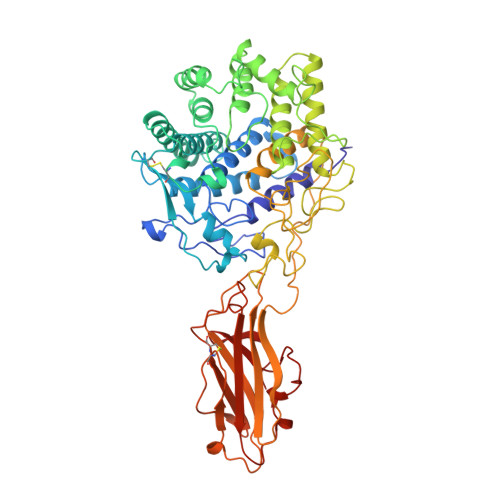
ENDO/EXOCELLULASE:CELLOPENTAOSE FROM THERMOMONOSPORA


Experimental Data Snapshot

  • Method: X-RAY DIFFRACTION
  • Resolution: 2.00 Å
  • R-Value Work: 
    0.215 (Depositor), 0.187 (DCC) 
  • R-Value Observed: 
    0.215 (Depositor) 

wwPDB Validation 3D Report Full Report

Validation slider image for 4TF4

This is version 2.1 of the entry. See complete history

Literature

Structure and mechanism of endo/exocellulase E4 from Thermomonospora fusca.

Sakon, J.Irwin, D.Wilson, D.B.Karplus, P.A.

(1997) Nat Struct Biol 4: 810-818

  • DOI: https://doi.org/10.1038/nsb1097-810
  • Primary Citation Related Structures: 
    1JS4, 1TF4, 3TF4, 4TF4

  • PubMed Abstract: 

    Cellulase E4 from Thermomonospora fusca is unusual in that it has characteristics of both exo- and endo-cellulases. Here we report the crystal structure of a 68K M(r) fragment of E4 (E4-68) at 1.9 A resolution. E4-68 contains both a family 9 catalytic domain, exhibiting an (alpha/alpha)6 barrel fold, and a family III cellulose binding domain, having an antiparallel beta-sandwich fold. While neither of these folds is novel, E4-68 provides the first cellulase structure having interacting catalytic and cellulose binding domains. The complexes of E4-68 with cellopentaose, cellotriose and cellobiose reveal conformational changes associated with ligand binding and allow us to propose a catalytic mechanism for family 9 enzymes. We also provide evidence that E4 has two novel characteristics: first it combines exo- and endo-activities and second, when it functions as an exo-cellulase, it cleaves off cellotetraose units.


  • Organizational Affiliation
    • Section of Biochemistry, Molecular and Cell Biology, Cornell University, Ithaca, New York 14853, USA.

Macromolecule Content 

  • Total Structure Weight: 136.61 kDa 
  • Atom Count: 11,002 
  • Modeled Residue Count: 1,210 
  • Deposited Residue Count: 1,210 
  • Unique protein chains: 1

Macromolecules

Find similar proteins by:|  3D Structure
Entity ID: 1
MoleculeChains  Sequence LengthOrganismDetailsImage
T. FUSCA ENDO/EXO-CELLULASE E4 CATALYTIC DOMAIN AND CELLULOSE-BINDING DOMAIN
A, B
605Thermobifida fuscaMutation(s): 0 
Gene Names: BAMH1-PST1 FRAGMENT OF T. FUSC
EC: 3.2.1.4
UniProt
Find proteins for P26221 (Thermobifida fusca)
Explore P26221 
Go to UniProtKB:  P26221
Entity Groups
Sequence Clusters30% Identity50% Identity70% Identity90% Identity95% Identity100% Identity
UniProt GroupP26221
Sequence Annotations
Expand
Reference Sequence

Oligosaccharides

Help  
Entity ID: 2
MoleculeChains Length2D Diagram GlycosylationD Interactions
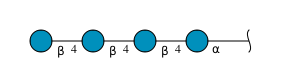
beta-D-glucopyranose-(1-4)-beta-D-glucopyranose-(1-4)-beta-D-glucopyranose-(1-4)-alpha-D-glucopyranose
C, E
4N/A
Glycosylation Resources
GlyTouCan: G41724ZD
GlyCosmos: G41724ZD
GlyGen: G41724ZD
Entity ID: 3
MoleculeChains Length2D Diagram GlycosylationD Interactions
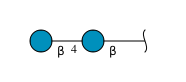
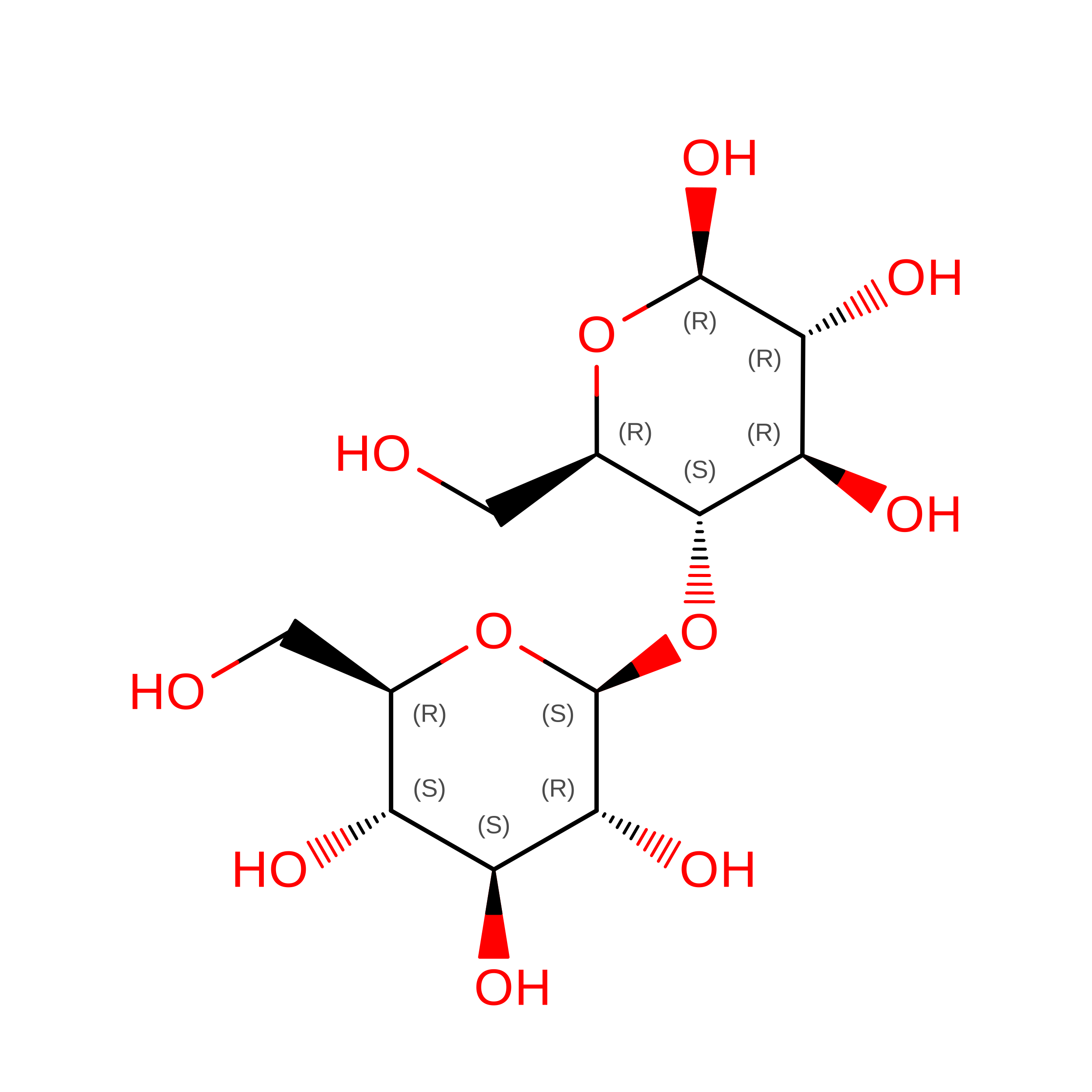
beta-D-glucopyranose-(1-4)-beta-D-glucopyranose
D, F
2N/A
Glycosylation Resources
GlyTouCan: G84824ZO
GlyCosmos: G84824ZO

Biologically Interesting Molecules (External Reference) 

1 Unique

Experimental Data & Validation

Experimental Data

  • Method: X-RAY DIFFRACTION
  • Resolution: 2.00 Å
  • R-Value Work:  0.215 (Depositor), 0.187 (DCC) 
  • R-Value Observed: 0.215 (Depositor) 
Space Group: P 41 21 2
Unit Cell:
Length ( Å )Angle ( ˚ )
a = 145.68α = 90
b = 145.68β = 90
c = 157.08γ = 90
Software Package:
Software NamePurpose
SCALEPACKdata scaling
PHASESphasing
X-PLORmodel building
X-PLORrefinement
X-PLORphasing

Structure Validation

View Full Validation Report


Entry History 

Deposition Data

Revision History  (Full details and data files)

  • Version 1.0: 1997-09-04
    Type: Initial release
  • Version 1.1: 2008-03-25
    Changes: Version format compliance
  • Version 1.2: 2011-07-13
    Changes: Version format compliance
  • Version 2.0: 2020-07-29
    Type: Remediation
    Reason: Carbohydrate remediation
    Changes: Advisory, Atomic model, Data collection, Derived calculations, Structure summary
  • Version 2.1: 2024-11-13
    Changes: Advisory, Data collection, Database references, Structure summary