4QDH | pdb_00004qdh

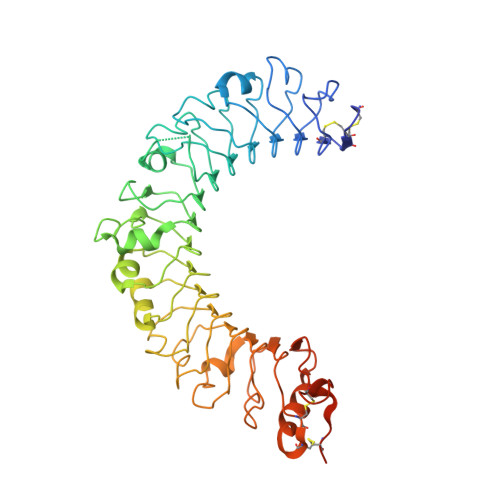
Crystal Structure of the C-terminal Domain of Mouse TLR9


Experimental Data Snapshot

  • Method: X-RAY DIFFRACTION
  • Resolution: 2.40 Å
  • R-Value Free: 
    0.247 (Depositor), 0.247 (DCC) 
  • R-Value Work: 
    0.214 (Depositor), 0.217 (DCC) 
  • R-Value Observed: 
    0.216 (Depositor) 

Starting Model: experimental
View more details

wwPDB Validation 3D Report Full Report

Validation slider image for 4QDH

Ligand Structure Quality Assessment 


This is version 1.6 of the entry. See complete history

Literature

Crystal structure of the C-terminal domain of mouse TLR9.

Collins, B.Wilson, I.A.

(2014) Proteins 82: 2874-2878

  • DOI: https://doi.org/10.1002/prot.24616
  • Primary Citation Related Structures: 
    4QDH

  • PubMed Abstract: 

    Toll-like receptors (TLRs) are important pattern recognition receptors that function in innate immunity. Elucidating the structure and signaling mechanisms of TLR9, a sensor of foreign and endogenous DNA, is essential for understanding its key role in immunity against microbial pathogens as well as in autoimmunity. Abundant evidence suggests that the TLR9-CTD (C-terminal domain) by itself is capable of DNA binding and signaling. The crystal structure of unliganded mouse TLR9-CTD is presented. TLR9-CTD exhibits one unique feature, a cluster of stacked aromatic and arginine side chains on its concave face. Overall, its structure is most related to the TLR8-CTD, suggesting a similar mode of ligand binding and signaling.


  • Organizational Affiliation
    • Department of Integrative Structural and Computational Biology, The Scripps Research Institute, La Jolla, California.

Macromolecule Content 

  • Total Structure Weight: 100.53 kDa 
  • Atom Count: 6,532 
  • Modeled Residue Count: 795 
  • Deposited Residue Count: 876 
  • Unique protein chains: 1

Macromolecules

Find similar proteins by:|  3D Structure
Entity ID: 1
MoleculeChains  Sequence LengthOrganismDetailsImage
Variable lymphocyte receptor B, Toll-like receptor 9 chimera
A, B
438Eptatretus burgeriMus musculusMutation(s): 0 
Gene Names: Tlr9VLRB
UniProt
Find proteins for Q4G1L2 (Eptatretus burgeri)
Explore Q4G1L2 
Go to UniProtKB:  Q4G1L2
Find proteins for Q9EQU3 (Mus musculus)
Explore Q9EQU3 
Go to UniProtKB:  Q9EQU3
Entity Groups
Sequence Clusters30% Identity50% Identity70% Identity90% Identity95% Identity100% Identity
UniProt GroupsQ9EQU3Q4G1L2
Glycosylation
Glycosylation Sites: 5Go to GlyGen: Q9EQU3-1
Sequence Annotations
Expand
Reference Sequence

Small Molecules

Ligands 2 Unique
IDChains Name / Formula / InChI Key2D Diagram3D Interactions
NAG

Query on NAG


Download:Ideal Coordinates CCD File
C [auth A]
D [auth A]
E [auth A]
F [auth A]
G [auth A]
C [auth A],
D [auth A],
E [auth A],
F [auth A],
G [auth A],
L [auth B],
M [auth B],
N [auth B],
O [auth B],
P [auth B]
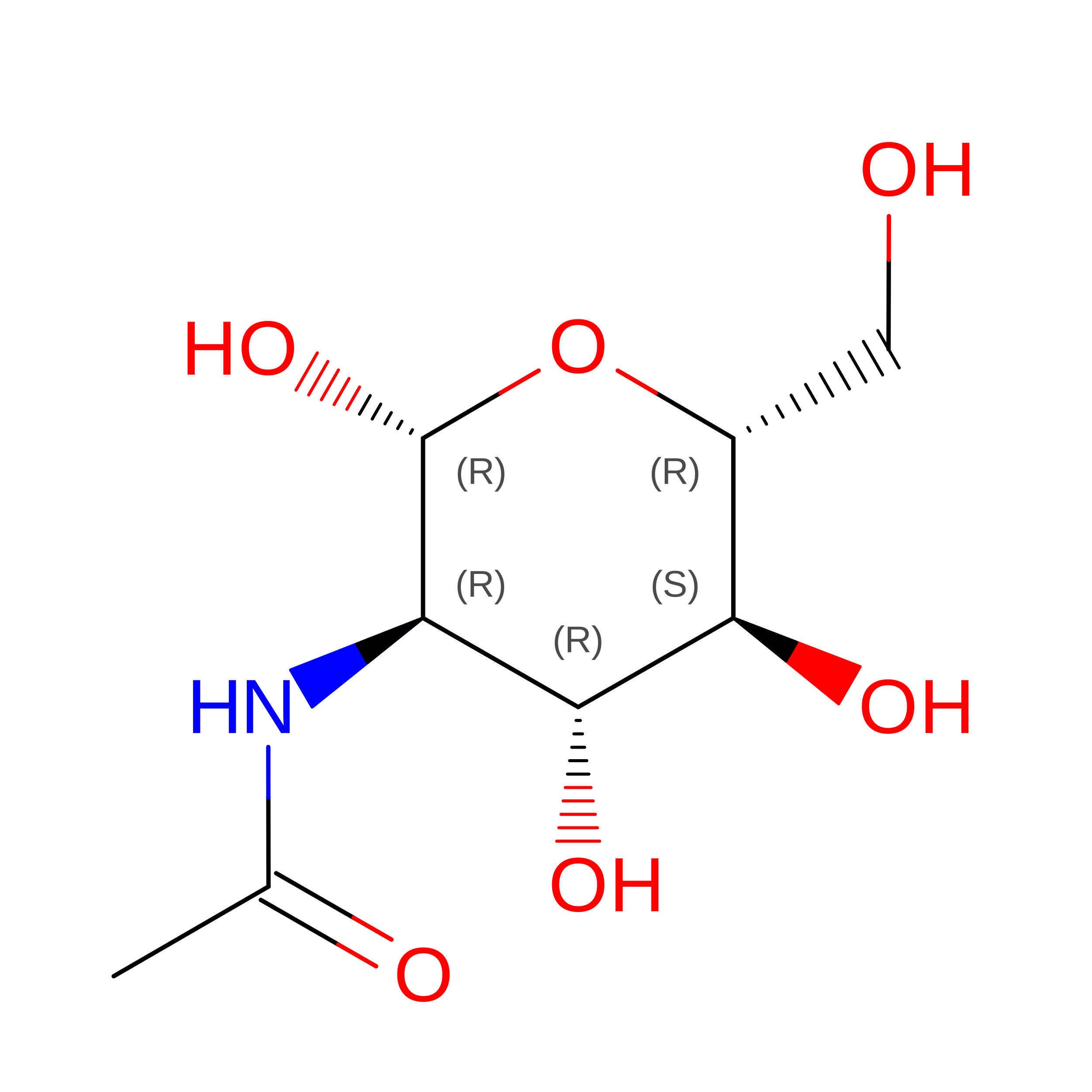
2-acetamido-2-deoxy-beta-D-glucopyranose
C8 H15 N O6
OVRNDRQMDRJTHS-FMDGEEDCSA-N
SO4

Query on SO4


Download:Ideal Coordinates CCD File
H [auth A]
I [auth A]
J [auth A]
K [auth A]
Q [auth B]
H [auth A],
I [auth A],
J [auth A],
K [auth A],
Q [auth B],
R [auth B],
S [auth B],
T [auth B]
SULFATE ION
O4 S
QAOWNCQODCNURD-UHFFFAOYSA-L

Experimental Data & Validation

Experimental Data

  • Method: X-RAY DIFFRACTION
  • Resolution: 2.40 Å
  • R-Value Free:  0.247 (Depositor), 0.247 (DCC) 
  • R-Value Work:  0.214 (Depositor), 0.217 (DCC) 
  • R-Value Observed: 0.216 (Depositor) 
Space Group: P 31 2 1
Unit Cell:
Length ( Å )Angle ( ˚ )
a = 106.025α = 90
b = 106.025β = 90
c = 221.549γ = 120
Software Package:
Software NamePurpose
Blu-Icedata collection
PHASERphasing
PHENIXrefinement
XDSdata reduction
XDSdata scaling

Structure Validation

View Full Validation Report


Ligand Structure Quality Assessment 


Entry History 

Deposition Data

Revision History  (Full details and data files)

  • Version 1.0: 2014-06-11
    Type: Initial release
  • Version 1.1: 2014-07-02
    Changes: Database references
  • Version 1.2: 2014-10-08
    Changes: Database references
  • Version 1.3: 2017-07-26
    Changes: Refinement description, Source and taxonomy
  • Version 1.4: 2020-07-29
    Type: Remediation
    Reason: Carbohydrate remediation
    Changes: Data collection, Database references, Derived calculations, Structure summary
  • Version 1.5: 2023-09-20
    Changes: Data collection, Database references, Refinement description, Structure summary
  • Version 1.6: 2024-10-30
    Changes: Structure summary