4OH3 | pdb_00004oh3

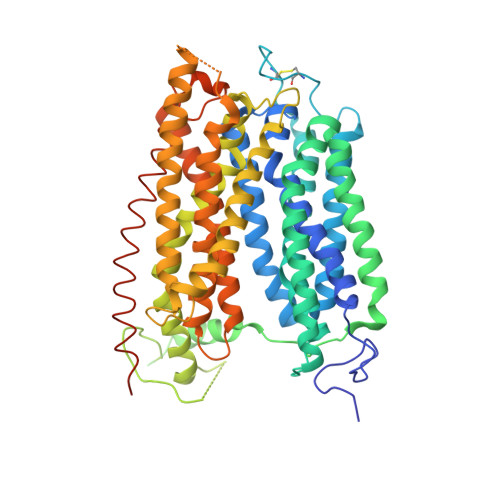
Crystal structure of a nitrate transporter


Experimental Data Snapshot

  • Method: X-RAY DIFFRACTION
  • Resolution: 3.25 Å
  • R-Value Free: 
    0.307 (Depositor), 0.314 (DCC) 
  • R-Value Work: 
    0.235 (Depositor), 0.242 (DCC) 
  • R-Value Observed: 
    0.238 (Depositor) 

wwPDB Validation 3D Report Full Report

Validation slider image for 4OH3

Ligand Structure Quality Assessment 


This is version 1.2 of the entry. See complete history

Literature

Crystal structure of the plant dual-affinity nitrate transporter NRT1.1.

Sun, J.Bankston, J.R.Payandeh, J.Hinds, T.R.Zagotta, W.N.Zheng, N.

(2014) Nature 507: 73-77

  • DOI: https://doi.org/10.1038/nature13074
  • Primary Citation Related Structures: 
    4OH3

  • PubMed Abstract: 

    Nitrate is a primary nutrient for plant growth, but its levels in soil can fluctuate by several orders of magnitude. Previous studies have identified Arabidopsis NRT1.1 as a dual-affinity nitrate transporter that can take up nitrate over a wide range of concentrations. The mode of action of NRT1.1 is controlled by phosphorylation of a key residue, Thr 101; however, how this post-translational modification switches the transporter between two affinity states remains unclear. Here we report the crystal structure of unphosphorylated NRT1.1, which reveals an unexpected homodimer in the inward-facing conformation. In this low-affinity state, the Thr 101 phosphorylation site is embedded in a pocket immediately adjacent to the dimer interface, linking the phosphorylation status of the transporter to its oligomeric state. Using a cell-based fluorescence resonance energy transfer assay, we show that functional NRT1.1 dimerizes in the cell membrane and that the phosphomimetic mutation of Thr 101 converts the protein into a monophasic high-affinity transporter by structurally decoupling the dimer. Together with analyses of the substrate transport tunnel, our results establish a phosphorylation-controlled dimerization switch that allows NRT1.1 to uptake nitrate with two distinct affinity modes.


  • Organizational Affiliation
    • Department of Pharmacology, Box 357280, University of Washington, Seattle, Washington 98195, USA.

Macromolecule Content 

  • Total Structure Weight: 132.76 kDa 
  • Atom Count: 8,048 
  • Modeled Residue Count: 1,049 
  • Deposited Residue Count: 1,198 
  • Unique protein chains: 1

Macromolecules

Find similar proteins by:|  3D Structure
Entity ID: 1
MoleculeChains  Sequence LengthOrganismDetailsImage
Nitrate transporter 1.1
A, B
599Arabidopsis thalianaMutation(s): 0 
Gene Names: NRT1.1CHL1NRT1At1g12110F12F1.1T28K15_13
Membrane Entity: Yes 
UniProt
Find proteins for Q05085 (Arabidopsis thaliana)
Explore Q05085 
Go to UniProtKB:  Q05085
Entity Groups
Sequence Clusters30% Identity50% Identity70% Identity90% Identity95% Identity100% Identity
UniProt GroupQ05085
Sequence Annotations
Expand
Reference Sequence

Experimental Data & Validation

Experimental Data

  • Method: X-RAY DIFFRACTION
  • Resolution: 3.25 Å
  • R-Value Free:  0.307 (Depositor), 0.314 (DCC) 
  • R-Value Work:  0.235 (Depositor), 0.242 (DCC) 
  • R-Value Observed: 0.238 (Depositor) 
Space Group: C 2 2 21
Unit Cell:
Length ( Å )Angle ( ˚ )
a = 84.8α = 90
b = 188.465β = 90
c = 262.848γ = 90
Software Package:
Software NamePurpose
ADSCdata collection
PHENIXmodel building
PHENIXrefinement
HKL-2000data reduction
HKL-2000data scaling
PHENIXphasing

Structure Validation

View Full Validation Report


Ligand Structure Quality Assessment 


Entry History 

Deposition Data

Revision History  (Full details and data files)

  • Version 1.0: 2014-03-05
    Type: Initial release
  • Version 1.1: 2014-03-12
    Changes: Database references
  • Version 1.2: 2024-11-20
    Changes: Data collection, Database references, Derived calculations, Structure summary