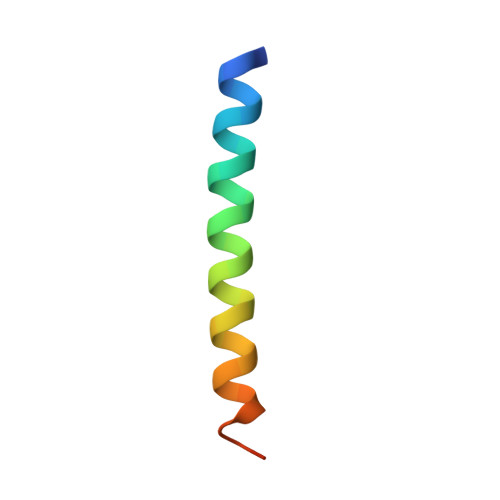
4NJ0 | pdb_00004nj0

GCN4-p1 single Val9 to Ile mutant


Experimental Data Snapshot

  • Method: X-RAY DIFFRACTION
  • Resolution: 1.90 Å
  • R-Value Free: 
    0.283 (Depositor), 0.284 (DCC) 
  • R-Value Work: 
    0.258 (Depositor), 0.253 (DCC) 
  • R-Value Observed: 
    0.259 (Depositor) 

Starting Model: experimental
View more details

wwPDB Validation 3D Report Full Report

Validation slider image for 4NJ0

This is version 1.2 of the entry. See complete history

Literature

Tuning assembly size in Peptide-based supramolecular polymers by modulation of subunit association affinity.

Oshaben, K.M.Horne, W.S.

(2014) Biomacromolecules 15: 1436-1442

  • DOI: https://doi.org/10.1021/bm5000423
  • Primary Citation Related Structures: 
    4NIZ, 4NJ0, 4NJ1, 4NJ2

  • PubMed Abstract: 

    Nature uses proteins and nucleic acids to form a wide array of functional architectures, and scientists have found inspiration from these structures in the rational design of synthetic biomaterials. We have recently shown that a modular subunit consisting of two α-helical coiled coil peptides attached at their midpoints by an organic linking group can spontaneously self-assemble in aqueous solution to form a soluble supramolecular polymer. Here we explore the use of coiled-coil association affinity, readily tuned by amino acid sequence, as a means to predictably alter properties of these supramolecular assemblies. A series of dimeric coiled-coil peptide sequences with identical quaternary folded structures but systematically altered folded stability were designed and biophysically characterized. The sequences were cross-linked to generate a series of branched, self-assembling biomacromolecular subunits. A clear relationship is observed between coiled-coil association affinity and apparent hydrodynamic diameter of the supramolecular polymers formed by these subunits. Our results provide a family of soluble supramolecular polymers of tunable size and well-characterized coiled-coil sequences that add to the library of building blocks available for use in the rational design of protein-based supramolecular biomaterials.


  • Organizational Affiliation
    • Department of Chemistry, University of Pittsburgh , Pittsburgh, Pennsylvania 15260, United States.

Macromolecule Content 

  • Total Structure Weight: 8.09 kDa 
  • Atom Count: 557 
  • Modeled Residue Count: 66 
  • Deposited Residue Count: 70 
  • Unique protein chains: 1

Macromolecules

Find similar proteins by:|  3D Structure
Entity ID: 1
MoleculeChains  Sequence LengthOrganismDetailsImage
General control protein GCN4
A, B
35Saccharomyces cerevisiae S288CMutation(s): 3 
UniProt
Find proteins for P03069 (Saccharomyces cerevisiae (strain ATCC 204508 / S288c))
Explore P03069 
Go to UniProtKB:  P03069
Entity Groups
Sequence Clusters30% Identity50% Identity70% Identity90% Identity95% Identity100% Identity
UniProt GroupP03069
Sequence Annotations
Expand
Reference Sequence

Experimental Data & Validation

Experimental Data

  • Method: X-RAY DIFFRACTION
  • Resolution: 1.90 Å
  • R-Value Free:  0.283 (Depositor), 0.284 (DCC) 
  • R-Value Work:  0.258 (Depositor), 0.253 (DCC) 
  • R-Value Observed: 0.259 (Depositor) 
Space Group: C 1 2 1
Unit Cell:
Length ( Å )Angle ( ˚ )
a = 83.199α = 90
b = 30.41β = 102.01
c = 27.788γ = 90
Software Package:
Software NamePurpose
CrystalCleardata collection
PHASERphasing
PHENIXrefinement
d*TREKdata reduction
d*TREKdata scaling

Structure Validation

View Full Validation Report


Entry History 

Deposition Data

Revision History  (Full details and data files)

  • Version 1.0: 2014-08-20
    Type: Initial release
  • Version 1.1: 2023-09-20
    Changes: Data collection, Database references, Derived calculations, Refinement description
  • Version 1.2: 2024-11-06
    Changes: Structure summary