4ZZM | pdb_00004zzm

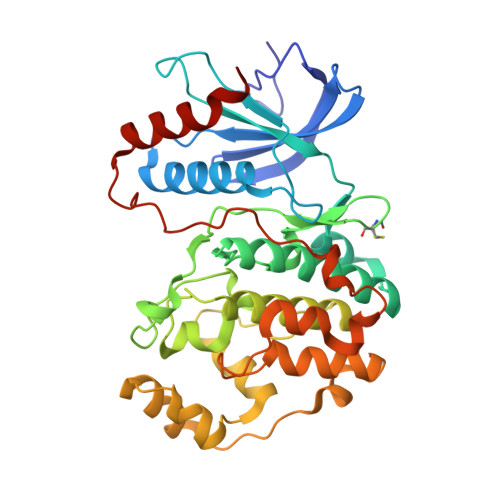
Human ERK2 in complex with an irreversible inhibitor


Experimental Data Snapshot

  • Method: X-RAY DIFFRACTION
  • Resolution: 1.89 Å
  • R-Value Free: 
    0.254 (Depositor), 0.265 (DCC) 
  • R-Value Work: 
    0.207 (Depositor), 0.212 (DCC) 
  • R-Value Observed: 
    0.210 (Depositor) 

wwPDB Validation 3D Report Full Report

Validation slider image for 4ZZM

Ligand Structure Quality Assessment 


This is version 1.2 of the entry. See complete history

Literature

Structure-Guided Design of Highly Selective and Potent Covalent Inhibitors of Erk1/2.

Ward, R.A.Colclough, N.Challinor, M.Debreczeni, J.Eckersley, K.Fairley, G.Feron, L.Flemington, V.Graham, M.A.Greenwood, R.Hopcroft, P.Howard, T.D.James, M.Jones, C.D.Jones, C.R.Renshaw, J.Roberts, K.Snow, L.Tonge, M.Yeung, K.

(2015) J Med Chem 58: 4790

  • DOI: https://doi.org/10.1021/acs.jmedchem.5b00466
  • Primary Citation Related Structures: 
    4ZZM, 4ZZN, 4ZZO

  • PubMed Abstract: 

    The RAS/RAF/MEK/ERK signaling pathway has been targeted with a number of small molecule inhibitors in oncology clinical development across multiple disease indications. Importantly, cell lines with acquired resistance to B-RAF and MEK inhibitors have been shown to maintain sensitivity to ERK1/2 inhibition by small molecule inhibitors. There are a number of selective, noncovalent ERK1/2 inhibitors reported along with the promiscuous hypothemycin (and related analogues) that act via a covalent mechanism of action. This article reports the identification of multiple series of highly selective covalent ERK1/2 inhibitors informed by structure-based drug design (SBDD). As a starting point for these covalent inhibitors, reported ERK1/2 inhibitors and a chemical series identified via high-throughput screening were exploited. These approaches resulted in the identification of selective covalent tool compounds for potential in vitro and in vivo studies to assess the risks and or benefits of targeting this pathway through such a mechanism of action.

Macromolecule Content 

  • Total Structure Weight: 41.21 kDa 
  • Atom Count: 2,865 
  • Modeled Residue Count: 345 
  • Deposited Residue Count: 350 
  • Unique protein chains: 1

Macromolecules

Find similar proteins by:|  3D Structure
Entity ID: 1
MoleculeChains  Sequence LengthOrganismDetailsImage
MITOGEN-ACTIVATED PROTEIN KINASE 1350Homo sapiensMutation(s): 0 
EC: 2.7.11.24
UniProt & NIH Common Fund Data Resources
Find proteins for P28482 (Homo sapiens)
Explore P28482 
Go to UniProtKB:  P28482
PHAROS:  P28482
GTEx:  ENSG00000100030 
Entity Groups
Sequence Clusters30% Identity50% Identity70% Identity90% Identity95% Identity100% Identity
UniProt GroupP28482
Sequence Annotations
Expand
Reference Sequence

Small Molecules

Ligands 2 Unique
IDChains Name / Formula / InChI Key2D Diagram3D Interactions
CQ6

Query on CQ6


Download:Ideal Coordinates CCD File
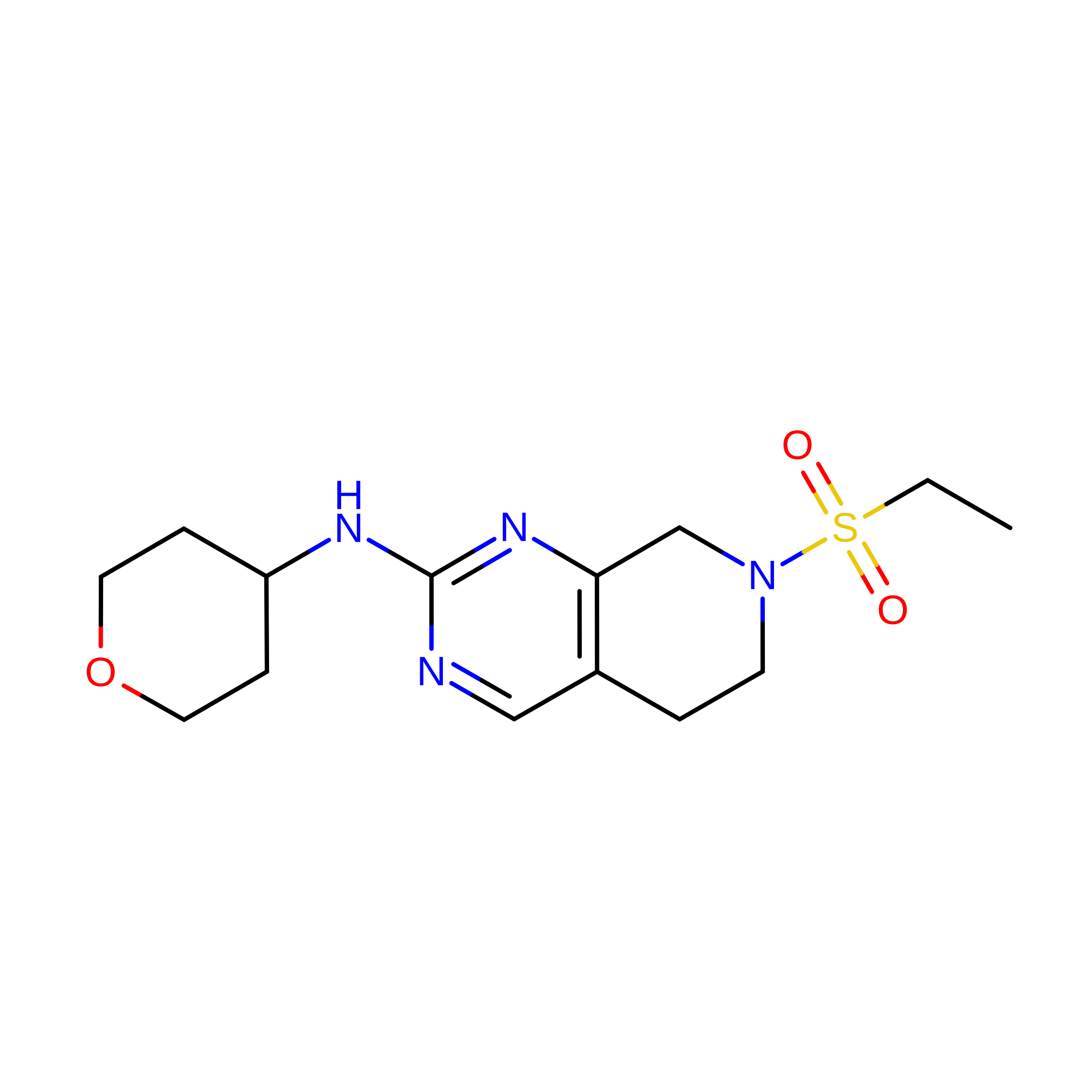
C [auth A]7-ethylsulfonyl-N-(oxan-4-yl)-6,8-dihydro-5H-pyrido[3,4-d]pyrimidin-2-amine
C14 H22 N4 O3 S
IYULUKZVVYXBLY-UHFFFAOYSA-N
SO4

Query on SO4


Download:Ideal Coordinates CCD File
B [auth A]SULFATE ION
O4 S
QAOWNCQODCNURD-UHFFFAOYSA-L
Modified Residues  1 Unique
IDChains TypeFormula2D DiagramParent
CME
Query on CME
A
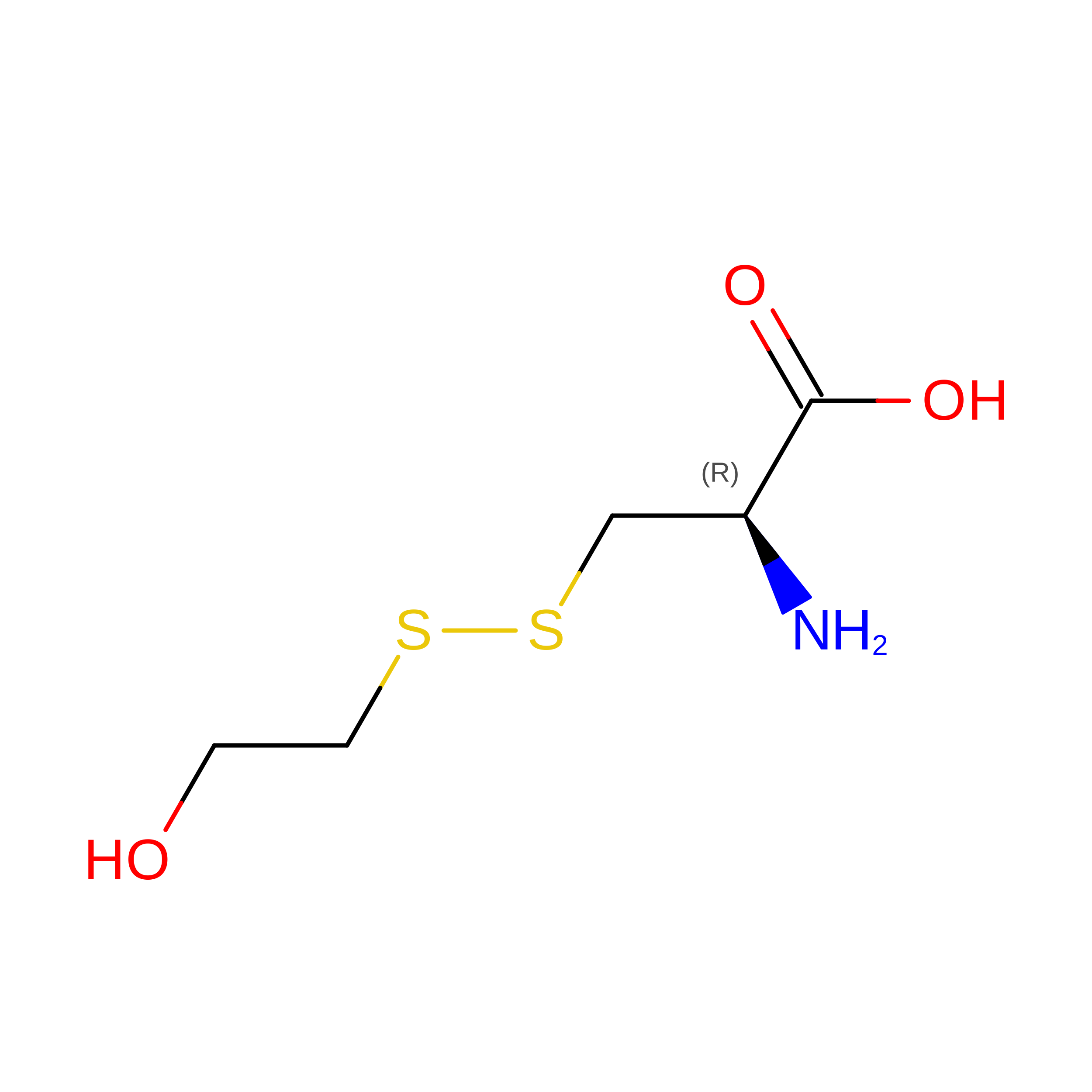
L-PEPTIDE LINKINGC5 H11 N O3 S2CYS
Binding Affinity Annotations 
IDSourceBinding Affinity
CQ6 BindingDB:  4ZZM IC50: min: 9000, max: 1.00e+4 (nM) from 3 assay(s)

Experimental Data & Validation

Experimental Data

  • Method: X-RAY DIFFRACTION
  • Resolution: 1.89 Å
  • R-Value Free:  0.254 (Depositor), 0.265 (DCC) 
  • R-Value Work:  0.207 (Depositor), 0.212 (DCC) 
  • R-Value Observed: 0.210 (Depositor) 
Space Group: P 1 21 1
Unit Cell:
Length ( Å )Angle ( ˚ )
a = 48.88α = 90
b = 70.31β = 109.12
c = 60.41γ = 90
Software Package:
Software NamePurpose
BUSTERrefinement
XDSdata reduction
Aimlessdata scaling
PHASERphasing

Structure Validation

View Full Validation Report


Ligand Structure Quality Assessment 


Entry History 

Revision History  (Full details and data files)

  • Version 1.0: 2015-05-27
    Type: Initial release
  • Version 1.1: 2015-08-26
    Changes: Database references
  • Version 1.2: 2024-10-23
    Changes: Data collection, Database references, Derived calculations, Other, Structure summary