4ZDO | pdb_00004zdo

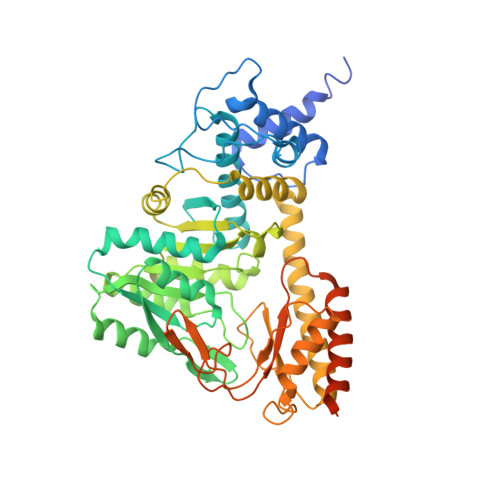
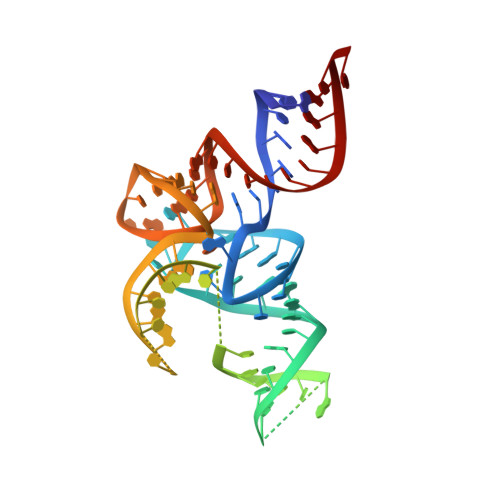
The crystal structure of T325S mutant of human SepSecS in complex with selenocysteine tRNA (tRNASec)


Experimental Data Snapshot

  • Method: X-RAY DIFFRACTION
  • Resolution: 2.65 Å
  • R-Value Free: 
    0.235 (Depositor), 0.236 (DCC) 
  • R-Value Work: 
    0.198 (Depositor), 0.200 (DCC) 
  • R-Value Observed: 
    0.200 (Depositor) 

Starting Model: experimental
View more details

wwPDB Validation 3D Report Full Report

Validation slider image for 4ZDO

Ligand Structure Quality Assessment 


This is version 1.6 of the entry. See complete history

Literature

Structural basis for early-onset neurological disorders caused by mutations in human selenocysteine synthase.

Puppala, A.K.French, R.L.Matthies, D.Baxa, U.Subramaniam, S.Simonovic, M.

(2016) Sci Rep 6: 32563-32563

  • DOI: https://doi.org/10.1038/srep32563
  • Primary Citation Related Structures: 
    4ZDL, 4ZDO, 4ZDP

  • PubMed Abstract: 

    Selenocysteine synthase (SepSecS) catalyzes the terminal reaction of selenocysteine, and is vital for human selenoproteome integrity. Autosomal recessive inheritance of mutations in SepSecS-Ala239Thr, Thr325Ser, Tyr334Cys and Tyr429*-induced severe, early-onset, neurological disorders in distinct human populations. Although harboring different mutant alleles, patients presented remarkably similar phenotypes typified by cerebellar and cerebral atrophy, seizures, irritability, ataxia, and extreme spasticity. However, it has remained unclear how these genetic alterations affected the structure of SepSecS and subsequently elicited the development of a neurological pathology. Herein, our biophysical and structural characterization demonstrates that, with the exception of Tyr429*, pathogenic mutations decrease protein stability and trigger protein misfolding. We propose that the reduced stability and increased propensity towards misfolding are the main causes for the loss of SepSecS activity in afflicted patients, and that these factors contribute to disease progression. We also suggest that misfolding of enzymes regulating protein synthesis should be considered in the diagnosis and study of childhood neurological disorders.


  • Organizational Affiliation
    • Department of Biochemistry an Molecular Genetics, University of Illinois at Chicago, Chicago, Illinois 60607, USA.

Macromolecule Content 

  • Total Structure Weight: 252.43 kDa 
  • Atom Count: 17,260 
  • Modeled Residue Count: 1,877 
  • Deposited Residue Count: 2,091 
  • Unique protein chains: 1
  • Unique nucleic acid chains: 1

Macromolecules


Find similar proteins by:|  3D Structure
Entity ID: 1
MoleculeChains  Sequence LengthOrganismDetailsImage
O-phosphoseryl-tRNA(Sec) selenium transferase
A, B, C, D
501Homo sapiensMutation(s): 1 
Gene Names: SEPSECSTRNP48
EC: 2.9.1.2
UniProt & NIH Common Fund Data Resources
Find proteins for Q9HD40 (Homo sapiens)
Explore Q9HD40 
Go to UniProtKB:  Q9HD40
PHAROS:  Q9HD40
GTEx:  ENSG00000109618 
Entity Groups
Sequence Clusters30% Identity50% Identity70% Identity90% Identity95% Identity100% Identity
UniProt GroupQ9HD40
Sequence Annotations
Expand
Reference Sequence
Find similar nucleic acids by:  (by identity cutoff) 
Entity ID: 2
MoleculeChains LengthOrganismImage
selenocysteine tRNA87Homo sapiens
Sequence Annotations
Expand
Reference Sequence

Small Molecules

Ligands 2 Unique
IDChains Name / Formula / InChI Key2D Diagram3D Interactions
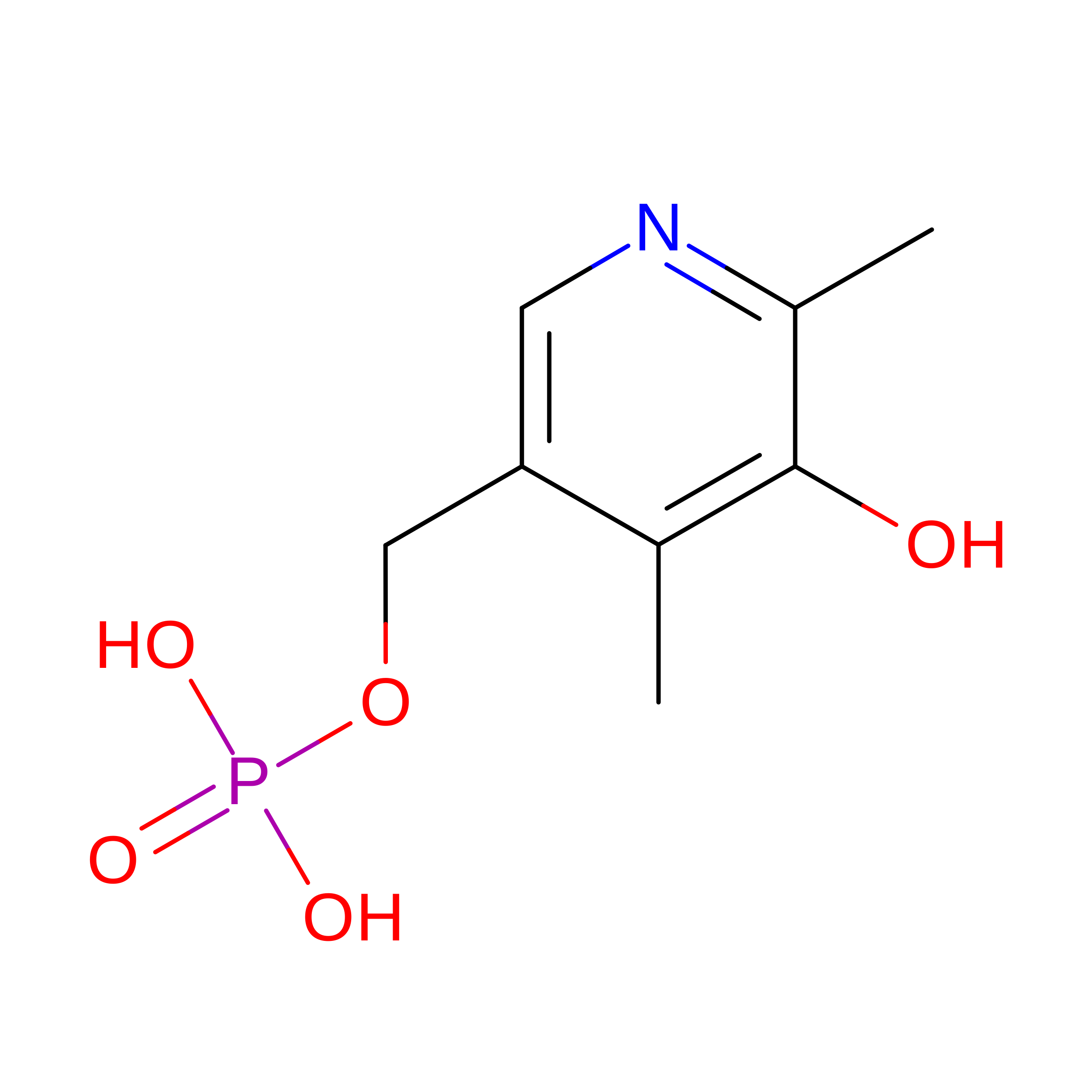
PLR

Query on PLR


Download:Ideal Coordinates CCD File
F [auth A],
H [auth B],
J [auth C],
L [auth D]
(5-HYDROXY-4,6-DIMETHYLPYRIDIN-3-YL)METHYL DIHYDROGEN PHOSPHATE
C8 H12 N O5 P
RBCOYOYDYNXAFA-UHFFFAOYSA-N
PO4

Query on PO4


Download:Ideal Coordinates CCD File
G [auth A],
I [auth B],
K [auth C],
M [auth D]
PHOSPHATE ION
O4 P
NBIIXXVUZAFLBC-UHFFFAOYSA-K

Experimental Data & Validation

Experimental Data

  • Method: X-RAY DIFFRACTION
  • Resolution: 2.65 Å
  • R-Value Free:  0.235 (Depositor), 0.236 (DCC) 
  • R-Value Work:  0.198 (Depositor), 0.200 (DCC) 
  • R-Value Observed: 0.200 (Depositor) 
Space Group: P 31 1 2
Unit Cell:
Length ( Å )Angle ( ˚ )
a = 166.238α = 90
b = 166.238β = 90
c = 238.16γ = 120
Software Package:
Software NamePurpose
PHENIXrefinement
HKL-2000data scaling
PDB_EXTRACTdata extraction
HKL-2000data reduction
PHASERphasing

Structure Validation

View Full Validation Report


Ligand Structure Quality Assessment 


Entry History 

& Funding Information

Deposition Data


Funding OrganizationLocationGrant Number
National Institutes of Health/National Institute of General Medical Sciences (NIH/NIGMS)United StatesGM097042

Revision History  (Full details and data files)

  • Version 1.0: 2016-04-20
    Type: Initial release
  • Version 1.1: 2016-09-14
    Changes: Database references
  • Version 1.2: 2016-10-05
    Changes: Database references
  • Version 1.3: 2017-09-20
    Changes: Author supporting evidence, Derived calculations
  • Version 1.4: 2019-12-25
    Changes: Author supporting evidence
  • Version 1.5: 2023-09-27
    Changes: Data collection, Database references, Refinement description
  • Version 1.6: 2024-11-20
    Changes: Structure summary