4ZBN | pdb_00004zbn

Non-helical DNA Triplex Forms a Unique Aptamer Scaffold for High Affinity Recognition of Nerve Growth Factor


Experimental Data Snapshot

  • Method: X-RAY DIFFRACTION
  • Resolution: 2.45 Å
  • R-Value Free: 
    0.257 (Depositor), 0.258 (DCC) 
  • R-Value Work: 
    0.202 (Depositor), 0.202 (DCC) 
  • R-Value Observed: 
    0.204 (Depositor) 

wwPDB Validation 3D Report Full Report

Validation slider image for 4ZBN

This is version 1.3 of the entry. See complete history

Literature

Non-helical DNA Triplex Forms a Unique Aptamer Scaffold for High Affinity Recognition of Nerve Growth Factor.

Jarvis, T.C.Davies, D.R.Hisaminato, A.Resnicow, D.I.Gupta, S.Waugh, S.M.Nagabukuro, A.Wadatsu, T.Hishigaki, H.Gawande, B.Zhang, C.Wolk, S.K.Mayfield, W.S.Nakaishi, Y.Burgin, A.B.Stewart, L.J.Edwards, T.E.Gelinas, A.D.Schneider, D.J.Janjic, N.

(2015) Structure 23: 1293-1304

  • DOI: https://doi.org/10.1016/j.str.2015.03.027
  • Primary Citation Related Structures: 
    4ZBN

  • PubMed Abstract: 

    Discerning the structural building blocks of macromolecules is essential for understanding their folding and function. For a new generation of modified nucleic acid ligands (called slow off-rate modified aptamers or SOMAmers), we previously observed essential functions of hydrophobic aromatic side chains in the context of well-known nucleic acid motifs. Here we report a 2.45-Å resolution crystal structure of a SOMAmer complexed with nerve growth factor that lacks any known nucleic acid motifs, instead adopting a configuration akin to a triangular prism. The SOMAmer utilizes extensive hydrophobic stacking interactions, non-canonical base pairing and irregular purine glycosidic bond angles to adopt a completely non-helical, compact S-shaped structure. Aromatic side chains contribute to folding by creating an unprecedented intercalating zipper-like motif and a prominent hydrophobic core. The structure provides compelling rationale for potent inhibitory activity of the SOMAmer and adds entirely novel motifs to the repertoire of structural elements uniquely available to SOMAmers.


  • Organizational Affiliation
    • SomaLogic, Inc., 2945 Wilderness Place, Boulder, CO 80301, USA.

Macromolecule Content 

  • Total Structure Weight: 46.86 kDa 
  • Atom Count: 2,883 
  • Modeled Residue Count: 252 
  • Deposited Residue Count: 296 
  • Unique protein chains: 1
  • Unique nucleic acid chains: 1

Macromolecules


Find similar proteins by:|  3D Structure
Entity ID: 2
MoleculeChains  Sequence LengthOrganismDetailsImage
Beta-nerve growth factorC [auth A],
D [auth B]
120Homo sapiensMutation(s): 0 
Gene Names: NGFNGFB
UniProt & NIH Common Fund Data Resources
Find proteins for P01138 (Homo sapiens)
Explore P01138 
Go to UniProtKB:  P01138
PHAROS:  P01138
GTEx:  ENSG00000134259 
Entity Groups
Sequence Clusters30% Identity50% Identity70% Identity90% Identity95% Identity100% Identity
UniProt GroupP01138
Sequence Annotations
Expand
Reference Sequence
Find similar nucleic acids by:  (by identity cutoff) 
Entity ID: 1
MoleculeChains LengthOrganismImage
DNA (28-MER)A [auth D],
B [auth E]
28synthetic construct
Sequence Annotations
Expand
Reference Sequence

Small Molecules

Ligands 1 Unique
IDChains Name / Formula / InChI Key2D Diagram3D Interactions
EPE

Query on EPE


Download:Ideal Coordinates CCD File
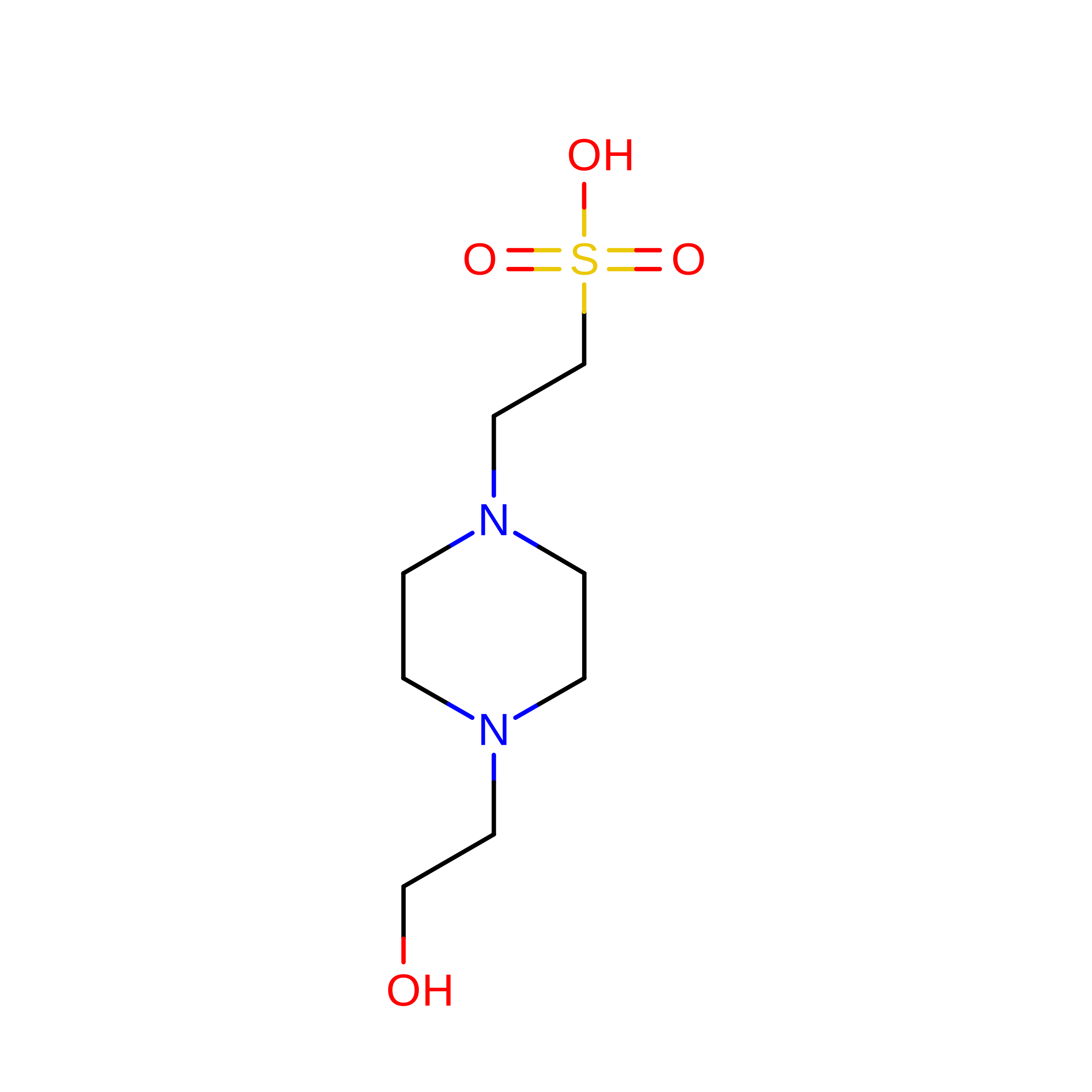
E [auth D]4-(2-HYDROXYETHYL)-1-PIPERAZINE ETHANESULFONIC ACID
C8 H18 N2 O4 S
JKMHFZQWWAIEOD-UHFFFAOYSA-N

Experimental Data & Validation

Experimental Data

  • Method: X-RAY DIFFRACTION
  • Resolution: 2.45 Å
  • R-Value Free:  0.257 (Depositor), 0.258 (DCC) 
  • R-Value Work:  0.202 (Depositor), 0.202 (DCC) 
  • R-Value Observed: 0.204 (Depositor) 
Space Group: C 1 2 1
Unit Cell:
Length ( Å )Angle ( ˚ )
a = 109.201α = 90
b = 60.708β = 95.57
c = 68.589γ = 90
Software Package:
Software NamePurpose
REFMACrefinement

Structure Validation

View Full Validation Report


Entry History 

Deposition Data

Revision History  (Full details and data files)

  • Version 1.0: 2015-06-10
    Type: Initial release
  • Version 1.1: 2015-06-17
    Changes: Database references
  • Version 1.2: 2015-07-15
    Changes: Database references
  • Version 1.3: 2024-10-23
    Changes: Data collection, Database references, Derived calculations, Source and taxonomy, Structure summary