4XRC | pdb_00004xrc

Antibody hemagglutinin Complexes


Experimental Data Snapshot

  • Method: X-RAY DIFFRACTION
  • Resolution: 2.74 Å
  • R-Value Free: 
    0.248 (Depositor), 0.248 (DCC) 
  • R-Value Work: 
    0.192 (Depositor), 0.194 (DCC) 
  • R-Value Observed: 
    0.195 (Depositor) 

wwPDB Validation 3D Report Full Report

Validation slider image for 4XRC

This is version 2.2 of the entry. See complete history

Literature

Vaccine-elicited antibody that neutralizes H5N1 influenza and variants binds the receptor site and polymorphic sites.

Winarski, K.L.Thornburg, N.J.Yu, Y.Sapparapu, G.Crowe, J.E.Spiller, B.W.

(2015) Proc Natl Acad Sci U S A 112: 9346-9351

  • DOI: https://doi.org/10.1073/pnas.1502762112
  • Primary Citation Related Structures: 
    4XNM, 4XNQ, 4XRC

  • PubMed Abstract: 

    Antigenic drift of circulating seasonal influenza viruses necessitates an international vaccine effort to reduce the impact on human health. A critical feature of the seasonal vaccine is that it stimulates an already primed immune system to diversify memory B cells to recognize closely related, but antigenically distinct, influenza glycoproteins (hemagglutinins). Influenza pandemics arise when hemagglutinins to which no preexisting adaptive immunity exists acquire the capacity to infect humans. Hemagglutinin 5 is one subtype to which little preexisting immunity exists and is only a few acquired mutations away from the ability to transmit efficiently between ferrets, and possibly humans. Here, we describe the structure and molecular mechanism of neutralization by H5.3, a vaccine-elicited antibody that neutralizes hemagglutinin 5 viruses and variants with expanded host range. H5.3 binds in the receptor-binding site, forming contacts that recapitulate many of the sialic acid interactions, as well as multiple peripheral interactions, yet is not sensitive to mutations that alter sialic acid binding. H5.3 is highly specific for a subset of H5 strains, and this specificity arises from interactions to the periphery of the receptor-binding site. H5.3 is also extremely potent, despite retaining germ line-like conformational flexibility.


  • Organizational Affiliation
    • Department of Pathology, Microbiology and Immunology, Vanderbilt University School of Medicine, Nashville, TN 37232;

Macromolecule Content 

  • Total Structure Weight: 141.77 kDa 
  • Atom Count: 9,883 
  • Modeled Residue Count: 1,265 
  • Deposited Residue Count: 1,294 
  • Unique protein chains: 3

Macromolecules

Find similar proteins by:|  3D Structure
Entity ID: 1
MoleculeChains  Sequence LengthOrganismDetailsImage
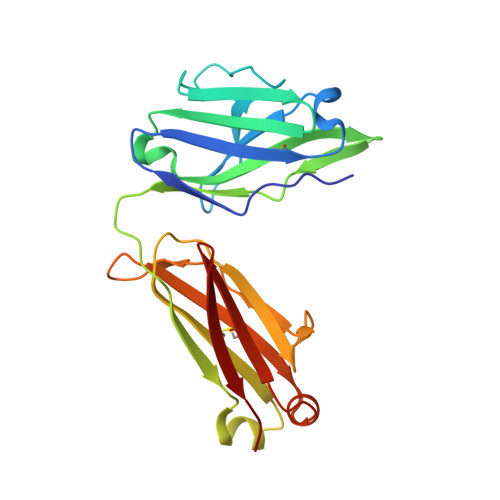
H5.3 Fab light chainA,
D [auth L]
208Homo sapiensMutation(s): 0 
Find similar proteins by:|  3D Structure
Entity ID: 2
MoleculeChains  Sequence LengthOrganismDetailsImage
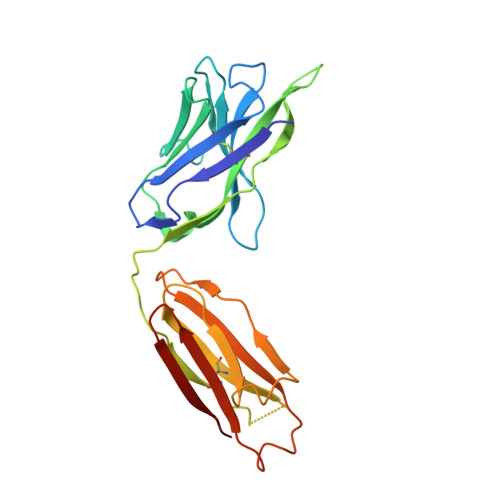
H5.3 Fab heavy chainB,
E [auth H]
227Homo sapiensMutation(s): 0 
Find similar proteins by:|  3D Structure
Entity ID: 3
MoleculeChains  Sequence LengthOrganismDetailsImage
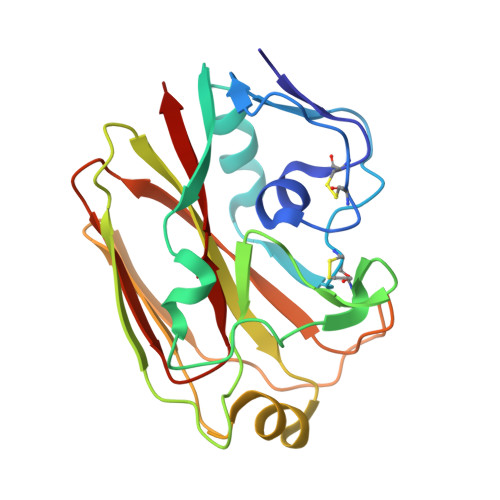
HemagglutininC [auth D],
F [auth C]
212Influenza A virusMutation(s): 3 
Gene Names: HA
UniProt
Find proteins for Q6DQ33 (Influenza A virus (strain A/Vietnam/1203/2004 H5N1))
Explore Q6DQ33 
Go to UniProtKB:  Q6DQ33
Entity Groups
Sequence Clusters30% Identity50% Identity70% Identity90% Identity95% Identity100% Identity
UniProt GroupQ6DQ33
Sequence Annotations
Expand
Reference Sequence

Oligosaccharides

Help  
Entity ID: 4
MoleculeChains Length2D Diagram GlycosylationD Interactions
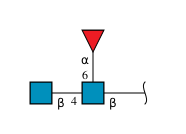
2-acetamido-2-deoxy-beta-D-glucopyranose-(1-4)-[alpha-L-fucopyranose-(1-6)]2-acetamido-2-deoxy-beta-D-glucopyranoseG [auth E]3N-Glycosylation
Glycosylation Resources
GlyTouCan: G21290RB
GlyCosmos: G21290RB
GlyGen: G21290RB

Experimental Data & Validation

Experimental Data

  • Method: X-RAY DIFFRACTION
  • Resolution: 2.74 Å
  • R-Value Free:  0.248 (Depositor), 0.248 (DCC) 
  • R-Value Work:  0.192 (Depositor), 0.194 (DCC) 
  • R-Value Observed: 0.195 (Depositor) 
Space Group: C 1 2 1
Unit Cell:
Length ( Å )Angle ( ˚ )
a = 248.42α = 90
b = 51.08β = 99.94
c = 127.61γ = 90
Software Package:
Software NamePurpose
PHENIXrefinement
HKL-2000data reduction
HKL-2000data scaling
PHENIXphasing

Structure Validation

View Full Validation Report


Entry History 

& Funding Information

Deposition Data


Funding OrganizationLocationGrant Number
National Institutes of Health/National Institute Of Allergy and Infectious Diseases (NIH/NIAID)United States5R21 AI092268
National Institutes of Health/National Institute Of Allergy and Infectious Diseases (NIH/NIAID)United StatesHHSN272200900047C

Revision History  (Full details and data files)

  • Version 1.0: 2015-07-15
    Type: Initial release
  • Version 1.1: 2015-07-29
    Changes: Database references
  • Version 1.2: 2015-08-12
    Changes: Database references
  • Version 1.3: 2015-09-09
    Changes: Source and taxonomy
  • Version 1.4: 2016-02-24
    Changes: Data collection
  • Version 1.5: 2017-09-13
    Changes: Author supporting evidence, Derived calculations
  • Version 1.6: 2019-12-11
    Changes: Author supporting evidence, Data collection
  • Version 2.0: 2020-07-29
    Type: Remediation
    Reason: Carbohydrate remediation
    Changes: Atomic model, Data collection, Derived calculations, Structure summary
  • Version 2.1: 2022-03-30
    Changes: Author supporting evidence, Database references, Derived calculations, Structure summary
  • Version 2.2: 2024-11-13
    Changes: Data collection, Structure summary