4XOO | pdb_00004xoo

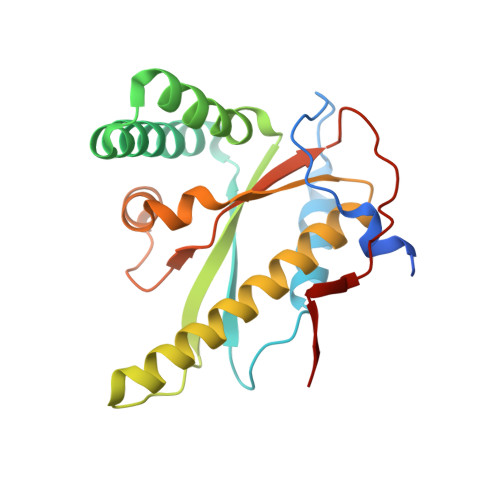
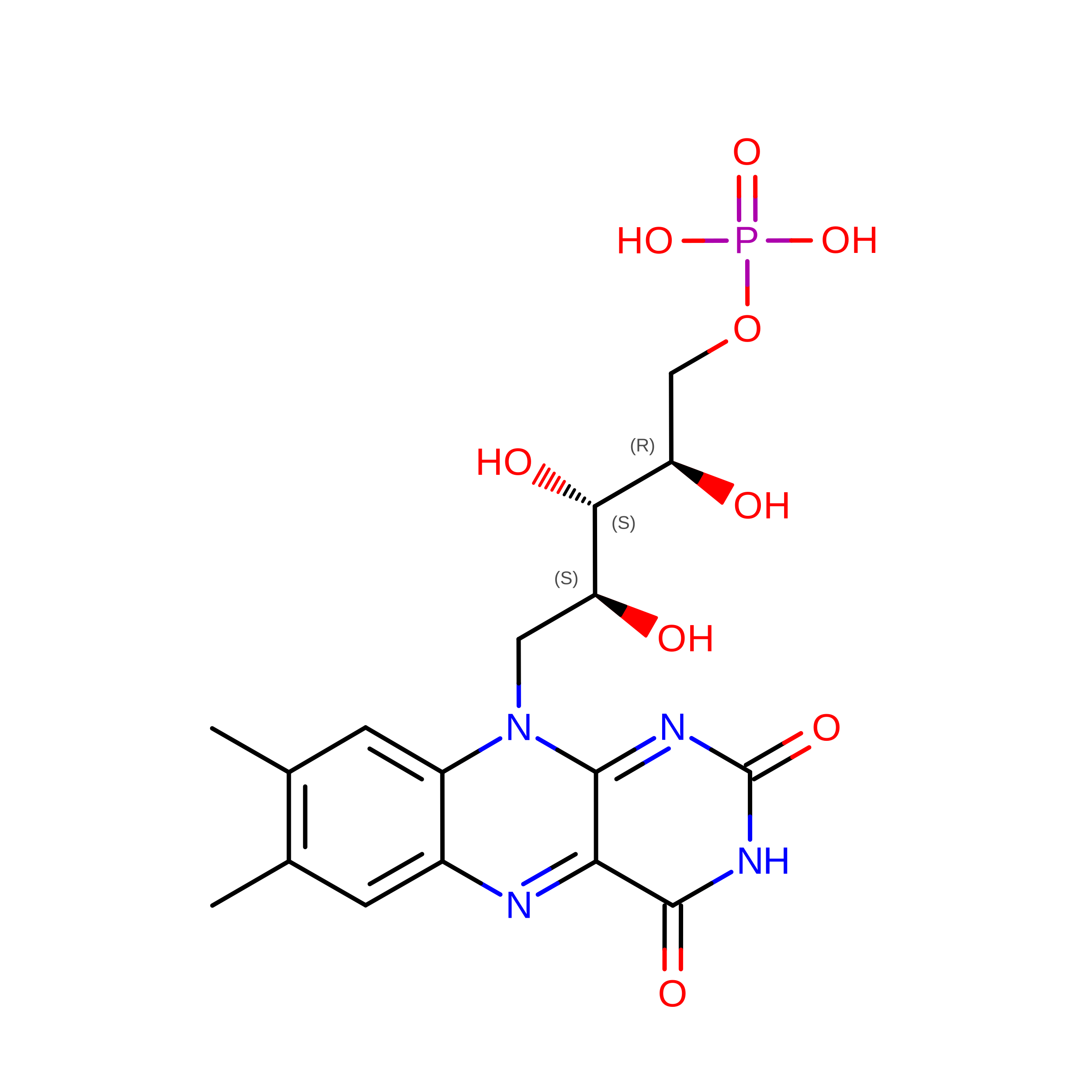
FMN complex of coenzyme F420:L-glutamate ligase (FbiB) from Mycobacterium tuberculosis (C-terminal domain)


Experimental Data Snapshot

  • Method: X-RAY DIFFRACTION
  • Resolution: 2.10 Å
  • R-Value Free: 
    0.269 (Depositor), 0.274 (DCC) 
  • R-Value Work: 
    0.232 (Depositor), 0.238 (DCC) 
  • R-Value Observed: 
    0.233 (Depositor) 

Starting Model: experimental
View more details

wwPDB Validation 3D Report Full Report

Validation slider image for 4XOO

Ligand Structure Quality Assessment 


This is version 1.3 of the entry. See complete history

Literature

Elongation of the Poly-gamma-glutamate Tail of F420 Requires Both Domains of the F420: gamma-Glutamyl Ligase (FbiB) of Mycobacterium tuberculosis.

Bashiri, G.Rehan, A.M.Sreebhavan, S.Baker, H.M.Baker, E.N.Squire, C.J.

(2016) J Biological Chem 291: 6882-6894

  • DOI: https://doi.org/10.1074/jbc.M115.689026
  • Primary Citation Related Structures: 
    4XOM, 4XOO, 4XOQ

  • PubMed Abstract: 

    Cofactor F420is an electron carrier with a major role in the oxidoreductive reactions ofMycobacterium tuberculosis, the causative agent of tuberculosis. A γ-glutamyl ligase catalyzes the final steps of the F420biosynthesis pathway by successive additions ofl-glutamate residues to F420-0, producing a poly-γ-glutamate tail. The enzyme responsible for this reaction in archaea (CofE) comprises a single domain and produces F420-2 as the major species. The homologousM. tuberculosisenzyme, FbiB, is a two-domain protein and produces F420with predominantly 5-7l-glutamate residues in the poly-γ-glutamate tail. The N-terminal domain of FbiB is homologous to CofE with an annotated γ-glutamyl ligase activity, whereas the C-terminal domain has sequence similarity to an FMN-dependent family of nitroreductase enzymes. Here we demonstrate that full-length FbiB adds multiplel-glutamate residues to F420-0in vitroto produce F420-5 after 24 h; communication between the two domains is critical for full γ-glutamyl ligase activity. We also present crystal structures of the C-terminal domain of FbiB in apo-, F420-0-, and FMN-bound states, displaying distinct sites for F420-0 and FMN ligands that partially overlap. Finally, we discuss the features of a full-length structural model produced by small angle x-ray scattering and its implications for the role of N- and C-terminal domains in catalysis.


  • Organizational Affiliation
    • From the Structural Biology Laboratory, School of Biological Sciences and Maurice Wilkins Centre for Molecular Biodiscovery, and.

Macromolecule Content 

  • Total Structure Weight: 91.24 kDa 
  • Atom Count: 5,996 
  • Modeled Residue Count: 784 
  • Deposited Residue Count: 828 
  • Unique protein chains: 1

Macromolecules

Find similar proteins by:|  3D Structure
Entity ID: 1
MoleculeChains  Sequence LengthOrganismDetailsImage
Coenzyme F420:L-glutamate ligase
A, B, C, D
207Mycobacterium tuberculosis H37RvMutation(s): 0 
Gene Names: fbiBRv3262
EC: 6.3.2.31 (PDB Primary Data), 6.3.2.34 (PDB Primary Data), 1.3.8.17 (UniProt)
UniProt
Find proteins for P9WP79 (Mycobacterium tuberculosis (strain ATCC 25618 / H37Rv))
Explore P9WP79 
Go to UniProtKB:  P9WP79
Entity Groups
Sequence Clusters30% Identity50% Identity70% Identity90% Identity95% Identity100% Identity
UniProt GroupP9WP79
Sequence Annotations
Expand
Reference Sequence

Experimental Data & Validation

Experimental Data

  • Method: X-RAY DIFFRACTION
  • Resolution: 2.10 Å
  • R-Value Free:  0.269 (Depositor), 0.274 (DCC) 
  • R-Value Work:  0.232 (Depositor), 0.238 (DCC) 
  • R-Value Observed: 0.233 (Depositor) 
Space Group: P 41 21 2
Unit Cell:
Length ( Å )Angle ( ˚ )
a = 137.135α = 90
b = 137.135β = 90
c = 101.395γ = 90
Software Package:
Software NamePurpose
REFMACrefinement
XDSdata reduction
Aimlessdata scaling
PHASERphasing

Structure Validation

View Full Validation Report


Ligand Structure Quality Assessment 


Entry History 

Deposition Data

Revision History  (Full details and data files)

  • Version 1.0: 2016-02-17
    Type: Initial release
  • Version 1.1: 2016-02-24
    Changes: Database references
  • Version 1.2: 2016-04-06
    Changes: Database references
  • Version 1.3: 2023-09-27
    Changes: Data collection, Database references, Derived calculations, Refinement description