4XK0 | pdb_00004xk0

Crystal structure of a tetramolecular RNA G-quadruplex in potassium


Experimental Data Snapshot

  • Method: X-RAY DIFFRACTION
  • Resolution: 1.08 Å
  • R-Value Free: 
    0.144 (Depositor), 0.178 (DCC) 
  • R-Value Work: 
    0.144 (Depositor), 0.174 (DCC) 

wwPDB Validation 3D Report Full Report

Validation slider image for 4XK0

This is version 2.0 of the entry. See complete history

Literature

Insights into the mechanism of a G-quadruplex-unwinding DEAH-box helicase.

Chen, M.C.Murat, P.Abecassis, K.Ferre-D'Amare, A.R.Balasubramanian, S.

(2015) Nucleic Acids Res 43: 2223-2231

  • DOI: https://doi.org/10.1093/nar/gkv051
  • Primary Citation Related Structures: 
    4XK0

  • PubMed Abstract: 

    The unwinding of nucleic acid secondary structures within cells is crucial to maintain genomic integrity and prevent abortive transcription and translation initiation. DHX36, also known as RHAU or G4R1, is a DEAH-box ATP-dependent helicase highly specific for DNA and RNA G-quadruplexes (G4s). A fundamental mechanistic understanding of the interaction between helicases and their G4 substrates is important to elucidate G4 biology and pave the way toward G4-targeted therapies. Here we analyze how the thermodynamic stability of G4 substrates affects binding and unwinding by DHX36. We modulated the stability of the G4 substrates by varying the sequence and the number of G-tetrads and by using small, G4-stabilizing molecules. We found an inverse correlation between the thermodynamic stability of the G4 substrates and rates of unwinding by DHX36. In stark contrast, the ATPase activity of the helicase was largely independent of substrate stability pointing toward a decoupling mechanism akin to what has been observed for many double-stranded DEAD-box RNA helicases. Our study provides the first evidence that DHX36 uses a local, non-processive mechanism to unwind G4 substrates, reminiscent of that of eukaryotic initiation factor 4A (eIF4A) on double-stranded substrates.


  • Organizational Affiliation
    • Department of Chemistry, University of Cambridge, Lensfield Road, Cambridge, CB2 1EW, UK National Heart, Lung and Blood Institute, 50 South Drive, MSC-8012, Bethesda, MD 20892-8012, USA.

Macromolecule Content 

  • Total Structure Weight: 4.66 kDa 
  • Atom Count: 331 
  • Modeled Residue Count: 12 
  • Deposited Residue Count: 12 
  • Unique nucleic acid chains: 1

Macromolecules

Find similar nucleic acids by:  Sequence
Entity ID: 1
MoleculeChains LengthOrganismImage
RNA (5'-(*UP*GP*GP*GP*GP*U)-3')A,
B [auth C]
6synthetic construct
Sequence Annotations
Expand
Reference Sequence

Small Molecules

Ligands 2 Unique
IDChains Name / Formula / InChI Key2D Diagram3D Interactions
BA

Query on BA


Download:Ideal Coordinates CCD File
H [auth A],
I [auth A],
N [auth C]
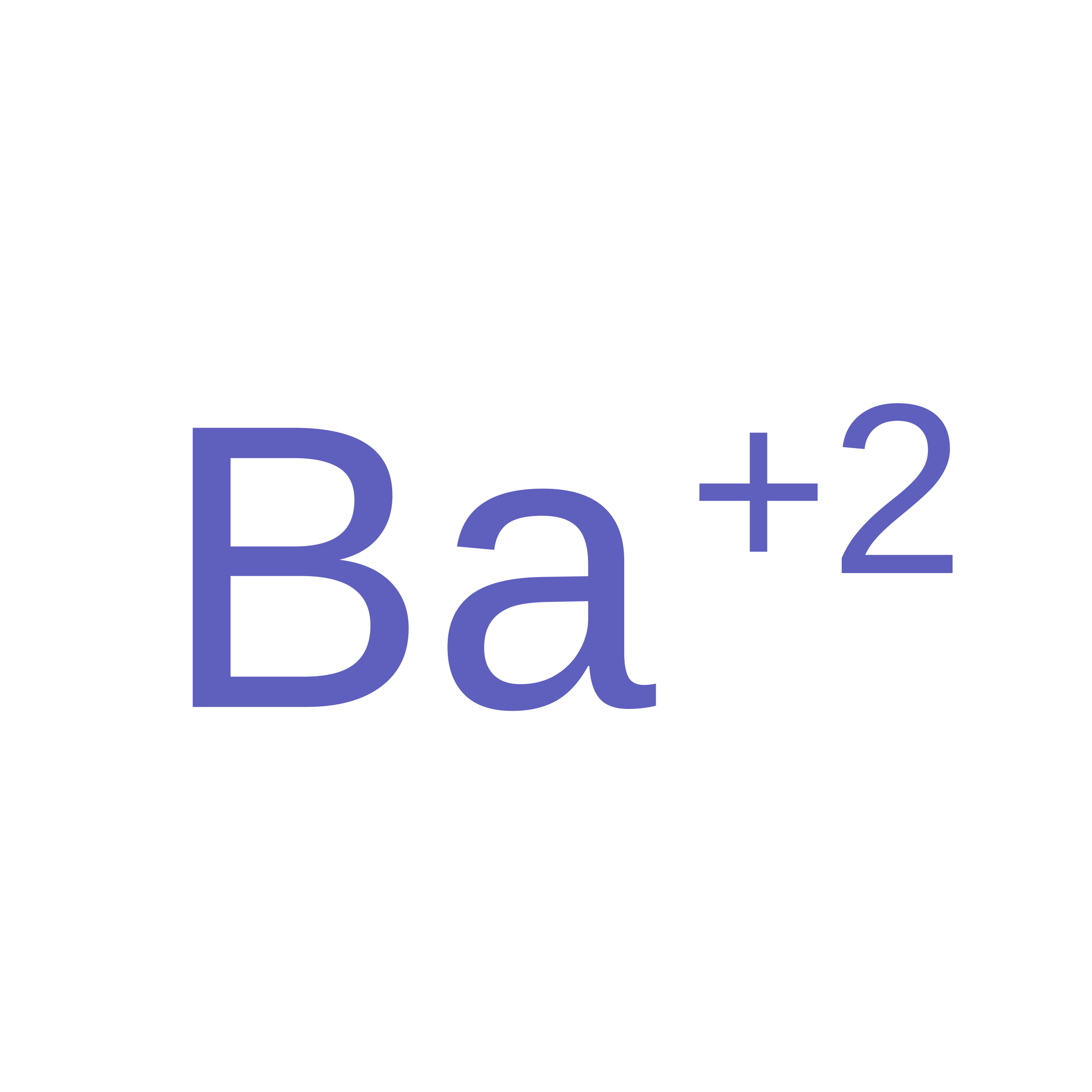
BARIUM ION
Ba
XDFCIPNJCBUZJN-UHFFFAOYSA-N
K

Query on K


Download:Ideal Coordinates CCD File
C [auth A]
D [auth A]
E [auth A]
F [auth A]
G [auth A]
C [auth A],
D [auth A],
E [auth A],
F [auth A],
G [auth A],
J [auth C],
K [auth C],
L [auth C],
M [auth C]
POTASSIUM ION
K
NPYPAHLBTDXSSS-UHFFFAOYSA-N

Experimental Data & Validation

Experimental Data

  • Method: X-RAY DIFFRACTION
  • Resolution: 1.08 Å
  • R-Value Free:  0.144 (Depositor), 0.178 (DCC) 
  • R-Value Work:  0.144 (Depositor), 0.174 (DCC) 
Space Group: P 4 21 2
Unit Cell:
Length ( Å )Angle ( ˚ )
a = 33.133α = 90
b = 33.133β = 90
c = 54.843γ = 90
Software Package:
Software NamePurpose
SHELXphasing
PHENIXrefinement
PDB_EXTRACTdata extraction
HKL-2000data scaling

Structure Validation

View Full Validation Report


Entry History 

Deposition Data

Revision History  (Full details and data files)

  • Version 1.0: 2015-02-11
    Type: Initial release
  • Version 1.1: 2015-02-18
    Changes: Database references
  • Version 1.2: 2015-03-11
    Changes: Database references
  • Version 1.3: 2015-08-19
    Changes: Refinement description
  • Version 2.0: 2024-05-08
    Changes: Atomic model, Data collection, Database references, Derived calculations