Download Mendeley
Structural analysis of Clostridium acetobutylicum ATCC 824 glycoside hydrolase from CAZy family GH105.
Germane, K.L., Servinsky, M.D., Gerlach, E.S., Sund, C.J., Hurley, M.M.(2015) Acta Crystallogr F Struct Biol Commun 71: 1100-1108
- PubMed: 26249707 Search on PubMedSearch on PubMed Central
- DOI: https://doi.org/10.1107/S2053230X15012121
- Primary Citation Related Structures:
4WU0 - PubMed Abstract:
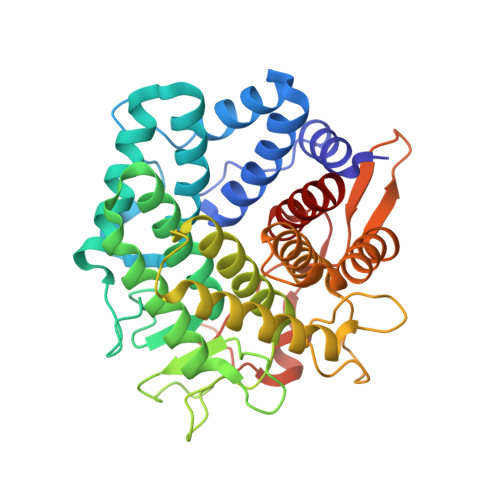
Clostridium acetobutylicum ATCC 824 gene CA_C0359 encodes a putative unsaturated rhamnogalacturonyl hydrolase (URH) with distant amino-acid sequence homology to YteR of Bacillus subtilis strain 168. YteR, like other URHs, has core structural homology to unsaturated glucuronyl hydrolases, but hydrolyzes the unsaturated disaccharide derivative of rhamnogalacturonan I. The crystal structure of the recombinant CA_C0359 protein was solved to 1.6 Å resolution by molecular replacement using the phase information of the previously reported structure of YteR (PDB entry 1nc5) from Bacillus subtilis strain 168. The YteR-like protein is a six-α-hairpin barrel with two β-sheet strands and a small helix overlaying the end of the hairpins next to the active site. The protein has low primary protein sequence identity to YteR but is structurally similar. The two tertiary structures align with a root-mean-square deviation of 1.4 Å and contain a highly conserved active pocket. There is a conserved aspartic acid residue in both structures, which has been shown to be important for hydration of the C=C bond during the release of unsaturated galacturonic acid by YteR. A surface electrostatic potential comparison of CA_C0359 and proteins from CAZy families GH88 and GH105 reveals the make-up of the active site to be a combination of the unsaturated rhamnogalacturonyl hydrolase and the unsaturated glucuronyl hydrolase from Bacillus subtilis strain 168. Structural and electrostatic comparisons suggests that the protein may have a slightly different substrate specificity from that of YteR.
- Oak Ridge Associated Universities, 4692 Millennium Drive, Suite 101, Belcamp, MD 21017, USA.
Organizational Affiliation: