4WQP | pdb_00004wqp

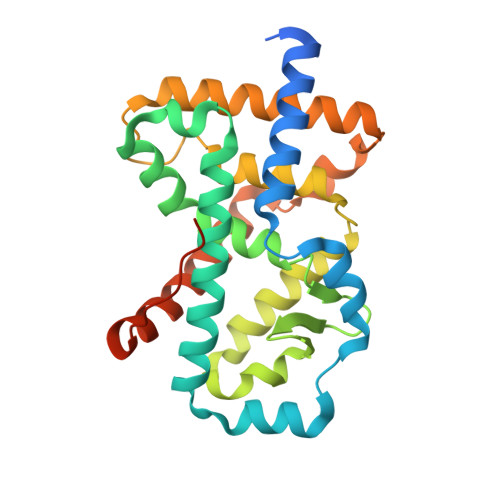
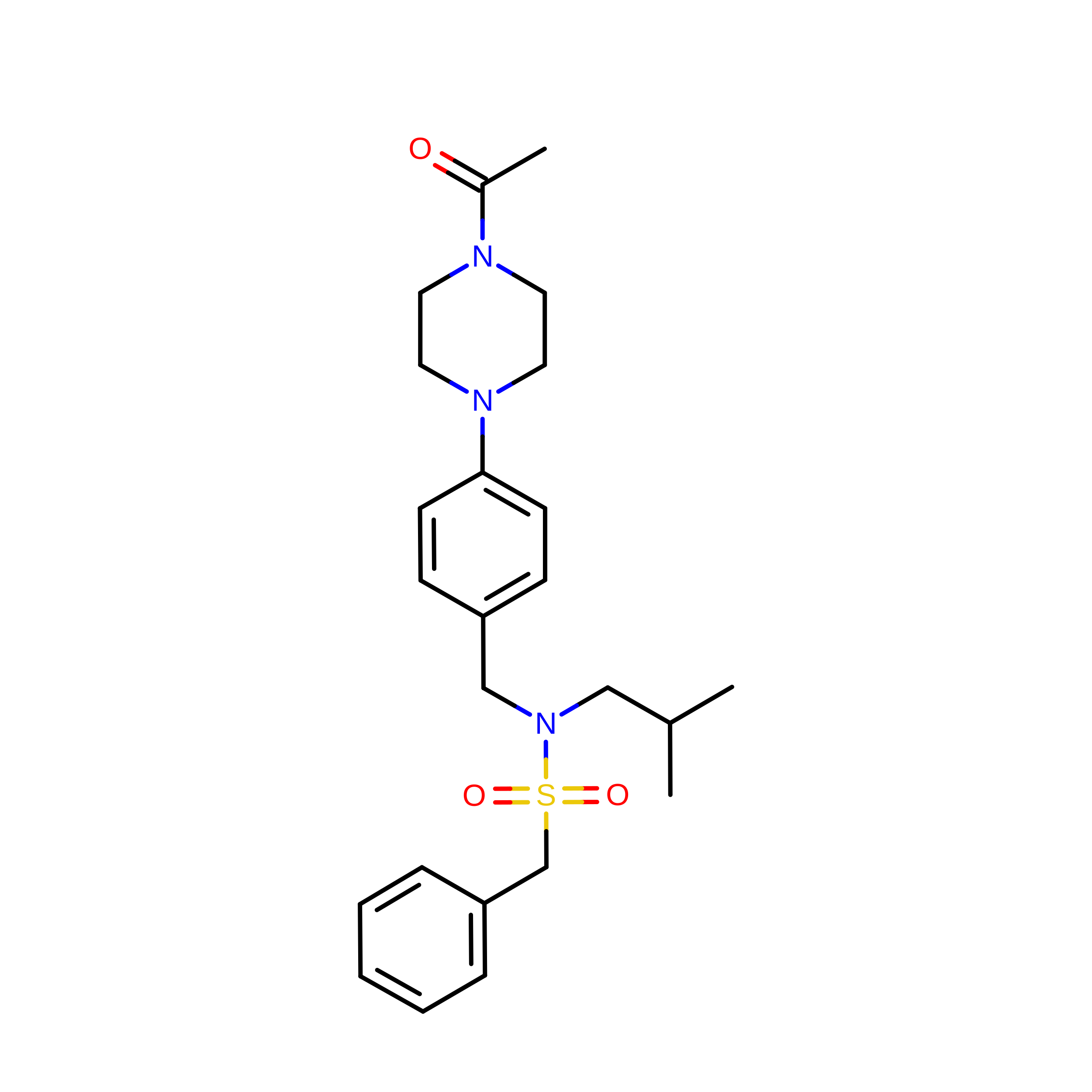
Crystal structure of RORc in complex with a benzyl sulfonamide inverse agonist


Experimental Data Snapshot

  • Method: X-RAY DIFFRACTION
  • Resolution: 1.99 Å
  • R-Value Free: 
    0.180 (Depositor), 0.172 (DCC) 
  • R-Value Work: 
    0.150 (Depositor), 0.148 (DCC) 
  • R-Value Observed: 
    0.151 (Depositor) 

wwPDB Validation 3D Report Full Report

Validation slider image for 4WQP

Ligand Structure Quality Assessment 


This is version 2.0 of the entry. See complete history

Literature

Minor Structural Change to Tertiary Sulfonamide RORc Ligands Led to Opposite Mechanisms of Action.

Rene, O.Fauber, B.P.de Leon Boenig, G.Burton, B.Eidenschenk, C.Everett, C.Gobbi, A.Hymowitz, S.G.Johnson, A.R.Kiefer, J.R.Liimatta, M.Lockey, P.Norman, M.Ouyang, W.Wallweber, H.A.Wong, H.

(2015) ACS Med Chem Lett 6: 276-281

  • DOI: https://doi.org/10.1021/ml500420y
  • Primary Citation Related Structures: 
    4WPF, 4WQP

  • PubMed Abstract: 

    A minor structural change to tertiary sulfonamide RORc ligands led to distinct mechanisms of action. Co-crystal structures of two compounds revealed mechanistically consistent protein conformational changes. Optimized phenylsulfonamides were identified as RORc agonists while benzylsulfonamides exhibited potent inverse agonist activity. Compounds behaving as agonists in our biochemical assay also gave rise to an increased production of IL-17 in human PBMCs whereas inverse agonists led to significant suppression of IL-17 under the same assay conditions. The most potent inverse agonist compound showed >180-fold selectivity over the ROR isoforms as well as all other nuclear receptors that were profiled.


  • Organizational Affiliation
    • Genentech, Inc., 1 DNA Way, South San Francisco, California 94080, United States.

Macromolecule Content 

  • Total Structure Weight: 64.42 kDa 
  • Atom Count: 4,205 
  • Modeled Residue Count: 468 
  • Deposited Residue Count: 543 
  • Unique protein chains: 2

Macromolecules

Find similar proteins by:|  3D Structure
Entity ID: 1
MoleculeChains  Sequence LengthOrganismDetailsImage
Nuclear receptor ROR-gamma
A, B
265Homo sapiensMutation(s): 0 
Gene Names: RORCNR1F3RORGRZRG
UniProt & NIH Common Fund Data Resources
Find proteins for P51449 (Homo sapiens)
Explore P51449 
Go to UniProtKB:  P51449
PHAROS:  P51449
GTEx:  ENSG00000143365 
Entity Groups
Sequence Clusters30% Identity50% Identity70% Identity90% Identity95% Identity100% Identity
UniProt GroupP51449
Sequence Annotations
Expand
Reference Sequence
Find similar proteins by:  Sequence   |   3D Structure  
Entity ID: 2
MoleculeChains  Sequence LengthOrganismDetailsImage
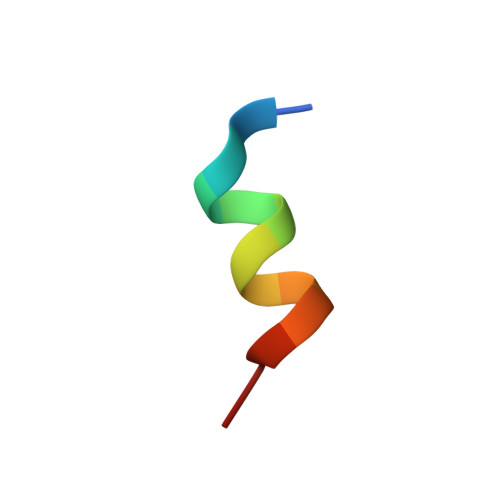
VAL-GLU-ARG-LEU-GLN-ILE-PHE-GLN-HIS-LEU-HIS-PRO-ILEC [auth P]13Homo sapiensMutation(s): 0 
Gene Names: Nuclear receptor ROR-gamma
UniProt & NIH Common Fund Data Resources
Find proteins for P51449 (Homo sapiens)
Explore P51449 
Go to UniProtKB:  P51449
PHAROS:  P51449
GTEx:  ENSG00000143365 
Entity Groups
Sequence Clusters30% Identity50% Identity70% Identity90% Identity95% Identity100% Identity
UniProt GroupP51449
Sequence Annotations
Expand
Reference Sequence

Small Molecules

Binding Affinity Annotations 
IDSourceBinding Affinity
3SX BindingDB:  4WQP IC50: 47 (nM) from 1 assay(s)
EC50: min: 57, max: 120 (nM) from 2 assay(s)

Experimental Data & Validation

Experimental Data

  • Method: X-RAY DIFFRACTION
  • Resolution: 1.99 Å
  • R-Value Free:  0.180 (Depositor), 0.172 (DCC) 
  • R-Value Work:  0.150 (Depositor), 0.148 (DCC) 
  • R-Value Observed: 0.151 (Depositor) 
Space Group: P 61
Unit Cell:
Length ( Å )Angle ( ˚ )
a = 99.735α = 90
b = 99.735β = 90
c = 129.606γ = 120
Software Package:
Software NamePurpose
REFMACrefinement
PDB_EXTRACTdata extraction

Structure Validation

View Full Validation Report


Ligand Structure Quality Assessment 


Entry History 

Deposition Data

Revision History  (Full details and data files)

  • Version 1.0: 2015-01-14
    Type: Initial release
  • Version 1.1: 2015-04-15
    Changes: Database references
  • Version 1.2: 2015-04-22
    Changes: Database references
  • Version 2.0: 2023-12-27
    Changes: Atomic model, Data collection, Database references, Derived calculations, Other, Source and taxonomy