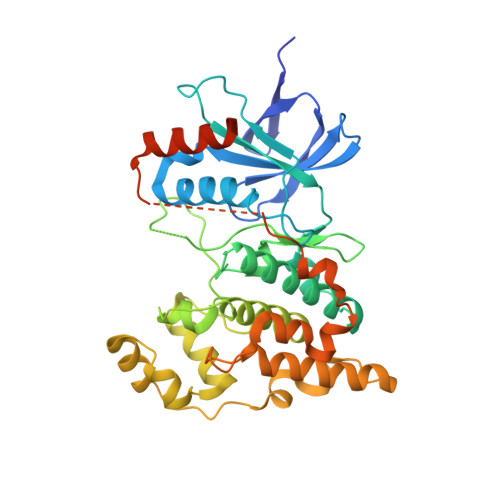
4WHZ | pdb_00004whz

Design and Synthesis of Highly Potent and Isoform Selective JNK3 Inhibitors: SAR Studies on Aminopyrazole Derivatives


Experimental Data Snapshot

  • Method: X-RAY DIFFRACTION
  • Resolution: 1.79 Å
  • R-Value Free: 
    0.227 (Depositor), 0.233 (DCC) 
  • R-Value Work: 
    0.193 (Depositor), 0.200 (DCC) 
  • R-Value Observed: 
    0.195 (Depositor) 

wwPDB Validation 3D Report Full Report

Validation slider image for 4WHZ

Ligand Structure Quality Assessment 


This is version 1.2 of the entry. See complete history

Literature

Design and Synthesis of Highly Potent and Isoform Selective JNK3 Inhibitors: SAR Studies on Aminopyrazole Derivatives.

Zheng, K.Iqbal, S.Hernandez, P.Park, H.LoGrasso, P.V.Feng, Y.

(2014) J Med Chem 57: 10013-10030

  • DOI: https://doi.org/10.1021/jm501256y
  • Primary Citation Related Structures: 
    4WHZ

  • PubMed Abstract: 

    The c-jun N-terminal kinase 3 (JNK3) is expressed primarily in the brain. Numerous reports have shown that inhibition of JNK3 is a promising strategy for treatment of neurodegeneration. The optimization of aminopyrazole-based JNK3 inhibitors with improved potency, isoform selectivity, and pharmacological properties by structure-activity relationship (SAR) studies utilizing biochemical and cell-based assays, and structure-based drug design is reported. These inhibitors had high selectivity over JNK1 and p38α, minimal cytotoxicity, potent inhibition of 6-OHDA-induced mitochondrial membrane potential dissipation and ROS generation, and good drug metabolism and pharmacokinetic (DMPK) properties for iv dosing. 26n was profiled against 464 kinases and was found to be highly selective hitting only seven kinases with >80% inhibition at 10 μM. Moreover, 26n showed good solubility, good brain penetration, and good DMPK properties. Finally, the crystal structure of 26k in complex with JNK3 was solved at 1.8 Å to explore the binding mode of aminopyrazole based JNK3 inhibitors.


  • Organizational Affiliation
    • Medicinal Chemistry, ‡Discovery Biology, §Crystallography/Modeling Facility, Translational Research Institute, and ∥Department of Molecular Therapeutics, Scripps Florida, The Scripps Research Institute , 130 Scripps Way, No. 2A1, Jupiter, Florida 33458, United States.

Macromolecule Content 

  • Total Structure Weight: 44.59 kDa 
  • Atom Count: 3,164 
  • Modeled Residue Count: 342 
  • Deposited Residue Count: 385 
  • Unique protein chains: 1

Macromolecules

Find similar proteins by:|  3D Structure
Entity ID: 1
MoleculeChains  Sequence LengthOrganismDetailsImage
Mitogen-activated protein kinase 10385Homo sapiensMutation(s): 0 
Gene Names: MAPK10JNK3JNK3APRKM10SAPK1B
EC: 2.7.11.24
UniProt & NIH Common Fund Data Resources
Find proteins for P53779 (Homo sapiens)
Explore P53779 
Go to UniProtKB:  P53779
PHAROS:  P53779
GTEx:  ENSG00000109339 
Entity Groups
Sequence Clusters30% Identity50% Identity70% Identity90% Identity95% Identity100% Identity
UniProt GroupP53779
Sequence Annotations
Expand
Reference Sequence

Small Molecules

Ligands 1 Unique
IDChains Name / Formula / InChI Key2D Diagram3D Interactions
3NL

Query on 3NL


Download:Ideal Coordinates CCD File
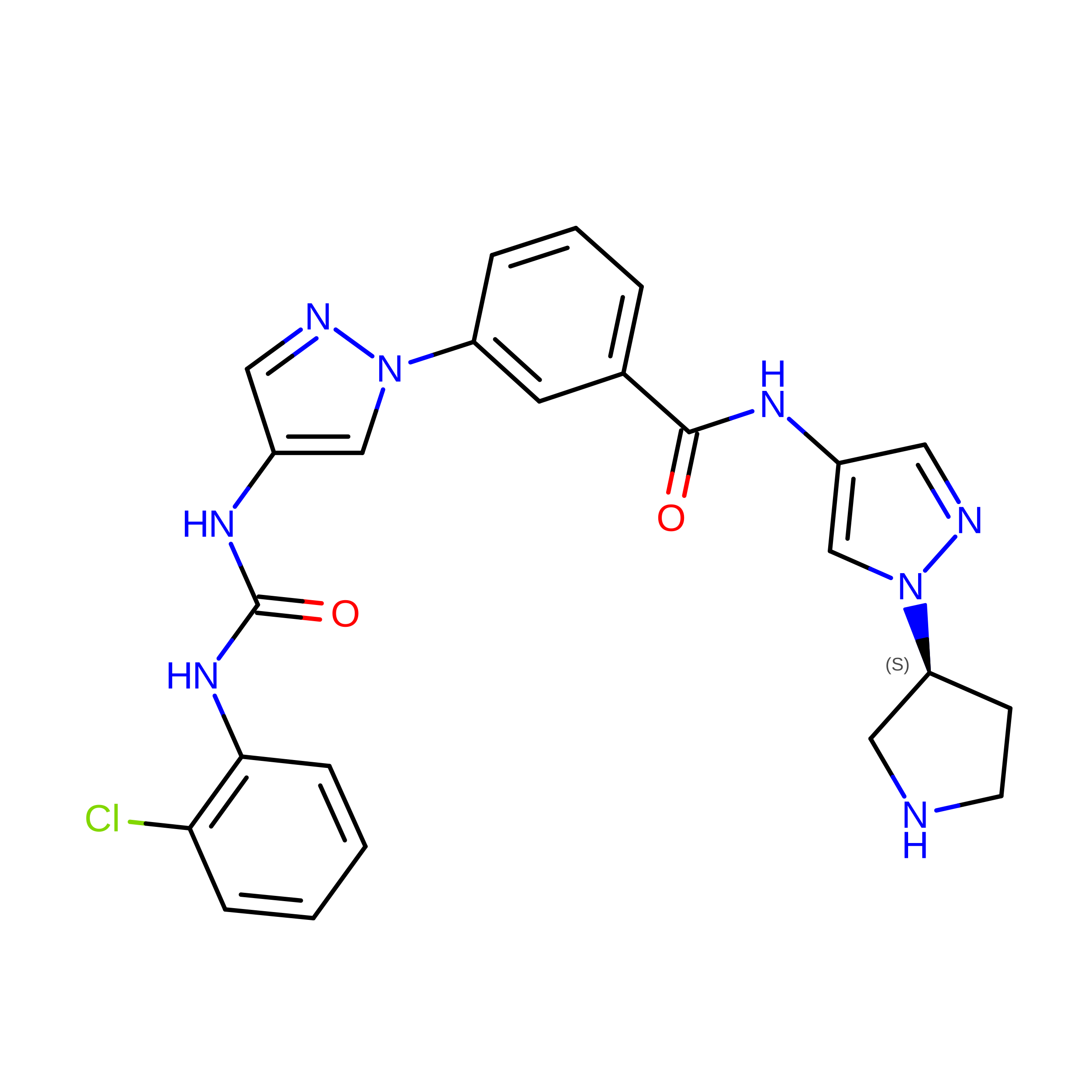
B [auth A]3-(4-{[(2-chlorophenyl)carbamoyl]amino}-1H-pyrazol-1-yl)-N-{1-[(3S)-pyrrolidin-3-yl]-1H-pyrazol-4-yl}benzamide
C24 H23 Cl N8 O2
IMARJVJNXLXPIX-FQEVSTJZSA-N

Experimental Data & Validation

Experimental Data

  • Method: X-RAY DIFFRACTION
  • Resolution: 1.79 Å
  • R-Value Free:  0.227 (Depositor), 0.233 (DCC) 
  • R-Value Work:  0.193 (Depositor), 0.200 (DCC) 
  • R-Value Observed: 0.195 (Depositor) 
Space Group: P 21 21 21
Unit Cell:
Length ( Å )Angle ( ˚ )
a = 53.92α = 90
b = 70.93β = 90
c = 107.69γ = 90
Software Package:
Software NamePurpose
BUSTERrefinement

Structure Validation

View Full Validation Report


Ligand Structure Quality Assessment 


Entry History 

Deposition Data

Revision History  (Full details and data files)

  • Version 1.0: 2014-11-26
    Type: Initial release
  • Version 1.1: 2014-12-31
    Changes: Database references
  • Version 1.2: 2023-12-27
    Changes: Data collection, Database references, Derived calculations, Other, Refinement description, Source and taxonomy, Structure summary