4W4X | pdb_00004w4x

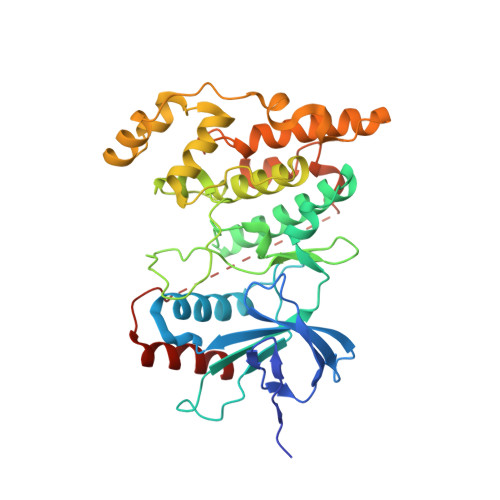
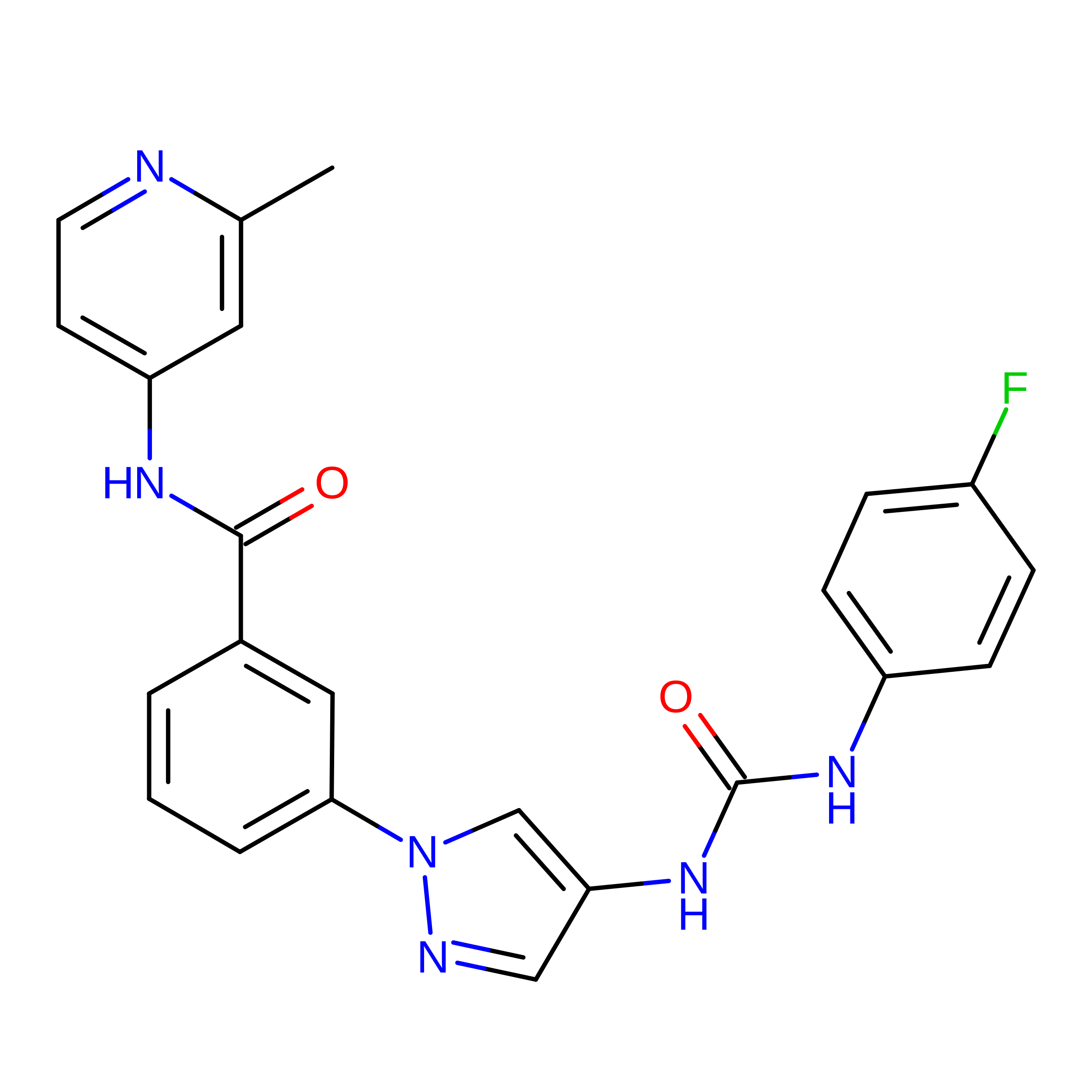
JNK2/3 in complex with 3-(4-{[(4-fluorophenyl)carbamoyl]amino}-1H-pyrazol-1-yl)-N-(2-methylpyridin-4-yl)benzamide


Experimental Data Snapshot

  • Method: X-RAY DIFFRACTION
  • Resolution: 2.65 Å
  • R-Value Free: 
    0.284 (Depositor), 0.144 (DCC) 
  • R-Value Work: 
    0.192 (Depositor) 
  • R-Value Observed: 
    0.197 (Depositor) 

wwPDB Validation 3D Report Full Report

Validation slider image for 4W4X

Ligand Structure Quality Assessment 


This is version 1.4 of the entry. See complete history

Literature

Structural Basis and Biological Consequences for JNK2/3 Isoform Selective Aminopyrazoles.

Park, H.Iqbal, S.Hernandez, P.Mora, R.Zheng, K.Feng, Y.LoGrasso, P.

(2015) Sci Rep 5: 8047-8047

  • DOI: https://doi.org/10.1038/srep08047
  • Primary Citation Related Structures: 
    4W4V, 4W4W, 4W4X, 4W4Y

  • PubMed Abstract: 

    Three JNK isoforms, JNK1, JNK2, and JNK3 have been reported and unique biological function has been ascribed to each. It is unknown if selective inhibition of these isoforms would confer therapeutic or safety benefit. To probe JNK isoform function we designed JNK2/3 inhibitors that have >30-fold selectivity over JNK1. Utilizing site-directed mutagenesis and x-ray crystallography we identified L144 in JNK3 as a key residue for selectivity. To test whether JNK2/3 selective inhibitors protect human dopaminergic neurons against neurotoxin-induced mitochondrial dysfunction, we monitored reactive oxygen species (ROS) generation and mitochondrial membrane potential (MMP). The results showed that JNK2/3 selective inhibitors protected against 6-hydroxydopamine-induced ROS generation and MMP depolarization. These results suggest that it was possible to develop JNK2/3 selective inhibitors and that residues in hydrophobic pocket I were responsible for selectivity. Moreover, the findings also suggest that inhibition of JNK2/3 likely contributed to protecting mitochondrial function and prevented ultimate cell death.


  • Organizational Affiliation
    • Department of Molecular Therapeutics and Translational Research Institute, The Scripps Research Institute, 130 Scripps Way #2A2, Jupiter, Florida 33458.

Macromolecule Content 

  • Total Structure Weight: 42.69 kDa 
  • Atom Count: 2,956 
  • Modeled Residue Count: 342 
  • Deposited Residue Count: 366 
  • Unique protein chains: 1

Macromolecules

Find similar proteins by:|  3D Structure
Entity ID: 1
MoleculeChains  Sequence LengthOrganismDetailsImage
c-jun NH2-terminal kinase 3366Homo sapiensMutation(s): 0 
Gene Names: MAPK10JNK3JNK3APRKM10SAPK1B
EC: 2.7.11.24
UniProt & NIH Common Fund Data Resources
Find proteins for P53779 (Homo sapiens)
Explore P53779 
Go to UniProtKB:  P53779
PHAROS:  P53779
GTEx:  ENSG00000109339 
Entity Groups
Sequence Clusters30% Identity50% Identity70% Identity90% Identity95% Identity100% Identity
UniProt GroupP53779
Sequence Annotations
Expand
Reference Sequence

Small Molecules

Ligands 1 Unique
IDChains Name / Formula / InChI Key2D Diagram3D Interactions
3HN

Query on 3HN


Download:Ideal Coordinates CCD File
B [auth A]3-(4-{[(4-fluorophenyl)carbamoyl]amino}-1H-pyrazol-1-yl)-N-(2-methylpyridin-4-yl)benzamide
C23 H19 F N6 O2
CHEAXMFRMQDNIT-UHFFFAOYSA-N

Experimental Data & Validation

Experimental Data

  • Method: X-RAY DIFFRACTION
  • Resolution: 2.65 Å
  • R-Value Free:  0.284 (Depositor), 0.144 (DCC) 
  • R-Value Work:  0.192 (Depositor) 
  • R-Value Observed: 0.197 (Depositor) 
Space Group: P 21 21 21
Unit Cell:
Length ( Å )Angle ( ˚ )
a = 52.5α = 90
b = 71.44β = 90
c = 107.64γ = 90
Software Package:
Software NamePurpose
BUSTERrefinement

Structure Validation

View Full Validation Report


Ligand Structure Quality Assessment 


Entry History 

& Funding Information

Deposition Data


Funding OrganizationLocationGrant Number
National Institutes of Health/National Institute of General Medical Sciences (NIH/NIGMS)United StatesGM103825
Department of Defense (DOD, United States)United StatesW81XWH-12-1-0431

Revision History  (Full details and data files)

  • Version 1.0: 2015-02-11
    Type: Initial release
  • Version 1.1: 2017-09-20
    Changes: Author supporting evidence, Derived calculations, Source and taxonomy
  • Version 1.2: 2019-04-10
    Changes: Author supporting evidence, Data collection
  • Version 1.3: 2019-11-27
    Changes: Author supporting evidence
  • Version 1.4: 2023-12-27
    Changes: Data collection, Database references