4UVM | pdb_00004uvm

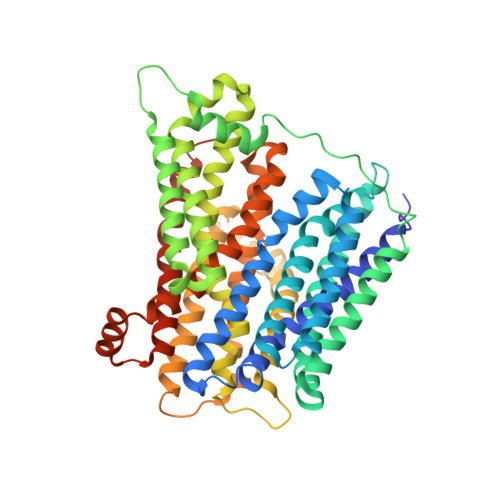
In meso crystal structure of the POT family transporter PepTSo


Experimental Data Snapshot

  • Method: X-RAY DIFFRACTION
  • Resolution: 3.00 Å
  • R-Value Free: 
    0.258 (Depositor), 0.269 (DCC) 
  • R-Value Work: 
    0.220 (Depositor), 0.241 (DCC) 
  • R-Value Observed: 
    0.222 (Depositor) 

Starting Model: experimental
View more details

wwPDB Validation 3D Report Full Report

Validation slider image for 4UVM

Ligand Structure Quality Assessment 


This is version 1.3 of the entry. See complete history

Literature

Gating Topology of the Proton-Coupled Oligopeptide Symporters.

Fowler, P.W.Orwick-Rydmark, M.Radestock, S.Solcan, N.Dijkman, P.M.Lyons, J.A.Kwok, J.Caffrey, M.Watts, A.Forrest, L.R.Newstead, S.

(2015) Structure 23: 290

  • DOI: https://doi.org/10.1016/j.str.2014.12.012
  • Primary Citation Related Structures: 
    4UVM

  • PubMed Abstract: 

    Proton-coupled oligopeptide transporters belong to the major facilitator superfamily (MFS) of membrane transporters. Recent crystal structures suggest the MFS fold facilitates transport through rearrangement of their two six-helix bundles around a central ligand binding site; how this is achieved, however, is poorly understood. Using modeling, molecular dynamics, crystallography, functional assays, and site-directed spin labeling combined with double electron-electron resonance (DEER) spectroscopy, we present a detailed study of the transport dynamics of two bacterial oligopeptide transporters, PepTSo and PepTSt. Our results identify several salt bridges that stabilize outward-facing conformations and we show that, for all the current structures of MFS transporters, the first two helices of each of the four inverted-topology repeat units form half of either the periplasmic or cytoplasmic gate and that these function cooperatively in a scissor-like motion to control access to the peptide binding site during transport.


  • Organizational Affiliation
    • Department of Biochemistry, University of Oxford, South Parks Road, Oxford OX1 3QU, UK. Electronic address: philip.fowler@bioch.ox.ac.uk.

Macromolecule Content 

  • Total Structure Weight: 59.26 kDa 
  • Atom Count: 4,048 
  • Modeled Residue Count: 505 
  • Deposited Residue Count: 524 
  • Unique protein chains: 1

Macromolecules

Find similar proteins by:|  3D Structure
Entity ID: 1
MoleculeChains  Sequence LengthOrganismDetailsImage
GLUTATHIONE UPTAKE TRANSPORTER524Shewanella oneidensis MR-1Mutation(s): 0 
Membrane Entity: Yes 
UniProt
Find proteins for Q8EKT7 (Shewanella oneidensis (strain ATCC 700550 / JCM 31522 / CIP 106686 / LMG 19005 / NCIMB 14063 / MR-1))
Explore Q8EKT7 
Go to UniProtKB:  Q8EKT7
Entity Groups
Sequence Clusters30% Identity50% Identity70% Identity90% Identity95% Identity100% Identity
UniProt GroupQ8EKT7
Sequence Annotations
Expand
Reference Sequence

Experimental Data & Validation

Experimental Data

  • Method: X-RAY DIFFRACTION
  • Resolution: 3.00 Å
  • R-Value Free:  0.258 (Depositor), 0.269 (DCC) 
  • R-Value Work:  0.220 (Depositor), 0.241 (DCC) 
  • R-Value Observed: 0.222 (Depositor) 
Space Group: P 41 21 2
Unit Cell:
Length ( Å )Angle ( ˚ )
a = 86.83α = 90
b = 86.83β = 90
c = 219.82γ = 90
Software Package:
Software NamePurpose
PHENIXrefinement
XDSdata reduction
XSCALEdata scaling
PHASERphasing

Structure Validation

View Full Validation Report


Ligand Structure Quality Assessment 


Entry History 

Deposition Data

Revision History  (Full details and data files)

  • Version 1.0: 2015-02-04
    Type: Initial release
  • Version 1.1: 2015-02-18
    Changes: Database references
  • Version 1.2: 2019-09-25
    Changes: Data collection, Experimental preparation, Other
  • Version 1.3: 2024-01-10
    Changes: Data collection, Database references, Derived calculations, Refinement description