4UP0 | pdb_00004up0

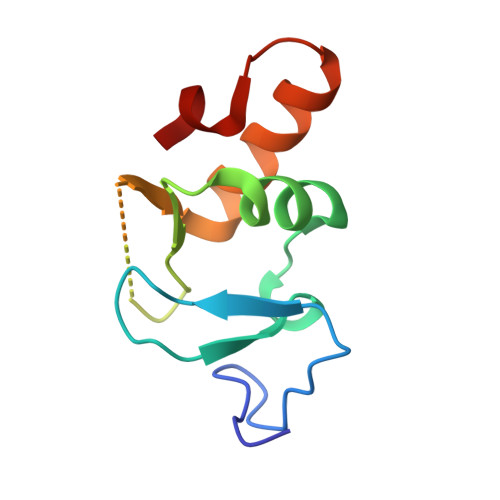
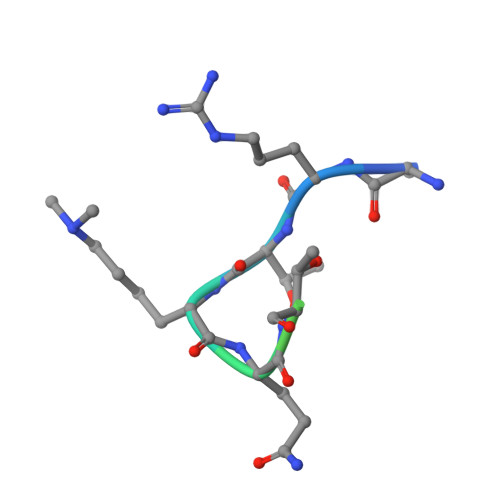
Ternary crystal structure of the Pygo2 PHD finger in complex with the B9L HD1 domain and a H3K4me2 peptide


Experimental Data Snapshot

  • Method: X-RAY DIFFRACTION
  • Resolution: 1.28 Å
  • R-Value Free: 
    0.166 (Depositor), 0.165 (DCC) 
  • R-Value Work: 
    0.138 (Depositor), 0.136 (DCC) 
  • R-Value Observed: 
    0.139 (Depositor) 

Starting Model: experimental
View more details

wwPDB Validation 3D Report Full Report

Validation slider image for 4UP0

This is version 1.2 of the entry. See complete history

Literature

Competitive Binding of a Benzimidazole to the Histone-Binding Pocket of the Pygo Phd Finger.

Miller, T.C.R.Rutherford, T.J.Birchall, K.Chugh, J.Fiedler, M.Bienz, M.

(2014) ACS Chem Biol 9: 2864

  • DOI: https://doi.org/10.1021/cb500585s
  • Primary Citation Related Structures: 
    4UP0, 4UP5

  • PubMed Abstract: 

    The Pygo-BCL9 complex is a chromatin reader, facilitating β-catenin-mediated oncogenesis, and is thus emerging as a potential therapeutic target for cancer. Its function relies on two ligand-binding surfaces of Pygo's PHD finger that anchor the histone H3 tail methylated at lysine 4 (H3K4me) with assistance from the BCL9 HD1 domain. Here, we report the first use of fragment-based screening by NMR to identify small molecules that block protein-protein interactions by a PHD finger. This led to the discovery of a set of benzothiazoles that bind to a cleft emanating from the PHD-HD1 interface, as defined by X-ray crystallography. Furthermore, we discovered a benzimidazole that docks into the H3K4me specificity pocket and displaces the native H3K4me peptide from the PHD finger. Our study demonstrates the ligandability of the Pygo-BCL9 complex and uncovers a privileged scaffold as a template for future development of lead inhibitors of oncogenesis.


  • Organizational Affiliation
    • MRC Laboratory of Molecular Biology , Francis Crick Avenue, Cambridge CB2 0QH, United Kingdom.

Macromolecule Content 

  • Total Structure Weight: 12.3 kDa 
  • Atom Count: 788 
  • Modeled Residue Count: 91 
  • Deposited Residue Count: 114 
  • Unique protein chains: 2

Macromolecules

Find similar proteins by:|  3D Structure
Entity ID: 1
MoleculeChains  Sequence LengthOrganismDetailsImage
PYGOPUS HOMOLOG 2, B-CELL CLL/LYMPHOMA 9-LIKE PROTEIN99Homo sapiensMutation(s): 0 
UniProt & NIH Common Fund Data Resources
Find proteins for Q86UU0 (Homo sapiens)
Explore Q86UU0 
Go to UniProtKB:  Q86UU0
PHAROS:  Q86UU0
GTEx:  ENSG00000186174 
Find proteins for Q9BRQ0 (Homo sapiens)
Explore Q9BRQ0 
Go to UniProtKB:  Q9BRQ0
PHAROS:  Q9BRQ0
GTEx:  ENSG00000163348 
Entity Groups
Sequence Clusters30% Identity50% Identity70% Identity90% Identity95% Identity100% Identity
UniProt GroupsQ9BRQ0Q86UU0
Sequence Annotations
Expand
Reference Sequence
Find similar proteins by:  Sequence   |   3D Structure  
Entity ID: 2
MoleculeChains  Sequence LengthOrganismDetailsImage
HISTONE H3.1B [auth F]15Homo sapiensMutation(s): 0 
UniProt & NIH Common Fund Data Resources
Find proteins for P68431 (Homo sapiens)
Explore P68431 
Go to UniProtKB:  P68431
Entity Groups
Sequence Clusters30% Identity50% Identity70% Identity90% Identity95% Identity100% Identity
UniProt GroupP68431
Sequence Annotations
Expand
Reference Sequence

Small Molecules

Modified Residues  2 Unique
IDChains TypeFormula2D DiagramParent
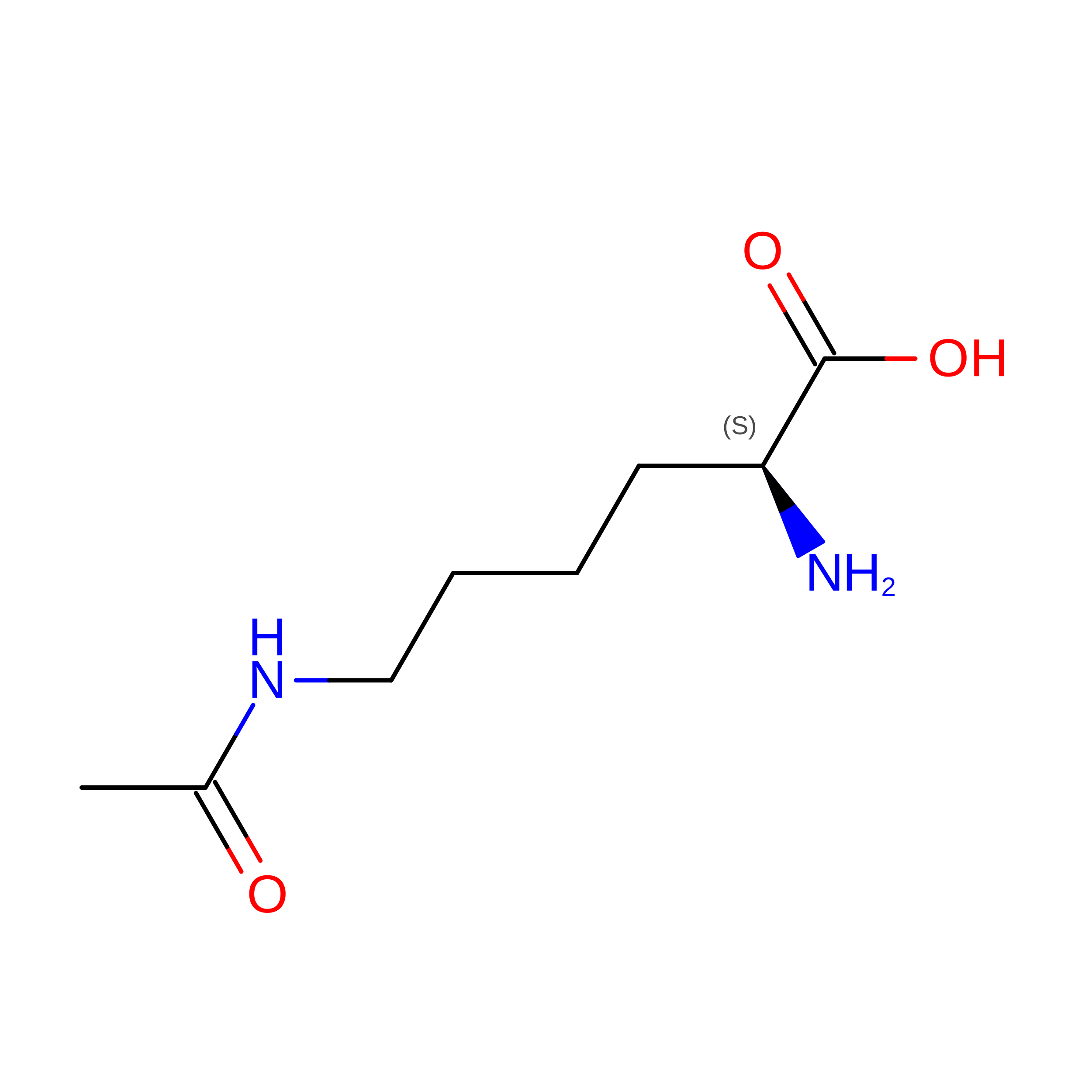
ALY
Query on ALY
B [auth F]L-PEPTIDE LINKINGC8 H16 N2 O3LYS
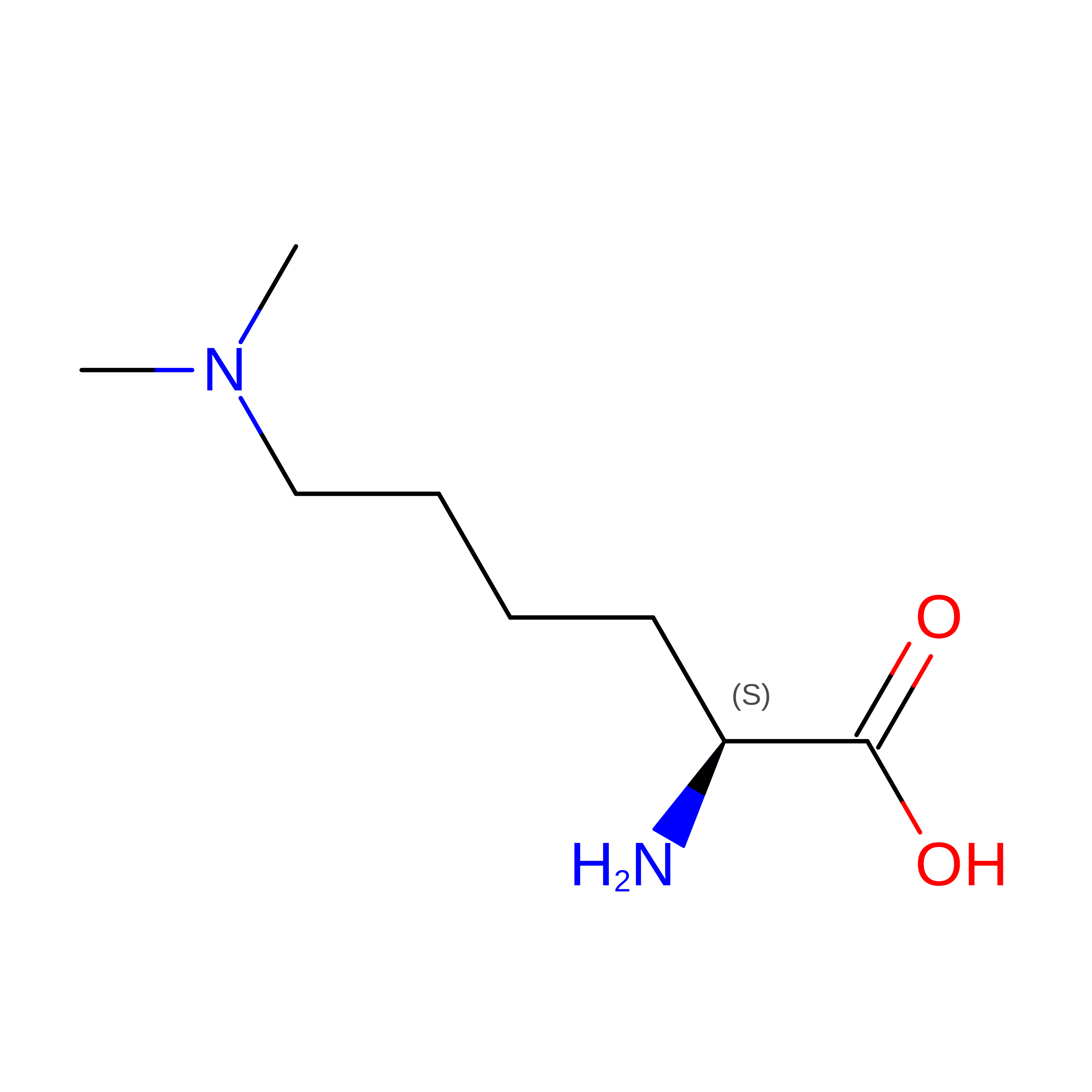
MLY
Query on MLY
B [auth F]L-PEPTIDE LINKINGC8 H18 N2 O2LYS

Experimental Data & Validation

Experimental Data

  • Method: X-RAY DIFFRACTION
  • Resolution: 1.28 Å
  • R-Value Free:  0.166 (Depositor), 0.165 (DCC) 
  • R-Value Work:  0.138 (Depositor), 0.136 (DCC) 
  • R-Value Observed: 0.139 (Depositor) 
Space Group: P 41 21 2
Unit Cell:
Length ( Å )Angle ( ˚ )
a = 53.91α = 90
b = 53.91β = 90
c = 57.94γ = 90
Software Package:
Software NamePurpose
REFMACrefinement
MOSFLMdata reduction
Aimlessdata scaling
PHASERphasing

Structure Validation

View Full Validation Report


Entry History 

Deposition Data

Revision History  (Full details and data files)

  • Version 1.0: 2014-11-05
    Type: Initial release
  • Version 1.1: 2015-01-14
    Changes: Database references
  • Version 1.2: 2024-01-10
    Changes: Data collection, Database references, Derived calculations, Other, Refinement description