Download Mendeley
Self-assembly of surface layer protein SbsC from Geobacillus stearothermophilus and common principles of Bacilli S-layers.
Grininger, C., Gambelli, L., Dordic, A., Eder, M., Buhlheller, C., Sagmeister, T., Oberdorfer, G., Vonck, J., Sleytr, U.B., Keller, W., Daum, B., Pavkov-Keller, T.(2026) J Biol Chem 302: 113461-113461
- PubMed: 42637081 Search on PubMedSearch on PubMed Central
- DOI: https://doi.org/10.1016/j.jbc.2026.113461
- Primary Citation Related Structures:
4UIC, 4UID, 4UIE, 4UJ6, 4UJ7, 4UJ8, 5FTX, 5FTY - PubMed Abstract:
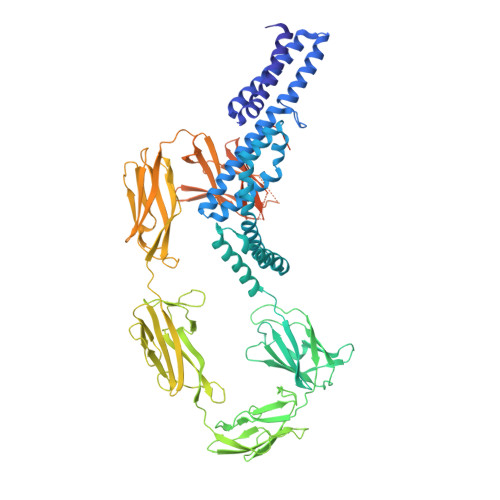
S-layers are (glyco)protein coats displayed on the external surface of many bacterial and archaeal species. By combining X-ray crystallography, electron cryo-tomography and SymProFold predictions, we propose the structure of the self-assembled S-layer protein (SLP) SbsC from the Gram-positive bacterium Geobacillus stearothermophilus ATCC 12980. SbsC consists of nine domains arranged like beads on a string. Domains 2 through 7 form a closed ring-like conformation, while the secondary cell wall polymer binding domain 1 and the auxiliary domains 8 and 9 protrude from the ring. Within the assembled lattice, the molecules adopt p1 symmetry and conform to the curvature of the bacterial surface, creating a sub-S-layer space, an enclosed space between the peptidoglycan layer and SLP lattice that may accommodate additional surface-associated proteins. Four Ca 2+ ions stabilize loop regions essential for intermolecular interactions and lattice integrity, while their removal reduces overall stability it does not abolish assembly. Comparative analysis with related SLPs, including SbsB from G. stearothermophilus and Sap/EA1 from Bacillus anthracis, supports a conserved ring-like domain arrangement across Bacillus-type S-layers. Given the involvement of S-layers in host interactions, immune evasion, and pathogenicity, particularly in Bacillusanthracis and Bacillus cereus group species, the identified intermolecular interfaces represent attractive targets for the development of novel antibacterial strategies.
- Institute of Molecular Biosciences, NAWI Graz, University of Graz, Graz, Austria. Electronic address: christoph.grininger@uni-graz.at.
Organizational Affiliation: