4TYO | pdb_00004tyo

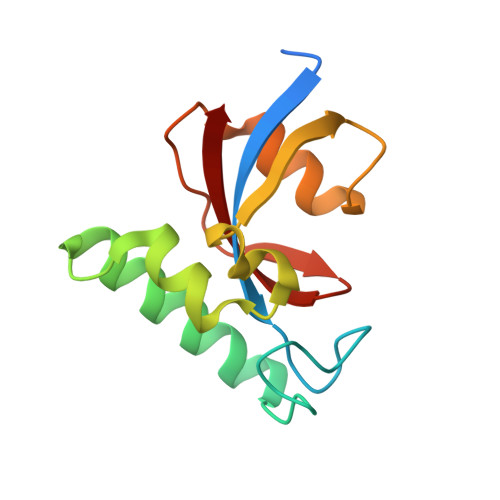
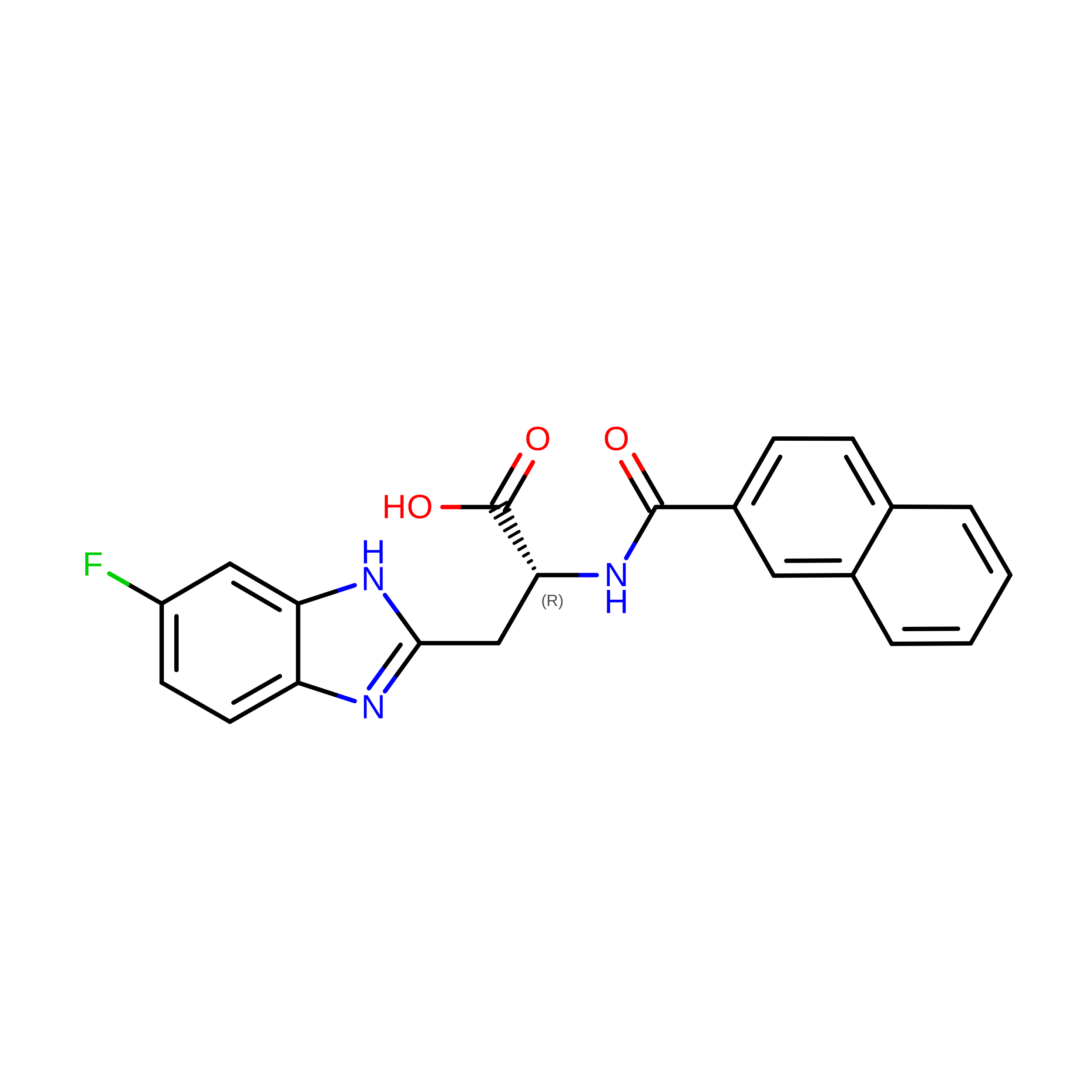
PPIase in complex with a non-phosphate small molecule inhibitor.


Experimental Data Snapshot

  • Method: X-RAY DIFFRACTION
  • Resolution: 1.75 Å
  • R-Value Free: 
    0.211 (Depositor), 0.209 (DCC) 
  • R-Value Work: 
    0.187 (Depositor), 0.178 (DCC) 
  • R-Value Observed: 
    0.188 (Depositor) 

wwPDB Validation 3D Report Full Report

Validation slider image for 4TYO

Ligand Structure Quality Assessment 


This is version 1.3 of the entry. See complete history. 

Literature

Structure-based design of novel human Pin1 inhibitors (III): Optimizing affinity beyond the phosphate recognition pocket.

Guo, C., Hou, X., Dong, L., Marakovits, J., Greasley, S., Dagostino, E., Ferre, R., Catherine Johnson, M., Humphries, P.S., Li, H., Paderes, G.D., Piraino, J., Kraynov, E., Murray, B.W.

(2014) Bioorg Med Chem Lett 24: 4187-4191

  • DOI: https://doi.org/10.1016/j.bmcl.2014.07.044
  • Primary Citation Related Structures: 
    4TYO

  • PubMed Abstract: 

    The design of potent Pin1 inhibitors has been challenging because its active site specifically recognizes a phospho-protein epitope. The de novo design of phosphate-based Pin1 inhibitors focusing on the phosphate recognition pocket and the successful replacement of the phosphate group with a carboxylate have been previously reported. The potency of the carboxylate series is now further improved through structure-based optimization of ligand-protein interactions in the proline binding site which exploits the H-bond interactions necessary for Pin1 catalytic function. Further optimization using a focused library approach led to the discovery of low nanomolar non-phosphate small molecular Pin1 inhibitors. Structural modifications designed to improve cell permeability resulted in Pin1 inhibitors with low micromolar anti-proliferative activities against cancer cells.


  • Organizational Affiliation: 
    • Oncology Medicinal Chemistry, Pfizer Worldwide Research & Development, San Diego, CA 92121, USA. Electronic address: alexguo01@gmail.com.

Macromolecule Content 

  • Total Structure Weight: 28.26 kDa 
  • Atom Count: 2,029 
  • Modeled Residue Count: 228 
  • Deposited Residue Count: 246 
  • Unique protein chains: 1

Macromolecules

Find similar proteins by:|  3D Structure
Entity ID: 1
MoleculeChains  Sequence LengthOrganismDetailsImage
Peptidyl-prolyl cis-trans isomerase NIMA-interacting 1
A, B
123Homo sapiensMutation(s): 2 
Gene Names: PIN1
EC: 5.2.1.8
UniProt & NIH Common Fund Data Resources
Find proteins for Q13526 (Homo sapiens)
Explore Q13526 
Go to UniProtKB:  Q13526
PHAROS:  Q13526
GTEx:  ENSG00000127445 
Entity Groups
Sequence Clusters30% Identity50% Identity70% Identity90% Identity95% Identity100% Identity
UniProt GroupQ13526
Sequence Annotations
Expand
Reference Sequence

Experimental Data & Validation

Experimental Data

  • Method: X-RAY DIFFRACTION
  • Resolution: 1.75 Å
  • R-Value Free:  0.211 (Depositor), 0.209 (DCC) 
  • R-Value Work:  0.187 (Depositor), 0.178 (DCC) 
  • R-Value Observed: 0.188 (Depositor) 
Space Group: C 1 2 1
Unit Cell:
Length ( Å )Angle ( ˚ )
a = 117.559α = 90
b = 36.525β = 100.82
c = 51.251γ = 90
Software Package:
Software NamePurpose
SCALEPACKdata scaling
BUSTER-TNTrefinement
PDB_EXTRACTdata extraction
BUSTERrefinement

Structure Validation

View Full Validation Report


Ligand Structure Quality Assessment 


Entry History 

Deposition Data

Revision History  (Full details and data files)

  • Version 1.0: 2014-08-20
    Type: Initial release
  • Version 1.1: 2014-10-01
    Changes: Database references
  • Version 1.2: 2017-11-22
    Changes: Database references, Derived calculations, Other, Refinement description, Source and taxonomy
  • Version 1.3: 2023-12-27
    Changes: Data collection, Database references, Refinement description