4TW8 | pdb_00004tw8

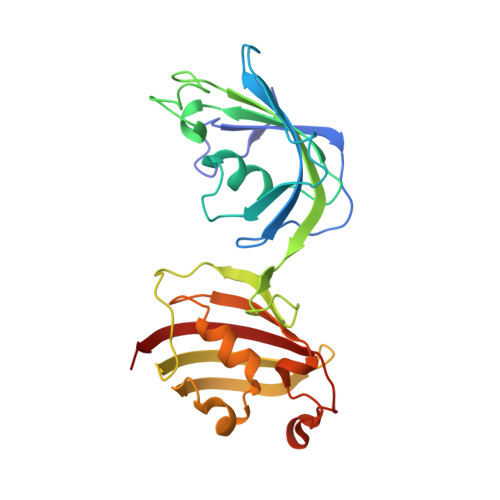
The Fk1-Fk2 domains of FKBP52 in complex with iFit-FL


Experimental Data Snapshot

  • Method: X-RAY DIFFRACTION
  • Resolution: 3.00 Å
  • R-Value Free: 
    0.257 (Depositor), 0.257 (DCC) 
  • R-Value Work: 
    0.210 (Depositor), 0.210 (DCC) 
  • R-Value Observed: 
    0.212 (Depositor) 

Starting Model: experimental
View more details

wwPDB Validation 3D Report Full Report

Validation slider image for 4TW8

Ligand Structure Quality Assessment 


This is version 1.3 of the entry. See complete history

Literature

Selective inhibitors of the FK506-binding protein 51 by induced fit.

Gaali, S.Kirschner, A.Cuboni, S.Hartmann, J.Kozany, C.Balsevich, G.Namendorf, C.Fernandez-Vizarra, P.Sippel, C.Zannas, A.S.Draenert, R.Binder, E.B.Almeida, O.F.Ruhter, G.Uhr, M.Schmidt, M.V.Touma, C.Bracher, A.Hausch, F.

(2015) Nat Chem Biol 11: 33-37

  • DOI: https://doi.org/10.1038/nchembio.1699
  • Primary Citation Related Structures: 
    4TW6, 4TW7, 4TW8

  • PubMed Abstract: 

    The FK506-binding protein 51 (FKBP51, encoded by the FKBP5 gene) is an established risk factor for stress-related psychiatric disorders such as major depression. Drug discovery for FKBP51 has been hampered by the inability to pharmacologically differentiate against the structurally similar but functional opposing homolog FKBP52, and all known FKBP ligands are unselective. Here, we report the discovery of the potent and highly selective inhibitors of FKBP51, SAFit1 and SAFit2. This new class of ligands achieves selectivity for FKBP51 by an induced-fit mechanism that is much less favorable for FKBP52. By using these ligands, we demonstrate that selective inhibition of FKBP51 enhances neurite elongation in neuronal cultures and improves neuroendocrine feedback and stress-coping behavior in mice. Our findings provide the structural and functional basis for the development of mechanistically new antidepressants.


  • Organizational Affiliation
    • Department of Translational Research in Psychiatry, Max Planck Institute of Psychiatry, Munich, Germany.

Macromolecule Content 

  • Total Structure Weight: 55.12 kDa 
  • Atom Count: 3,841 
  • Modeled Residue Count: 470 
  • Deposited Residue Count: 470 
  • Unique protein chains: 1

Macromolecules

Find similar proteins by:|  3D Structure
Entity ID: 1
MoleculeChains  Sequence LengthOrganismDetailsImage
Peptidyl-prolyl cis-trans isomerase FKBP4
A, B
235Homo sapiensMutation(s): 0 
Gene Names: FKBP4FKBP52
EC: 5.2.1.8
UniProt & NIH Common Fund Data Resources
Find proteins for Q02790 (Homo sapiens)
Explore Q02790 
Go to UniProtKB:  Q02790
PHAROS:  Q02790
GTEx:  ENSG00000004478 
Entity Groups
Sequence Clusters30% Identity50% Identity70% Identity90% Identity95% Identity100% Identity
UniProt GroupQ02790
Sequence Annotations
Expand
Reference Sequence

Small Molecules

Ligands 1 Unique
IDChains Name / Formula / InChI Key2D Diagram3D Interactions
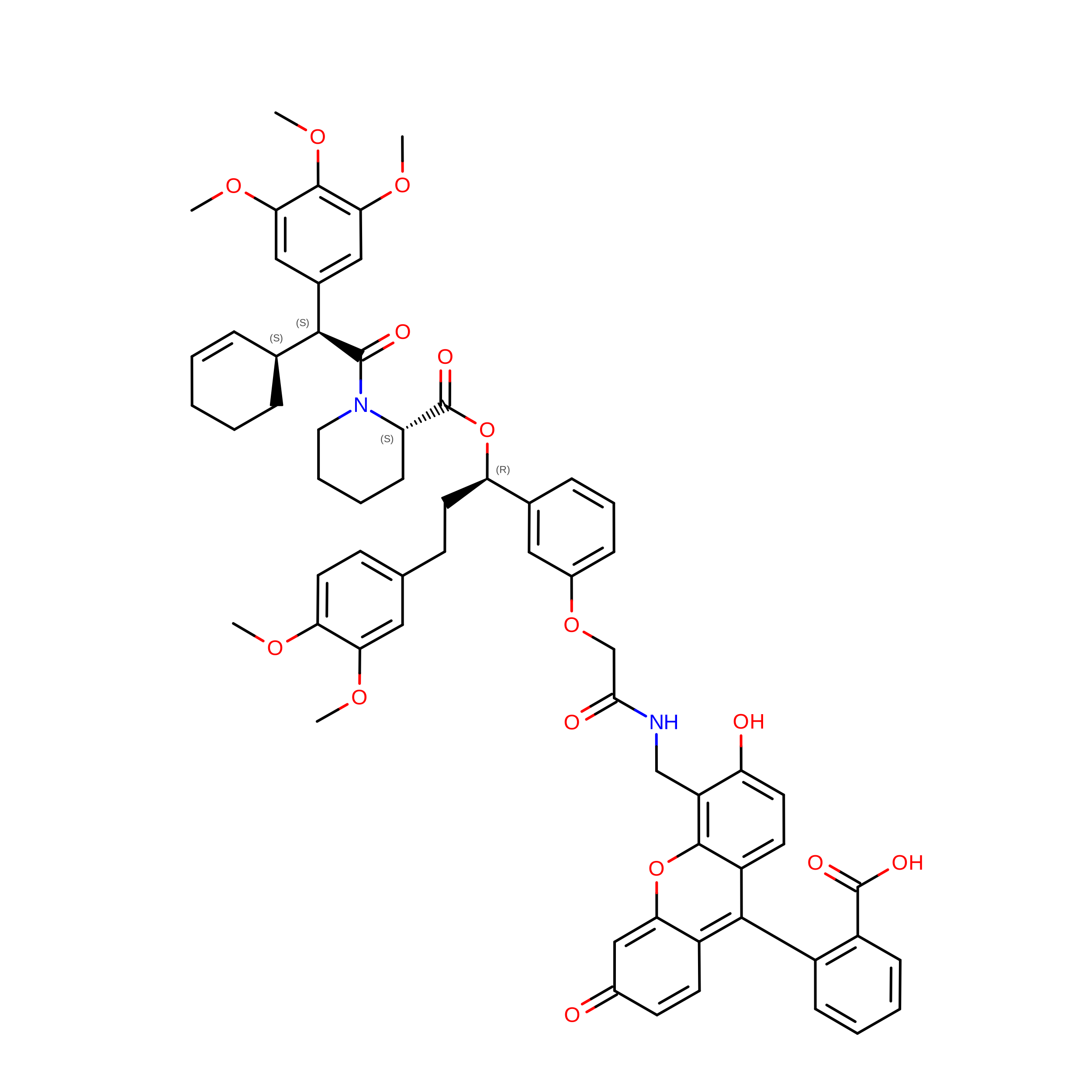
37M

Query on 37M


Download:Ideal Coordinates CCD File
C [auth A],
D [auth B]
2-(5-{[({3-[(1R)-1-[({(2S)-1-[(2S)-2-[(1S)-cyclohex-2-en-1-yl]-2-(3,4,5-trimethoxyphenyl)acetyl]piperidin-2-yl}carbonyl)oxy]-3-(3,4-dimethoxyphenyl)propyl]phenoxy}acetyl)amino]methyl}-6-hydroxy-3-oxo-3H-xanthen-9-yl)benzoic acid
C63 H64 N2 O15
VYEGSGNDADHBPR-OQAOPSLVSA-N

Experimental Data & Validation

Experimental Data

  • Method: X-RAY DIFFRACTION
  • Resolution: 3.00 Å
  • R-Value Free:  0.257 (Depositor), 0.257 (DCC) 
  • R-Value Work:  0.210 (Depositor), 0.210 (DCC) 
  • R-Value Observed: 0.212 (Depositor) 
Space Group: P 21 21 21
Unit Cell:
Length ( Å )Angle ( ˚ )
a = 45.654α = 90
b = 46.351β = 90
c = 310.064γ = 90
Software Package:
Software NamePurpose
SCALAdata scaling
MOLREPphasing
PDB_EXTRACTdata extraction
REFMACrefinement
XDSdata reduction
XSCALEdata reduction

Structure Validation

View Full Validation Report


Ligand Structure Quality Assessment 


Entry History 

Revision History  (Full details and data files)

  • Version 1.0: 2014-11-26
    Type: Initial release
  • Version 1.1: 2014-12-10
    Changes: Database references
  • Version 1.2: 2014-12-24
    Changes: Database references
  • Version 1.3: 2023-12-20
    Changes: Data collection, Database references, Refinement description