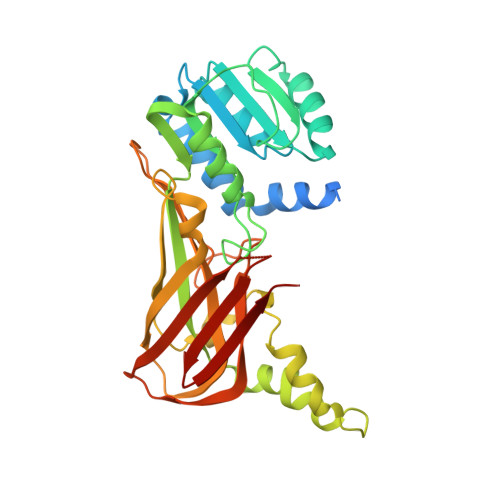
4RYL | pdb_00004ryl

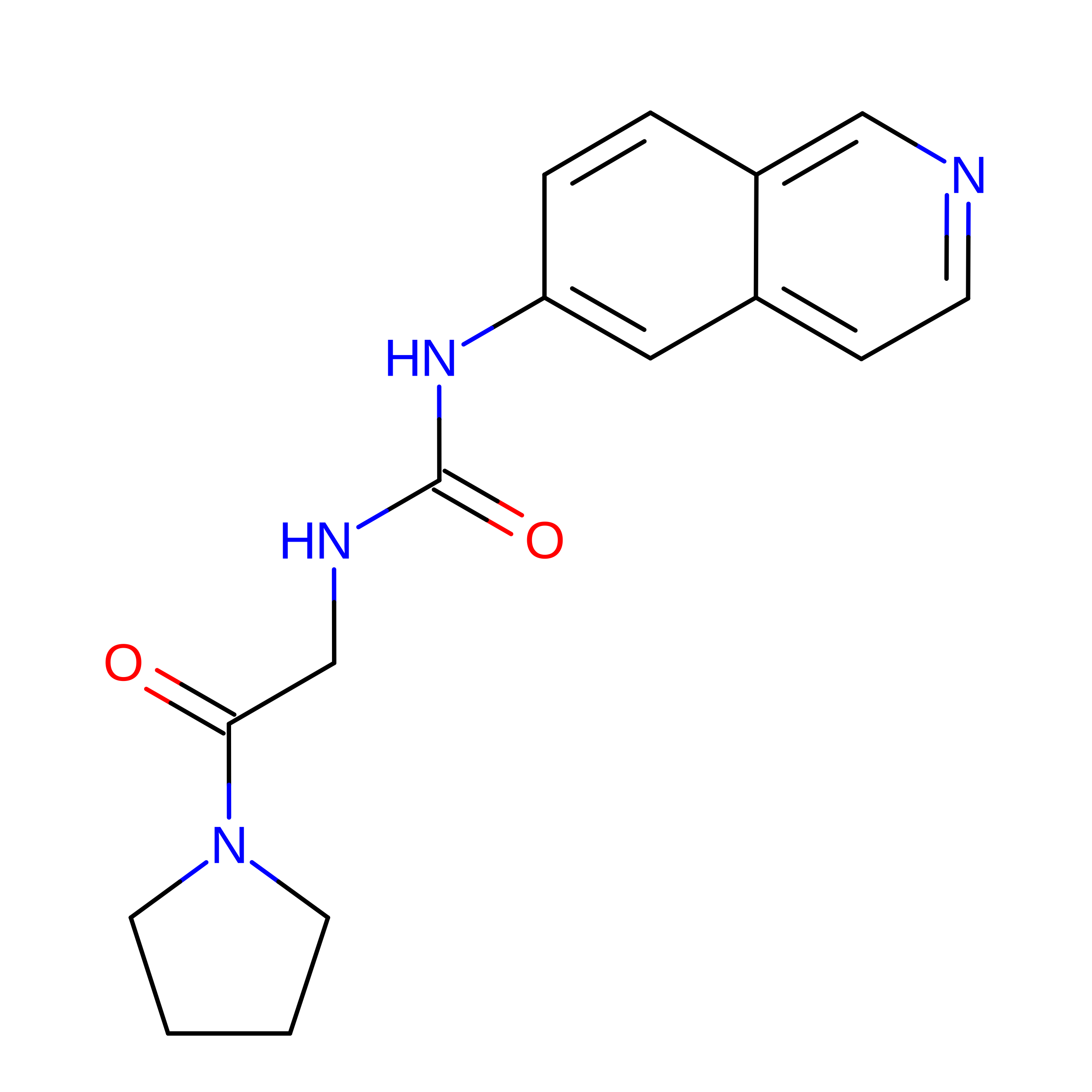
Human Protein Arginine Methyltransferase 3 in complex with 1-isoquinolin-6-yl-3-[2-oxo-2-(pyrrolidin-1-yl)ethyl]urea


Experimental Data Snapshot

  • Method: X-RAY DIFFRACTION
  • Resolution: 2.10 Å
  • R-Value Free: 
    0.232 (Depositor), 0.250 (DCC) 
  • R-Value Work: 
    0.186 (Depositor), 0.200 (DCC) 

Starting Model: experimental
View more details

wwPDB Validation   3D Report Full Report


Ligand Structure Quality Assessment 


This is version 1.4 of the entry. See complete history


Literature

A Potent, Selective and Cell-Active Allosteric Inhibitor of Protein Arginine Methyltransferase 3 (PRMT3).

Kaniskan, H.U.Szewczyk, M.M.Yu, Z.Eram, M.S.Yang, X.Schmidt, K.Luo, X.Dai, M.He, F.Zang, I.Lin, Y.Kennedy, S.Li, F.Dobrovetsky, E.Dong, A.Smil, D.Min, S.J.Landon, M.Lin-Jones, J.Huang, X.P.Roth, B.L.Schapira, M.Atadja, P.Barsyte-Lovejoy, D.Arrowsmith, C.H.Brown, P.J.Zhao, K.Jin, J.Vedadi, M.

(2015) Angew Chem Int Ed Engl 54: 5166-5170

  • DOI: https://doi.org/10.1002/anie.201412154
  • Primary Citation of Related Structures:  
    4RYL

  • PubMed Abstract: 

    PRMT3 catalyzes the asymmetric dimethylation of arginine residues of various proteins. It is essential for maturation of ribosomes, may have a role in lipogenesis, and is implicated in several diseases. A potent, selective, and cell-active PRMT3 inhibitor would be a valuable tool for further investigating PRMT3 biology. Here we report the discovery of the first PRMT3 chemical probe, SGC707, by structure-based optimization of the allosteric PRMT3 inhibitors we reported previously, and thorough characterization of this probe in biochemical, biophysical, and cellular assays. SGC707 is a potent PRMT3 inhibitor (IC50 =31±2 nM, KD =53±2 nM) with outstanding selectivity (selective against 31 other methyltransferases and more than 250 non-epigenetic targets). The mechanism of action studies and crystal structure of the PRMT3-SGC707 complex confirm the allosteric inhibition mode. Importantly, SGC707 engages PRMT3 and potently inhibits its methyltransferase activity in cells. It is also bioavailable and suitable for animal studies. This well-characterized chemical probe is an excellent tool to further study the role of PRMT3 in health and disease.


  • Organizational Affiliation
    • Departments of Structural and Chemical Biology, Oncological Sciences, and Pharmacology and System Therapeutics, Icahn School of Medicine at Mount Sinai, New York, NY 10029 (USA).

Macromolecules
Find similar proteins by:  (by identity cutoff)  |  3D Structure
Entity ID: 1
MoleculeChains Sequence LengthOrganismDetailsImage
PRMT3 protein340Homo sapiensMutation(s): 0 
Gene Names: PRMT3
EC: 2.1.1.319
UniProt & NIH Common Fund Data Resources
Find proteins for O60678 (Homo sapiens)
Explore O60678 
Go to UniProtKB:  O60678
PHAROS:  O60678
GTEx:  ENSG00000185238 
Entity Groups  
Sequence Clusters30% Identity50% Identity70% Identity90% Identity95% Identity100% Identity
UniProt GroupO60678
Sequence Annotations
Expand
  • Reference Sequence
Small Molecules
Binding Affinity Annotations 
IDSourceBinding Affinity
3ZG BindingDB:  4RYL IC50: min: 19, max: 225 (nM) from 3 assay(s)
EC50: min: 1800, max: 2000 (nM) from 2 assay(s)
Experimental Data & Validation

Experimental Data

  • Method: X-RAY DIFFRACTION
  • Resolution: 2.10 Å
  • R-Value Free:  0.232 (Depositor), 0.250 (DCC) 
  • R-Value Work:  0.186 (Depositor), 0.200 (DCC) 
Space Group: P 43 21 2
Unit Cell:
Length ( Å )Angle ( ˚ )
a = 70.691α = 90
b = 70.691β = 90
c = 173.559γ = 90
Software Package:
Software NamePurpose
SCALEPACKdata scaling
REFMACrefinement
PDB_EXTRACTdata extraction
JDirectordata collection
HKL-3000data reduction
HKL-3000data scaling
PHASERphasing
Cootmodel building

Structure Validation

View Full Validation Report


Ligand Structure Quality Assessment 


Entry History 

Revision History  (Full details and data files)

  • Version 1.0: 2015-02-25
    Type: Initial release
  • Version 1.1: 2015-03-18
    Changes: Database references, Structure summary
  • Version 1.2: 2015-05-06
    Changes: Database references
  • Version 1.3: 2017-11-22
    Changes: Refinement description
  • Version 1.4: 2023-09-20
    Changes: Data collection, Database references, Derived calculations, Refinement description