4RVT | pdb_00004rvt

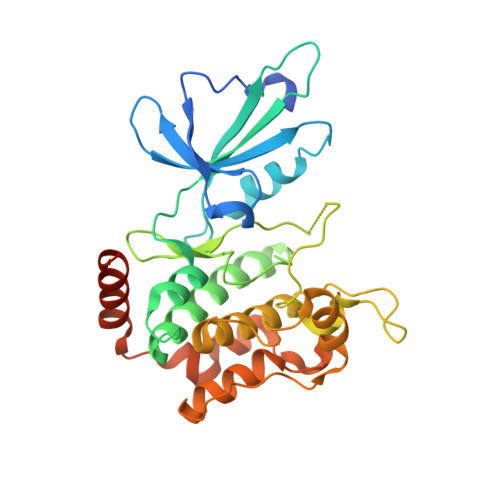
MAP4K4 in complex with a pyridin-2(1H)-one derivative


Experimental Data Snapshot

  • Method: X-RAY DIFFRACTION
  • Resolution: 2.40 Å
  • R-Value Free: 
    0.278 (Depositor), 0.281 (DCC) 
  • R-Value Work: 
    0.209 (Depositor), 0.213 (DCC) 
  • R-Value Observed: 
    0.212 (Depositor) 

Starting Model: experimental
View more details

wwPDB Validation 3D Report Full Report

Validation slider image for 4RVT

Ligand Structure Quality Assessment 


This is version 1.2 of the entry. See complete history

Literature

Neuritogenic Militarinone-Inspired 4-Hydroxypyridones Target the Stress Pathway Kinase MAP4K4.

Schroder, P.Forster, T.Kleine, S.Becker, C.Richters, A.Ziegler, S.Rauh, D.Kumar, K.Waldmann, H.

(2015) Angew Chem Int Ed Engl 54: 12398-12403

  • DOI: https://doi.org/10.1002/anie.201501515
  • Primary Citation Related Structures: 
    4RVT

  • PubMed Abstract: 

    Progressive loss and impaired restoration of neuronal activity are hallmarks of neurological diseases, and new small molecules with neurotrophic activity are in high demand. The militarinone alkaloids and structurally simplified analogues with 4-hydroxy-2-pyridone core structure induce pronounced neurite outgrowth, but their protein target has not been identified. Reported herein is the synthesis of a militarinone-inspired 4-hydroxy-2-pyridone collection, its investigation for enhancement of neurite outgrowth, and the discovery of the stress pathway kinase MAP4K4 as a target of the discovered neuritogenic pyridones. The most potent 4-hydroxy-2-pyridone is a selective ATP-competitive inhibitor of MAP4K4 but not of the other stress pathway related kinases, as proven by biochemical analysis and by a crystal structure of the inhibitor in complex with MAP4K4. The findings support the notion that MAP4K4 may be a new target for the treatment of neurodegenerative diseases.


  • Organizational Affiliation
    • Max-Planck-Institut für Molekulare Physiologie, Abteilung Chemische Biologie, Otto-Hahn-Straße 11, 44227 Dortmund (Germany).

Macromolecule Content 

  • Total Structure Weight: 75.57 kDa 
  • Atom Count: 4,714 
  • Modeled Residue Count: 578 
  • Deposited Residue Count: 656 
  • Unique protein chains: 1

Macromolecules

Find similar proteins by:|  3D Structure
Entity ID: 1
MoleculeChains  Sequence LengthOrganismDetailsImage
Mitogen-activated protein kinase kinase kinase kinase 4
A, B
328Homo sapiensMutation(s): 0 
Gene Names: HGKKIAA0687MAP4K4NIK
EC: 2.7.11.1
UniProt & NIH Common Fund Data Resources
Find proteins for O95819 (Homo sapiens)
Explore O95819 
Go to UniProtKB:  O95819
PHAROS:  O95819
GTEx:  ENSG00000071054 
Entity Groups
Sequence Clusters30% Identity50% Identity70% Identity90% Identity95% Identity100% Identity
UniProt GroupO95819
Sequence Annotations
Expand
Reference Sequence

Small Molecules

Ligands 2 Unique
IDChains Name / Formula / InChI Key2D Diagram3D Interactions
3XM

Query on 3XM


Download:Ideal Coordinates CCD File
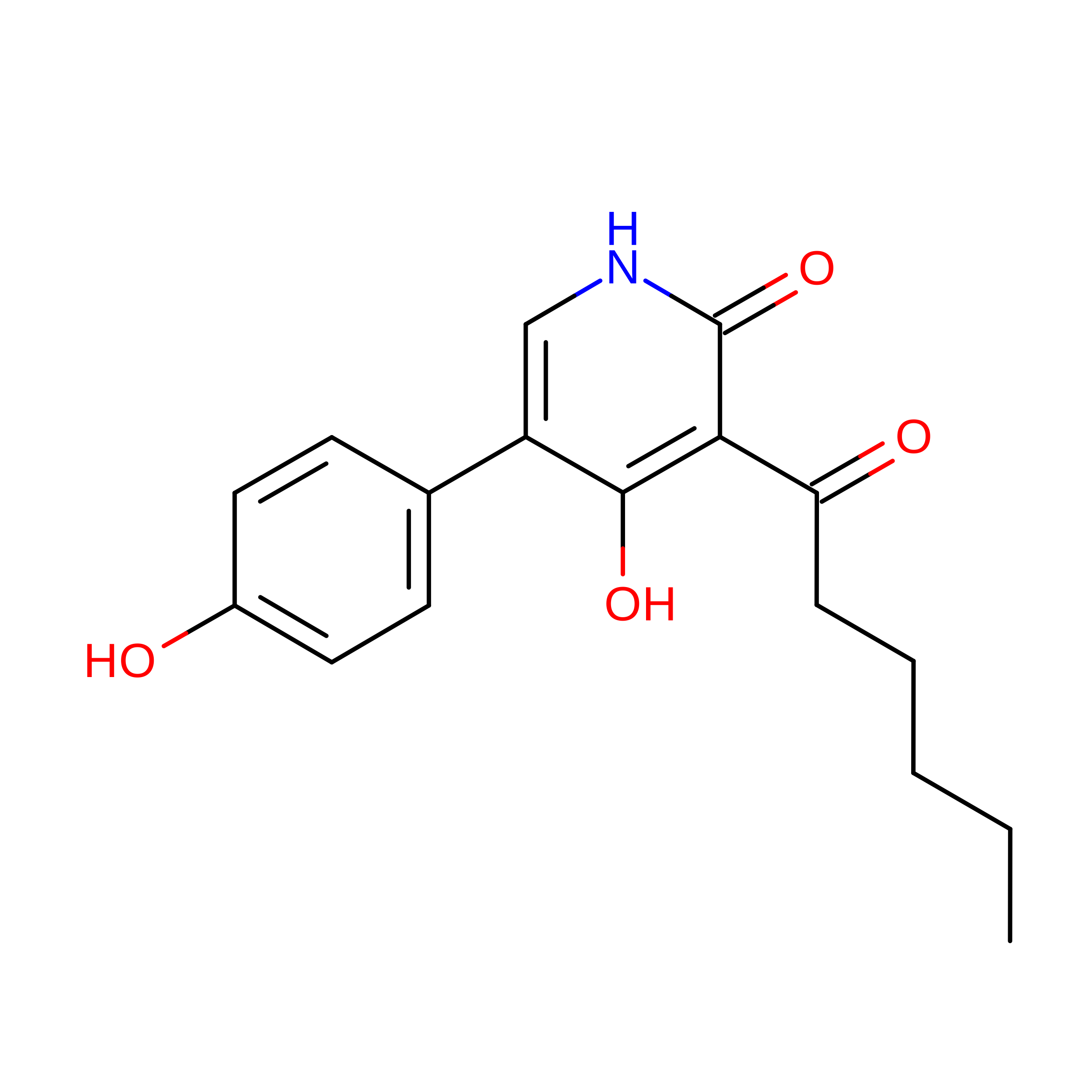
C [auth A]3-hexanoyl-4-hydroxy-5-(4-hydroxyphenyl)pyridin-2(1H)-one
C17 H19 N O4
NUFZHWWYFUWCIM-UHFFFAOYSA-N
MES

Query on MES


Download:Ideal Coordinates CCD File
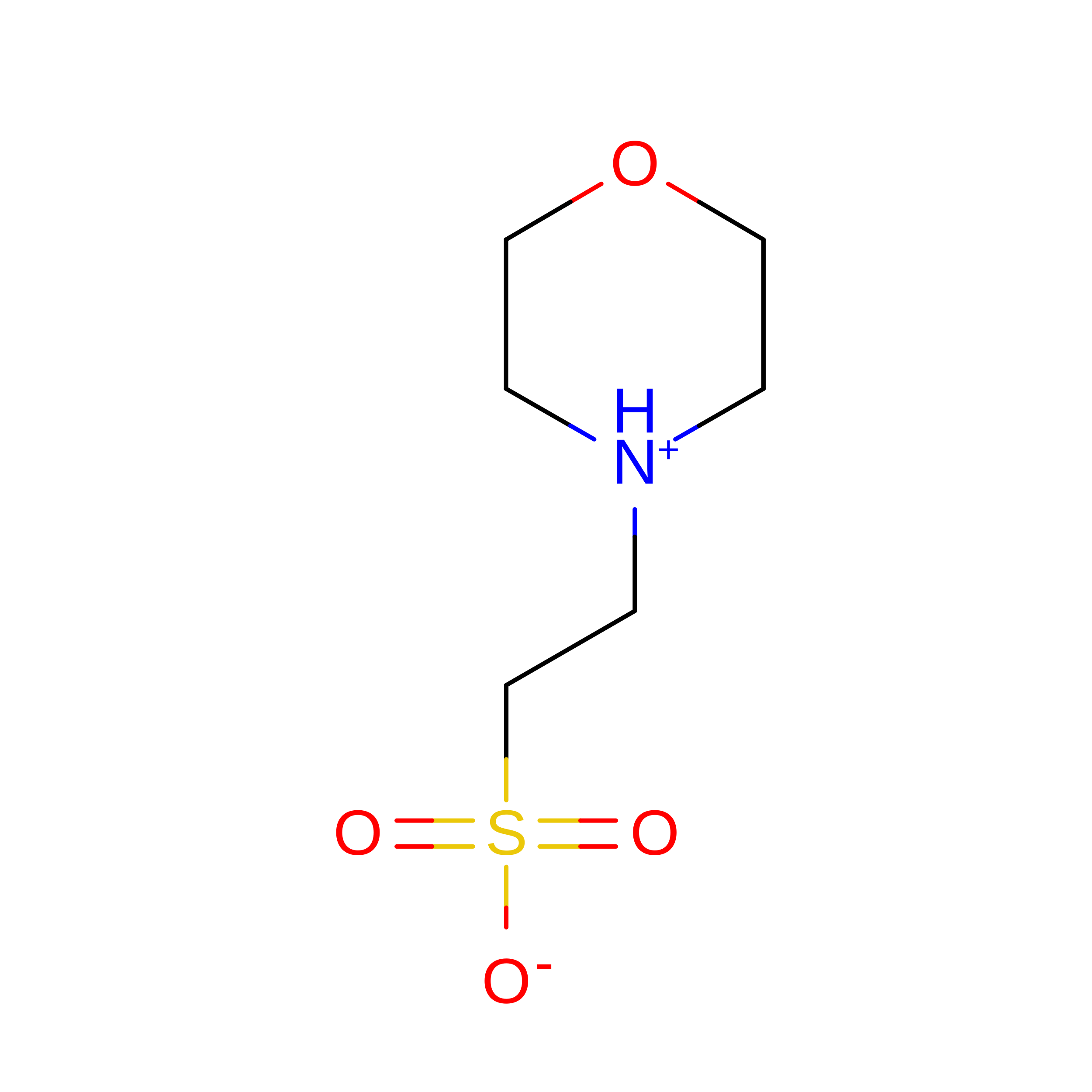
D [auth A]2-(N-MORPHOLINO)-ETHANESULFONIC ACID
C6 H13 N O4 S
SXGZJKUKBWWHRA-UHFFFAOYSA-N

Experimental Data & Validation

Experimental Data

  • Method: X-RAY DIFFRACTION
  • Resolution: 2.40 Å
  • R-Value Free:  0.278 (Depositor), 0.281 (DCC) 
  • R-Value Work:  0.209 (Depositor), 0.213 (DCC) 
  • R-Value Observed: 0.212 (Depositor) 
Space Group: P 21 21 21
Unit Cell:
Length ( Å )Angle ( ˚ )
a = 79.99α = 90
b = 90.25β = 90
c = 90.97γ = 90
Software Package:
Software NamePurpose
XSCALEdata scaling
PHASERphasing
REFMACrefinement
PDB_EXTRACTdata extraction
XDSdata scaling

Structure Validation

View Full Validation Report


Ligand Structure Quality Assessment 


Entry History 

Deposition Data

Revision History  (Full details and data files)

  • Version 1.0: 2015-05-27
    Type: Initial release
  • Version 1.1: 2015-10-21
    Changes: Database references, Other
  • Version 1.2: 2023-09-20
    Changes: Data collection, Database references, Derived calculations, Refinement description