4RUN | pdb_00004run

Crystal structure of human odorant binding protein OBPIIa


Experimental Data Snapshot

  • Method: X-RAY DIFFRACTION
  • Resolution: 2.60 Å
  • R-Value Free: 
    0.284 (Depositor), 0.288 (DCC) 
  • R-Value Work: 
    0.235 (Depositor), 0.236 (DCC) 
  • R-Value Observed: 
    0.237 (Depositor) 

Starting Model: experimental
View more details

wwPDB Validation 3D Report Full Report

Validation slider image for 4RUN

This is version 1.4 of the entry. See complete history

Literature

Crystal structure of the human odorant binding protein, OBPIIa.

Schiefner, A.Freier, R.Eichinger, A.Skerra, A.

(2015) Proteins 83: 1180-1184

  • DOI: https://doi.org/10.1002/prot.24797
  • Primary Citation Related Structures: 
    4RUN

  • PubMed Abstract: 

    Human odorant-binding protein, OBPIIa , is expressed by nasal epithelia to facilitate transport of hydrophobic odorant molecules across the aqueous mucus. Here, we report its crystallographic analysis at 2.6 Å resolution. OBPIIa is a monomeric protein that exhibits the classical lipocalin fold with a conserved eight-stranded β-barrel harboring a remarkably large hydrophobic pocket. Basic residues within the four loops that shape the entrance to this ligand-binding site evoke a positive electrostatic potential. Human OBPIIa shows distinct features compared with other mammalian OBPs, including a potentially reactive Cys side chain within its pocket similar to human tear lipocalin.


  • Organizational Affiliation
    • Munich Center for Integrated Protein Science (CIPS-M) and Lehrstuhl für Biologische Chemie, Technische Universität München, 85350 Freising-Weihenstephan, Germany.

Macromolecule Content 

  • Total Structure Weight: 37.5 kDa 
  • Atom Count: 2,433 
  • Modeled Residue Count: 299 
  • Deposited Residue Count: 322 
  • Unique protein chains: 1

Macromolecules

Find similar proteins by:|  3D Structure
Entity ID: 1
MoleculeChains  Sequence LengthOrganismDetailsImage
Odorant-binding protein 2a
A, B
161Homo sapiensMutation(s): 2 
Gene Names: OBP2A
UniProt & NIH Common Fund Data Resources
Find proteins for Q9NY56 (Homo sapiens)
Explore Q9NY56 
Go to UniProtKB:  Q9NY56
PHAROS:  Q9NY56
GTEx:  ENSG00000122136 
Entity Groups
Sequence Clusters30% Identity50% Identity70% Identity90% Identity95% Identity100% Identity
UniProt GroupQ9NY56
Sequence Annotations
Expand
Reference Sequence

Small Molecules

Ligands 1 Unique
IDChains Name / Formula / InChI Key2D Diagram3D Interactions
FLC

Query on FLC


Download:Ideal Coordinates CCD File
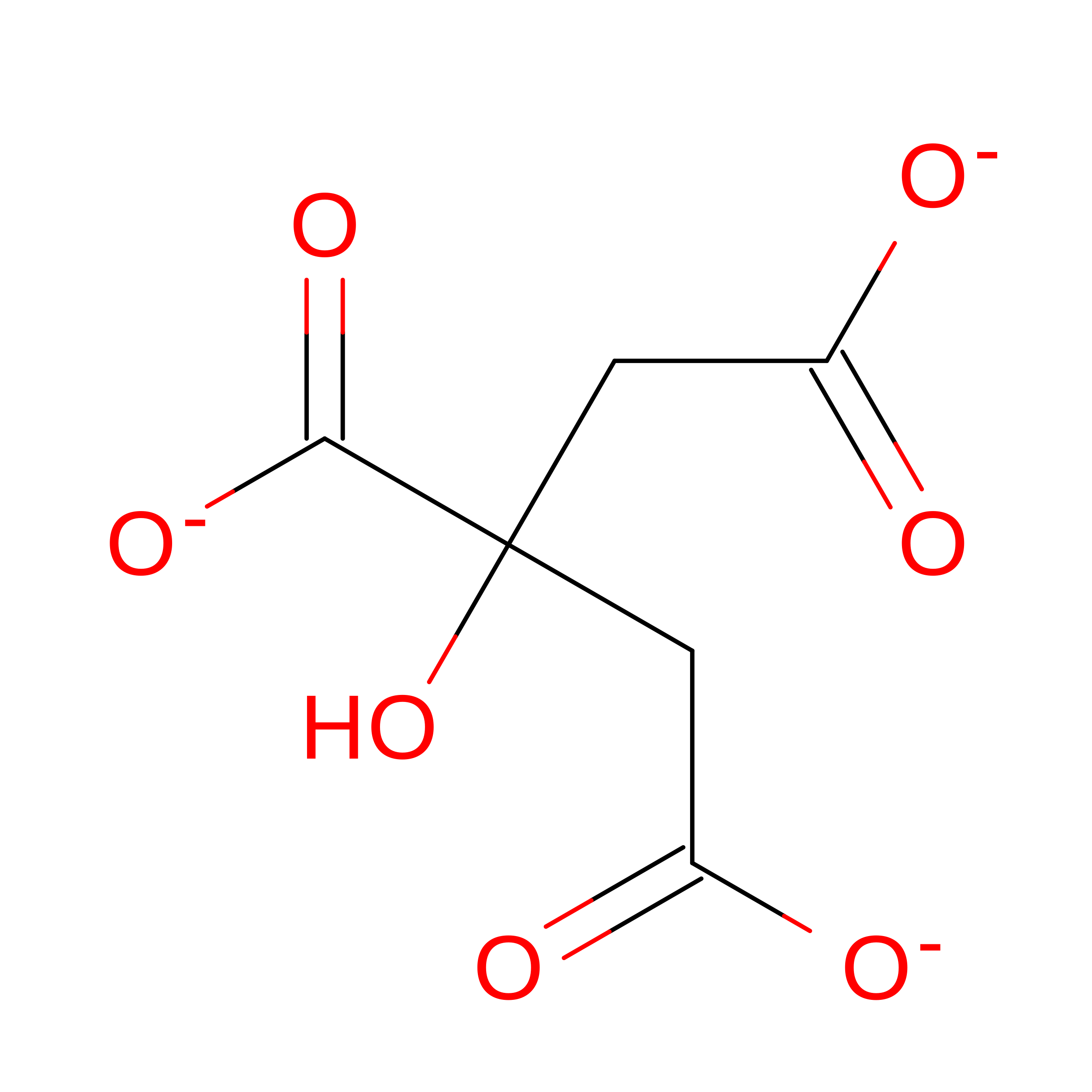
C [auth A]CITRATE ANION
C6 H5 O7
KRKNYBCHXYNGOX-UHFFFAOYSA-K

Experimental Data & Validation

Experimental Data

  • Method: X-RAY DIFFRACTION
  • Resolution: 2.60 Å
  • R-Value Free:  0.284 (Depositor), 0.288 (DCC) 
  • R-Value Work:  0.235 (Depositor), 0.236 (DCC) 
  • R-Value Observed: 0.237 (Depositor) 
Space Group: P 41 21 2
Unit Cell:
Length ( Å )Angle ( ˚ )
a = 52.949α = 90
b = 52.949β = 90
c = 232.098γ = 90
Software Package:
Software NamePurpose
XSCALEdata scaling
REFMACrefinement
PDB_EXTRACTdata extraction
MAR345data collection
XDSdata reduction
PHASERphasing

Structure Validation

View Full Validation Report


Entry History 

Deposition Data

Revision History  (Full details and data files)

  • Version 1.0: 2015-04-08
    Type: Initial release
  • Version 1.1: 2015-06-10
    Changes: Database references
  • Version 1.2: 2017-11-22
    Changes: Refinement description
  • Version 1.3: 2023-09-20
    Changes: Data collection, Database references, Derived calculations, Refinement description
  • Version 1.4: 2024-11-27
    Changes: Structure summary