4RPN | pdb_00004rpn

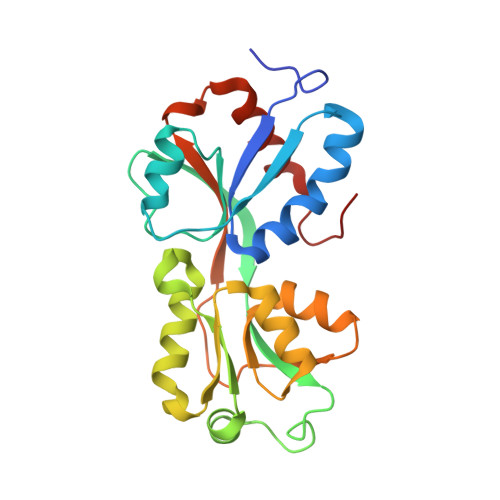
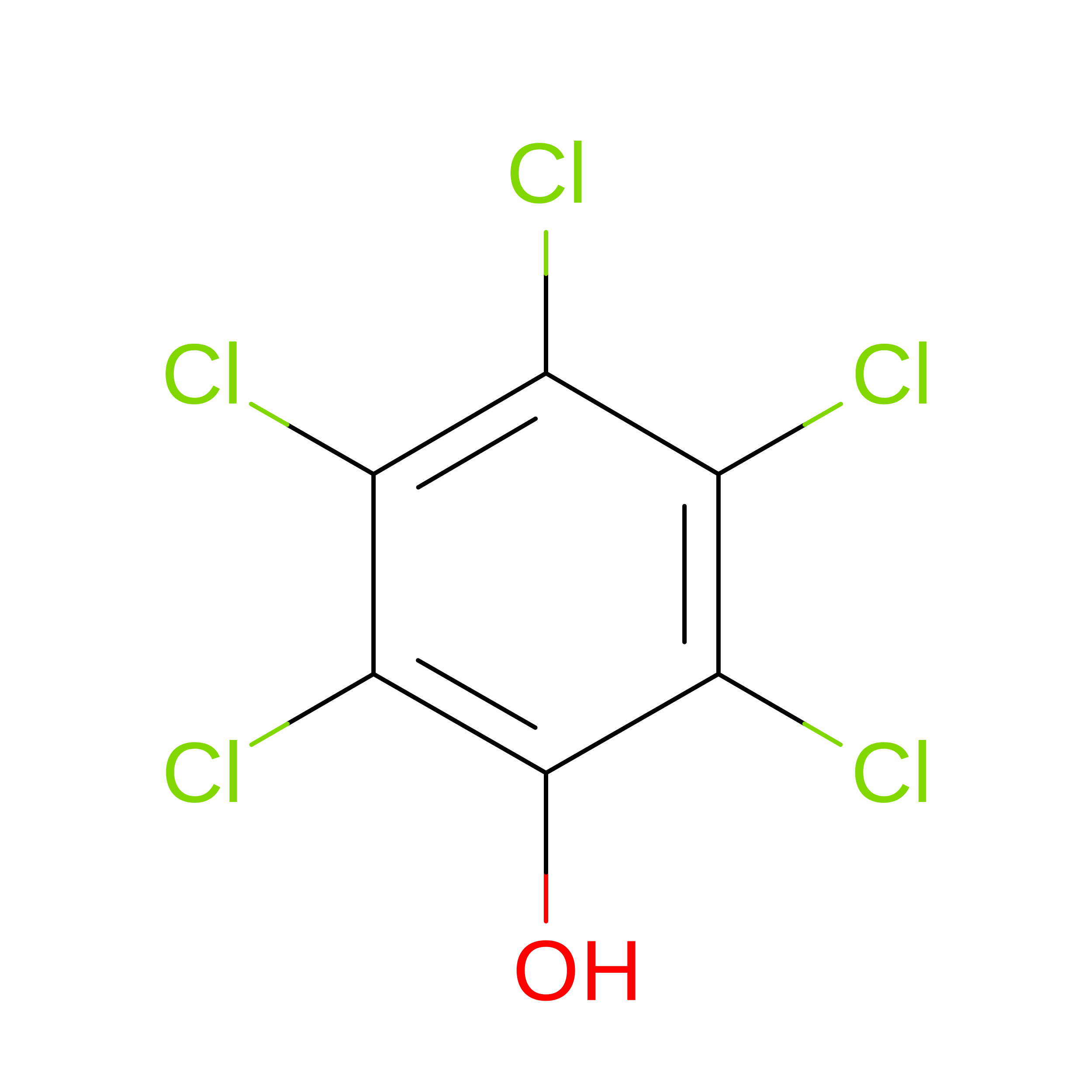
PcpR inducer binding domain complex with pentachlorophenol


Experimental Data Snapshot

  • Method: X-RAY DIFFRACTION
  • Resolution: 2.27 Å
  • R-Value Free: 
    0.215 (Depositor), 0.220 (DCC) 
  • R-Value Work: 
    0.177 (Depositor), 0.184 (DCC) 
  • R-Value Observed: 
    0.178 (Depositor) 

Starting Model: experimental
View more details

wwPDB Validation 3D Report Full Report

Validation slider image for 4RPN

Ligand Structure Quality Assessment 


This is version 1.1 of the entry. See complete history

Literature

Structures of the Inducer-Binding Domain of Pentachlorophenol-Degrading Gene Regulator PcpR from Sphingobium chlorophenolicum.

Hayes, R.P.Moural, T.W.Lewis, K.M.Onofrei, D.Xun, L.Kang, C.

(2014) Int J Mol Sci 15: 20736-20752

  • DOI: https://doi.org/10.3390/ijms151120736
  • Primary Citation Related Structures: 
    4RNS, 4RPN, 4RPO

  • PubMed Abstract: 

    PcpR is a LysR-type transcription factor from Sphingobium chlorophenolicum L-1 that is responsible for the activation of several genes involved in polychlorophenol degradation. PcpR responds to several polychlorophenols in vivo. Here, we report the crystal structures of the inducer-binding domain of PcpR in the apo-form and binary complexes with pentachlorophenol (PCP) and 2,4,6-trichlorophenol (2,4,6-TCP). Both X-ray crystal structures and isothermal titration calorimetry data indicated the association of two PCP molecules per PcpR, but only one 2,4,6-TCP molecule. The hydrophobic nature and hydrogen bonds of one binding cavity allowed the tight association of both PCP (Kd = 110 nM) and 2,4,6-TCP (Kd = 22.8 nM). However, the other cavity was unique to PCP with much weaker affinity (Kd = 70 μM) and thus its significance was not clear. Neither phenol nor benzoic acid displayed any significant affinity to PcpR, indicating a role of chlorine substitution in ligand specificity. When PcpR is compared with TcpR, a LysR-type regulator controlling the expression of 2,4,6-trichlorophenol degradation in Cupriavidus necator JMP134, most of the residues constituting the two inducer-binding cavities of PcpR are different, except for their general hydrophobic nature. The finding concurs that PcpR uses various polychlorophenols as long as it includes 2,4,6-trichlorophenol, as inducers; whereas TcpR is only responsive to 2,4,6-trichlorophenol.


  • Organizational Affiliation
    • Department of Chemistry, Washington State University, Pullman, WA 99164-4630, USA. robert_hayes@wsu.edu.

Macromolecule Content 

  • Total Structure Weight: 103.55 kDa 
  • Atom Count: 7,434 
  • Modeled Residue Count: 873 
  • Deposited Residue Count: 892 
  • Unique protein chains: 1

Macromolecules

Find similar proteins by:|  3D Structure
Entity ID: 1
MoleculeChains  Sequence LengthOrganismDetailsImage
PCP degradation transcriptional activation proteinA [auth D],
B [auth C],
C [auth A],
D [auth B]
223Sphingobium chlorophenolicumMutation(s): 0 
Gene Names: pcpR
UniProt
Find proteins for P52679 (Sphingobium chlorophenolicum)
Explore P52679 
Go to UniProtKB:  P52679
Entity Groups
Sequence Clusters30% Identity50% Identity70% Identity90% Identity95% Identity100% Identity
UniProt GroupP52679
Sequence Annotations
Expand
Reference Sequence

Experimental Data & Validation

Experimental Data

  • Method: X-RAY DIFFRACTION
  • Resolution: 2.27 Å
  • R-Value Free:  0.215 (Depositor), 0.220 (DCC) 
  • R-Value Work:  0.177 (Depositor), 0.184 (DCC) 
  • R-Value Observed: 0.178 (Depositor) 
Space Group: H 3
Unit Cell:
Length ( Å )Angle ( ˚ )
a = 169.048α = 90
b = 169.048β = 90
c = 110.264γ = 120
Software Package:
Software NamePurpose
BOSdata collection
PHASERphasing
PHENIXrefinement
HKL-2000data reduction
HKL-2000data scaling

Structure Validation

View Full Validation Report


Ligand Structure Quality Assessment 


Entry History 

Deposition Data

Revision History  (Full details and data files)

  • Version 1.0: 2014-11-26
    Type: Initial release
  • Version 1.1: 2023-09-20
    Changes: Data collection, Database references, Derived calculations, Refinement description