4R12 | pdb_00004r12

Crystal structure of the gamma-secretase component Nicastrin


Experimental Data Snapshot

  • Method: X-RAY DIFFRACTION
  • Resolution: 1.95 Å
  • R-Value Free: 
    0.205 (Depositor), 0.206 (DCC) 
  • R-Value Work: 
    0.179 (Depositor), 0.183 (DCC) 
  • R-Value Observed: 
    0.181 (Depositor) 

Starting Model: experimental
View more details

wwPDB Validation 3D Report Full Report

Validation slider image for 4R12

Ligand Structure Quality Assessment 


This is version 2.3 of the entry. See complete history

Literature

Crystal structure of the gamma-secretase component nicastrin.

Xie, T.Yan, C.Zhou, R.Zhao, Y.Sun, L.Yang, G.Lu, P.Ma, D.Shi, Y.

(2014) Proc Natl Acad Sci U S A 111: 13349-13354

  • DOI: https://doi.org/10.1073/pnas.1414837111
  • Primary Citation Related Structures: 
    4R12

  • PubMed Abstract: 

    γ-Secretase is an intramembrane protease responsible for the generation of amyloid-β (Aβ) peptides. Aberrant accumulation of Aβ leads to the formation of amyloid plaques in the brain of patients with Alzheimer's disease. Nicastrin is the putative substrate-recruiting component of the γ-secretase complex. No atomic-resolution structure had been identified on γ-secretase or any of its four components, hindering mechanistic understanding of γ-secretase function. Here we report the crystal structure of nicastrin from Dictyostelium purpureum at 1.95-Å resolution. The extracellular domain of nicastrin contains a large lobe and a small lobe. The large lobe of nicastrin, thought to be responsible for substrate recognition, associates with the small lobe through a hydrophobic pivot at the center. The putative substrate-binding pocket is shielded from the small lobe by a lid, which blocks substrate entry. These structural features suggest a working model of nicastrin function. Analysis of nicastrin structure provides insights into the assembly and architecture of the γ-secretase complex.


  • Organizational Affiliation
    • Ministry of Education Key Laboratory of Protein Science, Tsinghua-Peking Joint Center for Life Sciences, Center for Structural Biology, School of Life Sciences and School of Medicine, Tsinghua University, Beijing 100084, China.

Macromolecule Content 

  • Total Structure Weight: 68.44 kDa 
  • Atom Count: 5,068 
  • Modeled Residue Count: 573 
  • Deposited Residue Count: 593 
  • Unique protein chains: 1

Macromolecules

Find similar proteins by:|  3D Structure
Entity ID: 1
MoleculeChains  Sequence LengthOrganismDetailsImage
Putative uncharacterized protein593Dictyostelium purpureumMutation(s): 0 
Gene Names: DICPUDRAFT_96800
Membrane Entity: Yes 
UniProt
Find proteins for F0ZBA6 (Dictyostelium purpureum)
Explore F0ZBA6 
Go to UniProtKB:  F0ZBA6
Entity Groups
Sequence Clusters30% Identity50% Identity70% Identity90% Identity95% Identity100% Identity
UniProt GroupF0ZBA6
Glycosylation
Glycosylation Sites: 5
Sequence Annotations
Expand
Reference Sequence

Oligosaccharides

Help  
Entity ID: 2
MoleculeChains Length2D Diagram GlycosylationD Interactions
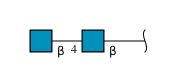
2-acetamido-2-deoxy-beta-D-glucopyranose-(1-4)-2-acetamido-2-deoxy-beta-D-glucopyranose
B
2N-Glycosylation
Glycosylation Resources
GlyTouCan: G42666HT
GlyCosmos: G42666HT
GlyGen: G42666HT
Entity ID: 3
MoleculeChains Length2D Diagram GlycosylationD Interactions
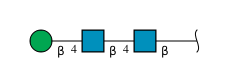
beta-D-mannopyranose-(1-4)-2-acetamido-2-deoxy-beta-D-glucopyranose-(1-4)-2-acetamido-2-deoxy-beta-D-glucopyranose
C
3N-Glycosylation
Glycosylation Resources
GlyTouCan: G15407YE
GlyCosmos: G15407YE
GlyGen: G15407YE

Experimental Data & Validation

Experimental Data

  • Method: X-RAY DIFFRACTION
  • Resolution: 1.95 Å
  • R-Value Free:  0.205 (Depositor), 0.206 (DCC) 
  • R-Value Work:  0.179 (Depositor), 0.183 (DCC) 
  • R-Value Observed: 0.181 (Depositor) 
Space Group: P 41 21 2
Unit Cell:
Length ( Å )Angle ( ˚ )
a = 65.584α = 90
b = 65.584β = 90
c = 344.475γ = 90
Software Package:
Software NamePurpose
ADSCdata collection
SOLVEphasing
PHENIXrefinement
HKL-2000data reduction
HKL-2000data scaling

Structure Validation

View Full Validation Report


Ligand Structure Quality Assessment 


Entry History 

Deposition Data

Revision History  (Full details and data files)

  • Version 1.0: 2014-09-17
    Type: Initial release
  • Version 2.0: 2020-07-29
    Type: Remediation
    Reason: Carbohydrate remediation
    Changes: Advisory, Atomic model, Data collection, Derived calculations, Structure summary
  • Version 2.1: 2022-08-24
    Changes: Database references, Structure summary
  • Version 2.2: 2023-11-08
    Changes: Data collection, Refinement description
  • Version 2.3: 2024-11-13
    Changes: Structure summary