4QR3 | pdb_00004qr3

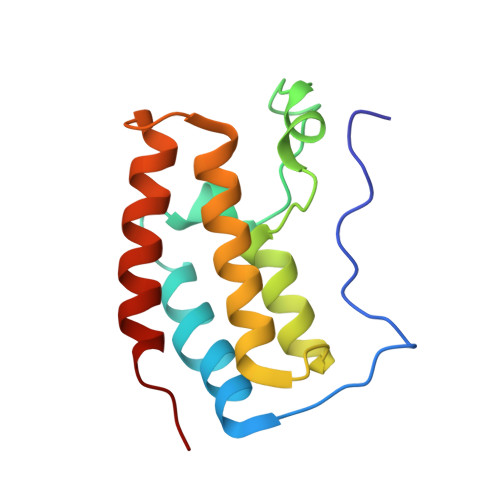
Brd4 Bromodomain 1 complex with its novel inhibitors


Experimental Data Snapshot

  • Method: X-RAY DIFFRACTION
  • Resolution: 1.37 Å
  • R-Value Free: 
    0.204 (Depositor), 0.202 (DCC) 
  • R-Value Work: 
    0.178 (Depositor), 0.179 (DCC) 
  • R-Value Observed: 
    0.179 (Depositor) 

wwPDB Validation 3D Report Full Report

Validation slider image for 4QR3

Ligand Structure Quality Assessment 


This is version 1.1 of the entry. See complete history. 

Literature

Fragment-based drug discovery of 2-thiazolidinones as BRD4 inhibitors: 2. Structure-based optimization

Zhao, L., Wang, Y., Cao, D.Y., Chen, T.T., Wang, Q., Li, Y., Xu, Y.C., Zhang, N., Wang, X., Chen, D., Chen, L., Chen, Y.L., Xia, G., Shi, Z., Liu, Y.C., Lin, Y., Miao, Z., Shen, J., Xiong, B.

(2015) J Med Chem 58: 1281-1297

  • DOI: https://doi.org/10.1021/jm501504k
  • Primary Citation Related Structures: 
    4QR3, 4QR4, 4QR5

  • PubMed Abstract: 

    The signal transduction of acetylated histone can be processed through a recognition module, bromodomain. Several inhibitors targeting BRD4, one of the bromodomain members, are in clinical trials as anticancer drugs. Hereby, we report our efforts on discovery and optimization of a new series of 2-thiazolidinones as BRD4 inhibitors along our previous study. In this work, guided by crystal structure analysis, we reversed the sulfonamide group and identified a new binding mode. A structure-activity relationship study on this new series led to several potent BRD4 inhibitors with IC50 of about 0.05-0.1 μM in FP binding assay and GI50 of 0.1-0.3 μM in cell based assays. To complete the lead-like assessment of this series, we further checked its effects on BRD4 downstream protein c-Myc, investigated its selectivity among five different bromodomain proteins, as well as the metabolic stability test, and reinforced the utility of 2-thiazolidinone scaffold as BET bromodomain inhibitors in novel anticancer drug development.


  • Organizational Affiliation: 
    • Department of Medicinal Chemistry, State Key Laboratory of Drug Research, Shanghai Institute of Materia Medica, ‡Division of Anti-Tumor Pharmacology, State Key Laboratory of Drug Research, Shanghai Institute of Materia Medica, and §Drug Discovery and Design Center, Shanghai Institute of Materia Medica, Chinese Academy of Sciences , 555 Zuchongzhi Road, Shanghai 201203, China.

Macromolecule Content 

  • Total Structure Weight: 15.17 kDa 
  • Atom Count: 1,218 
  • Modeled Residue Count: 125 
  • Deposited Residue Count: 125 
  • Unique protein chains: 1

Macromolecules

Find similar proteins by:|  3D Structure
Entity ID: 1
MoleculeChains  Sequence LengthOrganismDetailsImage
Bromodomain-containing protein 4125Homo sapiensMutation(s): 0 
Gene Names: BRD4, HUNK1
UniProt & NIH Common Fund Data Resources
Find proteins for O60885 (Homo sapiens)
Explore O60885 
Go to UniProtKB:  O60885
PHAROS:  O60885
GTEx:  ENSG00000141867 
Entity Groups
Sequence Clusters30% Identity50% Identity70% Identity90% Identity95% Identity100% Identity
UniProt GroupO60885
Sequence Annotations
Expand
Reference Sequence

Small Molecules

Ligands 1 Unique
IDChains Name / Formula / InChI Key2D Diagram3D Interactions
BNJ

Query on BNJ


Download:Ideal Coordinates CCD File
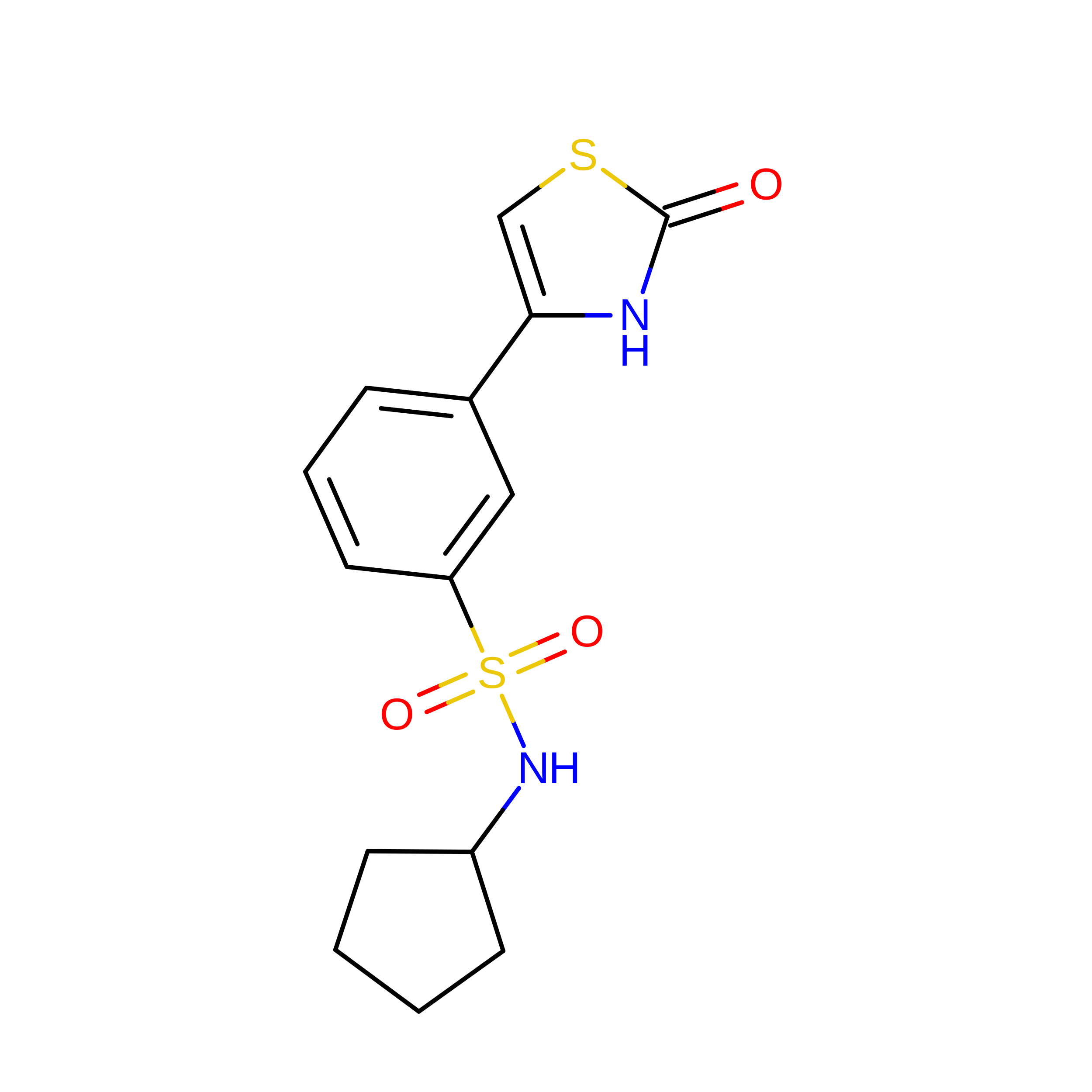
B [auth A]N-cyclopentyl-3-(2-oxo-2,3-dihydro-1,3-thiazol-4-yl)benzenesulfonamide
C14 H16 N2 O3 S2
YNSRHWKJAMIAPD-UHFFFAOYSA-N

Experimental Data & Validation

Experimental Data

  • Method: X-RAY DIFFRACTION
  • Resolution: 1.37 Å
  • R-Value Free:  0.204 (Depositor), 0.202 (DCC) 
  • R-Value Work:  0.178 (Depositor), 0.179 (DCC) 
  • R-Value Observed: 0.179 (Depositor) 
Space Group: P 21 21 21
Unit Cell:
Length ( Å )Angle ( ˚ )
a = 32.236α = 90
b = 47.326β = 90
c = 78.903γ = 90
Software Package:
Software NamePurpose
XSCALEdata scaling
PHASERphasing
PHENIXrefinement
PDB_EXTRACTdata extraction
Blu-Icedata collection

Structure Validation

View Full Validation Report


Ligand Structure Quality Assessment 


Entry History 

Deposition Data

Revision History  (Full details and data files)

  • Version 1.0: 2015-07-01
    Type: Initial release
  • Version 1.1: 2024-03-20
    Changes: Data collection, Database references, Derived calculations