4Q30 | pdb_00004q30

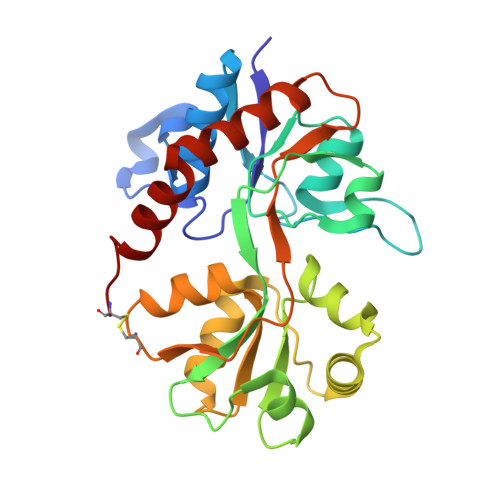
Nitrowillardiine bound to the ligand binding domain of GluA2 at pH 3.5


Experimental Data Snapshot

  • Method: X-RAY DIFFRACTION
  • Resolution: 2.03 Å
  • R-Value Free: 
    0.230 (Depositor), 0.228 (DCC) 
  • R-Value Work: 
    0.186 (Depositor), 0.185 (DCC) 
  • R-Value Observed: 
    0.187 (Depositor) 

Starting Model: experimental
View more details

wwPDB Validation 3D Report Full Report

Validation slider image for 4Q30

Ligand Structure Quality Assessment 


This is version 1.4 of the entry. See complete history

Literature

Thermodynamics and mechanism of the interaction of willardiine partial agonists with a glutamate receptor: implications for drug development.

Martinez, M.Ahmed, A.H.Loh, A.P.Oswald, R.E.

(2014) Biochemistry 53: 3790-3795

  • DOI: https://doi.org/10.1021/bi500511m
  • Primary Citation Related Structures: 
    4Q30

  • PubMed Abstract: 

    Understanding the thermodynamics of binding of a lead compound to a receptor can provide valuable information for drug design. The binding of compounds, particularly partial agonists, to subtypes of the α-amino-3-hydroxy-5-methyl-4-isoxazole-propionic acid (AMPA) receptor is, in some cases, driven by increases in entropy. Using a series of partial agonists based on the structure of the natural product, willardiine, we show that the charged state of the ligand determines the enthalpic contribution to binding. Willardiines have uracil rings with pKa values ranging from 5.5 to 10. The binding of the charged form is largely driven by enthalpy, while that of the uncharged form is largely driven by entropy. This is due at least in part to changes in the hydrogen bonding network within the binding site involving one water molecule. This work illustrates the importance of charge to the thermodynamics of binding of agonists and antagonists to AMPA receptors and provides clues for further drug discovery.


  • Organizational Affiliation
    • Department of Molecular Medicine, Cornell University , Ithaca, New York 14853, United States.

Macromolecule Content 

  • Total Structure Weight: 87.48 kDa 
  • Atom Count: 6,857 
  • Modeled Residue Count: 774 
  • Deposited Residue Count: 774 
  • Unique protein chains: 1

Macromolecules

Find similar proteins by:|  3D Structure
Entity ID: 1
MoleculeChains  Sequence LengthOrganismDetailsImage
Glutamate receptor 2 CHIMERIC PROTEINA [auth B],
B [auth D],
C [auth F]
258Rattus norvegicusMutation(s): 0 
Gene Names: Glur2Gria2
UniProt
Find proteins for P19491 (Rattus norvegicus)
Explore P19491 
Go to UniProtKB:  P19491
Entity Groups
Sequence Clusters30% Identity50% Identity70% Identity90% Identity95% Identity100% Identity
UniProt GroupP19491
Sequence Annotations
Expand
Reference Sequence

Small Molecules

Ligands 2 Unique
IDChains Name / Formula / InChI Key2D Diagram3D Interactions
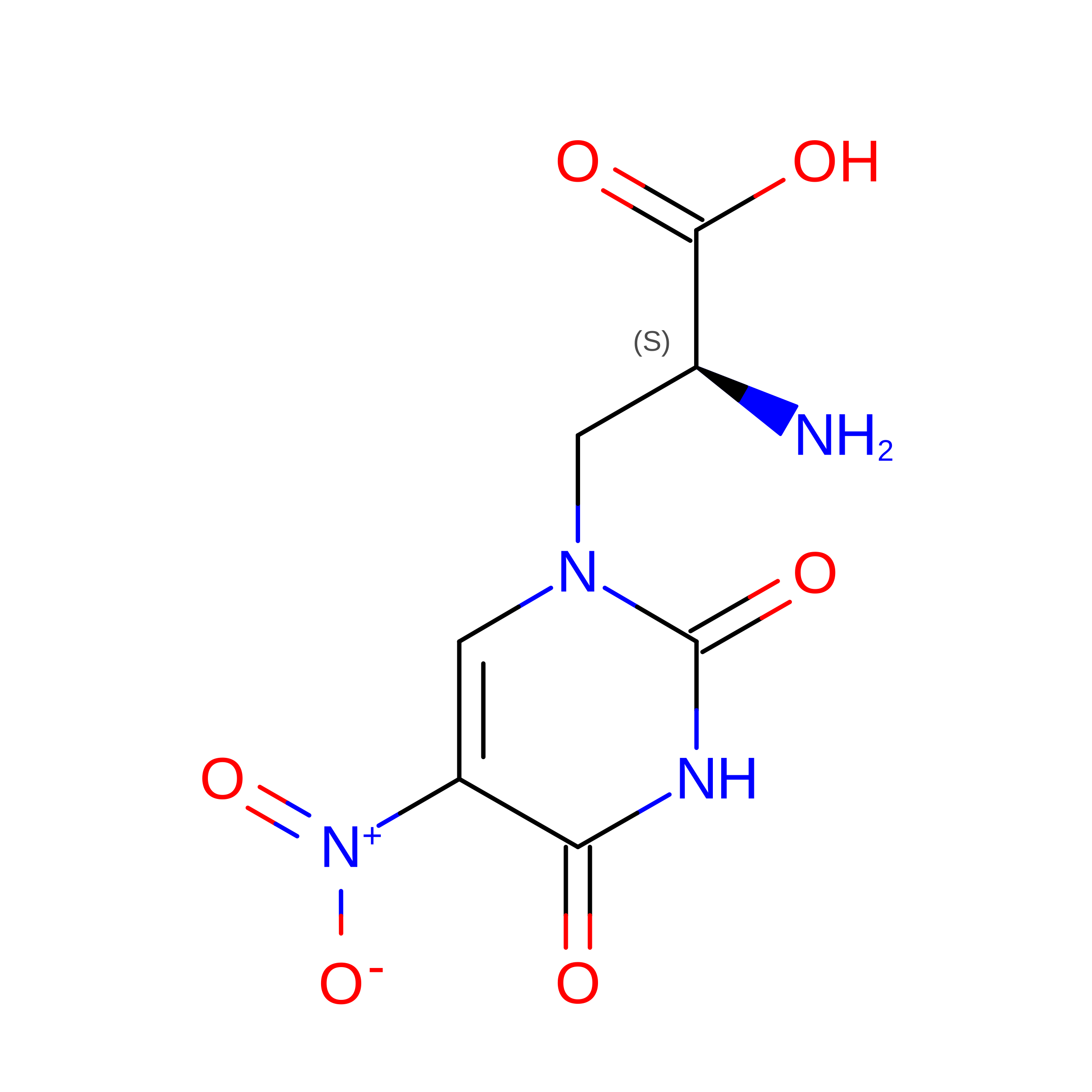
NWD

Query on NWD


Download:Ideal Coordinates CCD File
D [auth B],
G [auth D],
J [auth F]
3-(5-nitro-2,4-dioxo-3,4-dihydropyrimidin-1(2H)-yl)-L-alanine
C7 H8 N4 O6
IEBVITXSHAFLJR-VKHMYHEASA-N
ZN

Query on ZN


Download:Ideal Coordinates CCD File
E [auth B],
F [auth B],
H [auth D],
I [auth D],
K [auth F]
ZINC ION
Zn
PTFCDOFLOPIGGS-UHFFFAOYSA-N

Experimental Data & Validation

Experimental Data

  • Method: X-RAY DIFFRACTION
  • Resolution: 2.03 Å
  • R-Value Free:  0.230 (Depositor), 0.228 (DCC) 
  • R-Value Work:  0.186 (Depositor), 0.185 (DCC) 
  • R-Value Observed: 0.187 (Depositor) 
Space Group: P 2 21 21
Unit Cell:
Length ( Å )Angle ( ˚ )
a = 47.797α = 90
b = 113.27β = 90
c = 164.321γ = 90
Software Package:
Software NamePurpose
HKL-2000data collection
PHENIXmodel building
PHENIXrefinement
HKL-2000data reduction
HKL-2000data scaling
PHENIXphasing

Structure Validation

View Full Validation Report


Ligand Structure Quality Assessment 


Entry History 

Deposition Data

Revision History  (Full details and data files)

  • Version 1.0: 2014-06-04
    Type: Initial release
  • Version 1.1: 2014-07-02
    Changes: Database references
  • Version 1.2: 2017-07-26
    Changes: Data collection, Source and taxonomy
  • Version 1.3: 2023-09-20
    Changes: Data collection, Database references, Derived calculations, Refinement description
  • Version 1.4: 2024-11-20
    Changes: Structure summary