4PT1 | pdb_00004pt1

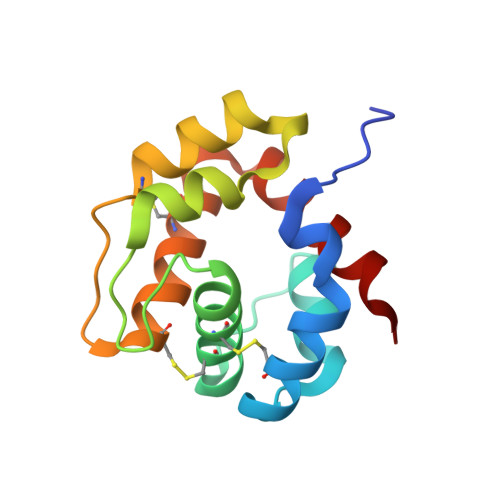
Crystal structure of Locusta migratoria odorant binding proteins lmigOBP1


Experimental Data Snapshot

  • Method: X-RAY DIFFRACTION
  • Resolution: 1.65 Å
  • R-Value Free: 
    0.229 (Depositor), 0.228 (DCC) 
  • R-Value Work: 
    0.184 (Depositor), 0.187 (DCC) 
  • R-Value Observed: 
    0.186 (Depositor) 

wwPDB Validation 3D Report Full Report

Validation slider image for 4PT1

This is version 1.2 of the entry. See complete history

Literature

Crystal structure of the Locusta migratoria odorant binding protein.

Zheng, J.Li, J.Han, L.Wang, Y.Wu, W.Qi, X.Tao, Y.Zhang, L.Zhang, Z.Chen, Z.

(2015) Biochem Biophys Res Commun 456: 737-742

  • DOI: https://doi.org/10.1016/j.bbrc.2014.12.048
  • Primary Citation Related Structures: 
    4PT1

  • PubMed Abstract: 

    Locusta migratoria (Lmig) causes enormous losses to agricultural products, especially because it often infests the world with great swarms as locust plagues. Locusts find their plant hosts on which they feed through their olfactory system, in which odorant binding proteins (OBPs) play an important role. Previous study indicated that the amino acid sequences of LmigOBP showed low similarity to OBPs from other insect orders and we speculated that it might perform unique binding behavior. Here, we solved the first LmigOBP1 structure at 1.65Å, which is a monomer in solution and disulfide bonds play a key role in maintaining its function. We show that LmigOBP1 possesses a unique seventh α-helix, which is located at the surface with strong interactions with the LmigOBP1 scaffold consisting of other six α-helices. Moreover, the seventh α-helix forms a wall of an "L" shaped internal hydrophobic cavity to accommodate linear ligands, which is consistent with the binding experiments. We also demonstrate that the ligand-binding pocket in LmigOBP1 is greatly different from that in the closest homologs mosquito OBPs. Taken together, this study provides a structural basis for designing small inhibitors to control locust.


  • Organizational Affiliation
    • State Key Laboratory of Agrobiotechnology, China Agricultural University, Beijing 100193, China.

Macromolecule Content 

  • Total Structure Weight: 30.46 kDa 
  • Atom Count: 2,185 
  • Modeled Residue Count: 257 
  • Deposited Residue Count: 262 
  • Unique protein chains: 1

Macromolecules

Find similar proteins by:|  3D Structure
Entity ID: 1
MoleculeChains  Sequence LengthOrganismDetailsImage
Odorant-binding protein 1d
A, B
131Locusta migratoriaMutation(s): 0 
Gene Names: lmigobp1
UniProt
Find proteins for Q3HM32 (Locusta migratoria)
Explore Q3HM32 
Go to UniProtKB:  Q3HM32
Entity Groups
Sequence Clusters30% Identity50% Identity70% Identity90% Identity95% Identity100% Identity
UniProt GroupQ3HM32
Sequence Annotations
Expand
Reference Sequence

Experimental Data & Validation

Experimental Data

  • Method: X-RAY DIFFRACTION
  • Resolution: 1.65 Å
  • R-Value Free:  0.229 (Depositor), 0.228 (DCC) 
  • R-Value Work:  0.184 (Depositor), 0.187 (DCC) 
  • R-Value Observed: 0.186 (Depositor) 
Space Group: P 1 21 1
Unit Cell:
Length ( Å )Angle ( ˚ )
a = 33.103α = 90
b = 66.039β = 92.41
c = 51.134γ = 90
Software Package:
Software NamePurpose
ADSCdata collection
BALBESphasing
REFMACrefinement
HKL-2000data reduction
HKL-2000data scaling

Structure Validation

View Full Validation Report


Entry History 

Deposition Data

Revision History  (Full details and data files)

  • Version 1.0: 2014-12-31
    Type: Initial release
  • Version 1.1: 2015-10-21
    Changes: Database references
  • Version 1.2: 2024-11-13
    Changes: Data collection, Database references, Derived calculations, Structure summary