4PSM | pdb_00004psm

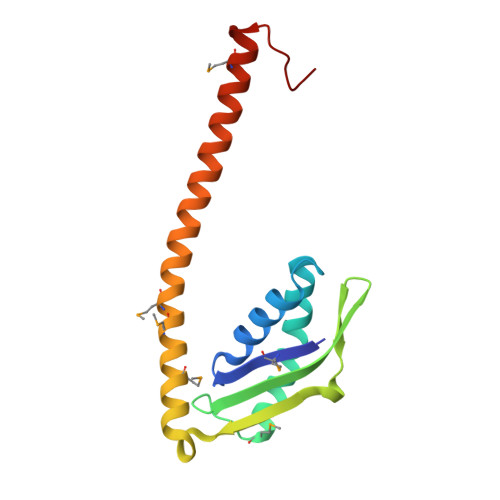
Crystal structure of pfuThermo-DBP-RP1 (crystal form II)


Experimental Data Snapshot

  • Method: X-RAY DIFFRACTION
  • Resolution: 2.43 Å
  • R-Value Free: 
    0.276 (Depositor), 0.270 (DCC) 
  • R-Value Work: 
    0.223 (Depositor), 0.221 (DCC) 
  • R-Value Observed: 
    0.225 (Depositor) 

Starting Model: experimental
View more details

wwPDB Validation 3D Report Full Report

Validation slider image for 4PSM

This is version 1.4 of the entry. See complete history

Literature

Entrapment of DNA in an intersubunit tunnel system of a single-stranded DNA-binding protein.

Ghalei, H.Moeller, H.v.Eppers, D.Sohmen, D.Wilson, D.N.Loll, B.Wahl, M.C.

(2014) Nucleic Acids Res 42: 6698-6708

  • DOI: https://doi.org/10.1093/nar/gku259
  • Primary Citation Related Structures: 
    4PSL, 4PSM, 4PSN, 4PSO

  • PubMed Abstract: 

    Instead of a classical single-stranded deoxyribonuleic acid (DNA)-binding protein (SSB), some hyperthermophilic crenarchaea harbor a non-canonical SSB termed ThermoDBP. Two related but poorly characterized groups of proteins, which share the ThermoDBP N-terminal DNA-binding domain, have a broader phylogenetic distribution and co-exist with ThermoDBPs and/or other SSBs. We have investigated the nucleic acid binding properties and crystal structures of representatives of these groups of ThermoDBP-related proteins (ThermoDBP-RPs) 1 and 2. ThermoDBP-RP 1 and 2 oligomerize by different mechanisms and only ThermoDBP-RP2 exhibits strong single-stranded DNA affinity in vitro. A crystal structure of ThermoDBP-RP2 in complex with DNA reveals how the NTD common to ThermoDBPs and ThermoDBP-RPs can contact the nucleic acid in a manner that allows a symmetric homotetrameric protein complex to bind single-stranded DNA molecules asymmetrically. While single-stranded DNA wraps around the surface or binds along channels of previously investigated SSBs, it traverses an internal, intersubunit tunnel system of a ThermoDBP-RP2 tetramer. Our results indicate that some archaea have acquired special SSBs for genome maintenance in particularly challenging environments.


  • Organizational Affiliation
    • Freie Universität Berlin, Fachbereich Biologie, Chemie, Pharmazie, Institut für Chemie und Biochemie, AG Strukturbiochemie, Takustr. 6, 14195 Berlin, Germany Max-Planck-Institute for Biophysical Chemistry, Department of Cellular Biochemistry, Am Fassberg 11, 37077 Göttingen, Germany.

Macromolecule Content 

  • Total Structure Weight: 70.53 kDa 
  • Atom Count: 4,883 
  • Modeled Residue Count: 586 
  • Deposited Residue Count: 596 
  • Unique protein chains: 1

Macromolecules

Find similar proteins by:|  3D Structure
Entity ID: 1
MoleculeChains  Sequence LengthOrganismDetailsImage
ssDNA binding protein
A, B, C, D
149Pyrococcus furiosus DSM 3638Mutation(s): 0 
Gene Names: PF1044
UniProt
Find proteins for Q8U208 (Pyrococcus furiosus (strain ATCC 43587 / DSM 3638 / JCM 8422 / Vc1))
Explore Q8U208 
Go to UniProtKB:  Q8U208
Entity Groups
Sequence Clusters30% Identity50% Identity70% Identity90% Identity95% Identity100% Identity
UniProt GroupQ8U208
Sequence Annotations
Expand
Reference Sequence

Experimental Data & Validation

Experimental Data

  • Method: X-RAY DIFFRACTION
  • Resolution: 2.43 Å
  • R-Value Free:  0.276 (Depositor), 0.270 (DCC) 
  • R-Value Work:  0.223 (Depositor), 0.221 (DCC) 
  • R-Value Observed: 0.225 (Depositor) 
Space Group: C 2 2 21
Unit Cell:
Length ( Å )Angle ( ˚ )
a = 61.251α = 90
b = 199.303β = 90
c = 114.859γ = 90
Software Package:
Software NamePurpose
MAR345dtbdata collection
PHASERphasing
PHENIXrefinement
XDSdata reduction
XSCALEdata scaling

Structure Validation

View Full Validation Report


Entry History 

Deposition Data

Revision History  (Full details and data files)

  • Version 1.0: 2014-04-30
    Type: Initial release
  • Version 1.1: 2014-06-25
    Changes: Database references
  • Version 1.2: 2023-09-20
    Changes: Data collection, Database references, Derived calculations, Refinement description
  • Version 1.3: 2023-12-06
    Changes: Data collection
  • Version 1.4: 2024-11-06
    Changes: Structure summary