4P2V | pdb_00004p2v

Structure of the AI-2 processing enzyme LsrF in complex with the product of the LsrG reaction P-HPD


Experimental Data Snapshot

  • Method: X-RAY DIFFRACTION
  • Resolution: 2.51 Å
  • R-Value Free: 
    0.271 (Depositor), 0.275 (DCC) 
  • R-Value Work: 
    0.235 (Depositor), 0.236 (DCC) 
  • R-Value Observed: 
    0.237 (Depositor) 

Starting Model: experimental
View more details

wwPDB Validation 3D Report Full Report

Validation slider image for 4P2V

Ligand Structure Quality Assessment 


This is version 1.5 of the entry. See complete history

Literature

LsrF, a coenzyme A-dependent thiolase, catalyzes the terminal step in processing the quorum sensing signal autoinducer-2.

Marques, J.C.Oh, I.K.Ly, D.C.Lamosa, P.Ventura, M.R.Miller, S.T.Xavier, K.B.

(2014) Proc Natl Acad Sci U S A 111: 14235-14240

  • DOI: https://doi.org/10.1073/pnas.1408691111
  • Primary Citation Related Structures: 
    4P2V

  • PubMed Abstract: 

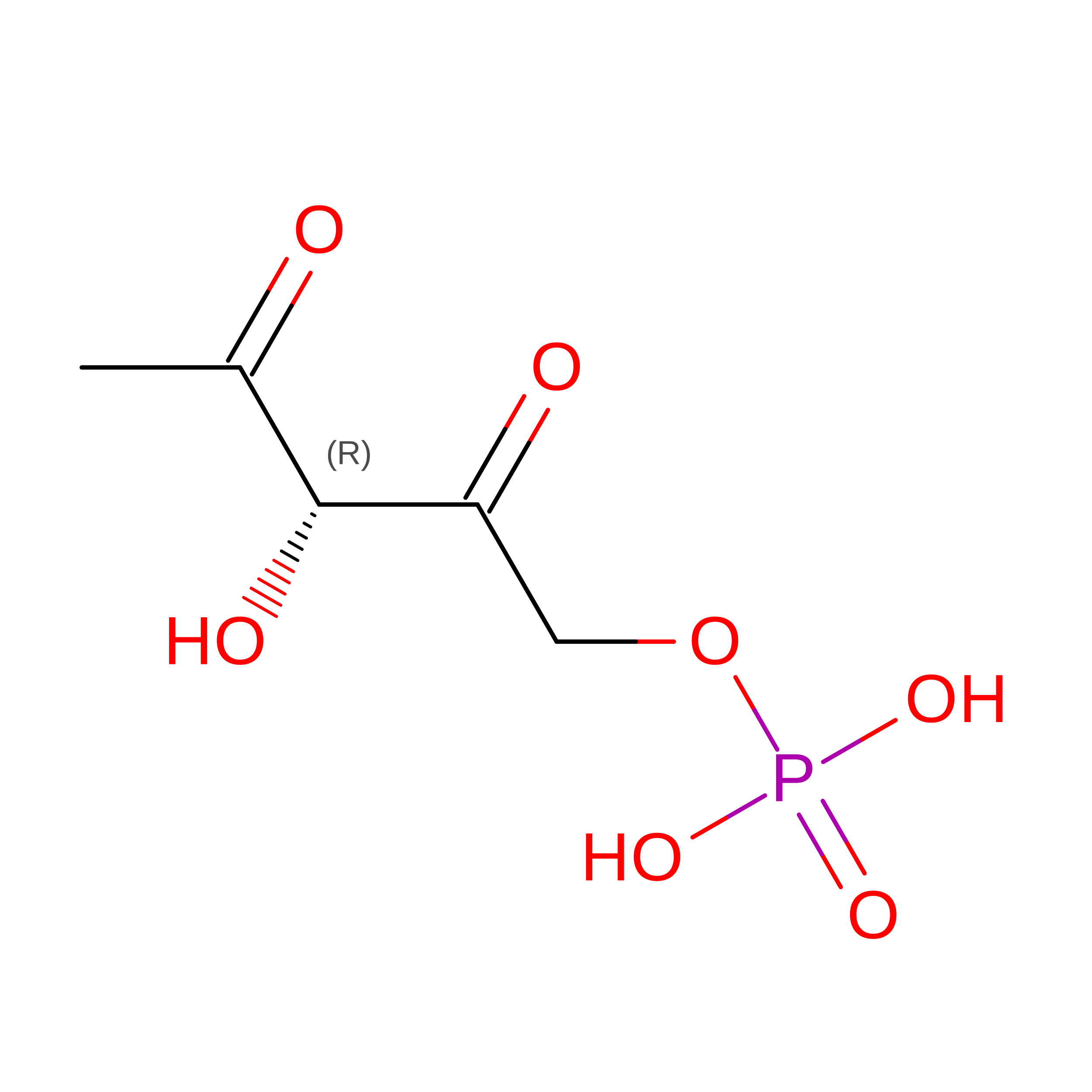
    The quorum sensing signal autoinducer-2 (AI-2) regulates important bacterial behaviors, including biofilm formation and the production of virulence factors. Some bacteria, such as Escherichia coli, can quench the AI-2 signal produced by a variety of species present in the environment, and thus can influence AI-2-dependent bacterial behaviors. This process involves uptake of AI-2 via the Lsr transporter, followed by phosphorylation and consequent intracellular sequestration. Here we determine the metabolic fate of intracellular AI-2 by characterizing LsrF, the terminal protein in the Lsr AI-2 processing pathway. We identify the substrates of LsrF as 3-hydroxy-2,4-pentadione-5-phosphate (P-HPD, an isomer of AI-2-phosphate) and coenzyme A, determine the crystal structure of an LsrF catalytic mutant bound to P-HPD, and identify the reaction products. We show that LsrF catalyzes the transfer of an acetyl group from P-HPD to coenzyme A yielding dihydroxyacetone phosphate and acetyl-CoA, two key central metabolites. We further propose that LsrF, despite strong structural homology to aldolases, acts as a thiolase, an activity previously undescribed for this family of enzymes. With this work, we have fully characterized the biological pathway for AI-2 processing in E. coli, a pathway that can be used to quench AI-2 and control quorum-sensing-regulated bacterial behaviors.


  • Organizational Affiliation
    • Instituto Gulbenkian de Ciência, 2780-156 Oeiras, Portugal; Champalimaud Neuroscience Programme, Champalimaud Centre for the Unknown, Av. de Brasilia, 1400-038 Lisbon, Portugal;

Macromolecule Content 

  • Total Structure Weight: 322.28 kDa 
  • Atom Count: 22,178 
  • Modeled Residue Count: 2,809 
  • Deposited Residue Count: 2,930 
  • Unique protein chains: 1

Macromolecules

Find similar proteins by:|  3D Structure
Entity ID: 1
MoleculeChains  Sequence LengthOrganismDetailsImage
Uncharacterized aldolase LsrF
A,
B,
C,
D,
E,
F,
G,
H,
I,
J [auth K]
293Escherichia coli K-12Mutation(s): 1 
Gene Names: lsrFyneBb1517JW1510
EC: 4.1.2 (PDB Primary Data), 2.3.1.245 (UniProt)
UniProt
Find proteins for P76143 (Escherichia coli (strain K12))
Explore P76143 
Go to UniProtKB:  P76143
Entity Groups
Sequence Clusters30% Identity50% Identity70% Identity90% Identity95% Identity100% Identity
UniProt GroupP76143
Sequence Annotations
Expand
Reference Sequence

Small Molecules

Ligands 1 Unique
IDChains Name / Formula / InChI Key2D Diagram3D Interactions
26T

Query on 26T


Download:Ideal Coordinates CCD File
K [auth A]
L [auth B]
M [auth C]
N [auth D]
O [auth E]
K [auth A],
L [auth B],
M [auth C],
N [auth D],
O [auth E],
P [auth F],
Q [auth G],
R [auth H],
S [auth I],
T [auth K]
(3R)-3-hydroxy-2,4-dioxopentyl dihydrogen phosphate
C5 H9 O7 P
AKHNGSPNHAFBII-RXMQYKEDSA-N

Experimental Data & Validation

Experimental Data

  • Method: X-RAY DIFFRACTION
  • Resolution: 2.51 Å
  • R-Value Free:  0.271 (Depositor), 0.275 (DCC) 
  • R-Value Work:  0.235 (Depositor), 0.236 (DCC) 
  • R-Value Observed: 0.237 (Depositor) 
Space Group: P 1 21 1
Unit Cell:
Length ( Å )Angle ( ˚ )
a = 78.617α = 90
b = 105.742β = 101.43
c = 170.402γ = 90
Software Package:
Software NamePurpose
PHENIXrefinement

Structure Validation

View Full Validation Report


Ligand Structure Quality Assessment 


Entry History 

& Funding Information

Deposition Data


Funding OrganizationLocationGrant Number
National Institutes of Health/National Institute of General Medical Sciences (NIH/NIGMS)United States1R15GM096478-01A1

Revision History  (Full details and data files)

  • Version 1.0: 2014-09-17
    Type: Initial release
  • Version 1.1: 2014-10-01
    Changes: Database references
  • Version 1.2: 2014-10-15
    Changes: Database references
  • Version 1.3: 2017-09-06
    Changes: Author supporting evidence, Database references, Derived calculations, Other, Source and taxonomy
  • Version 1.4: 2019-12-25
    Changes: Author supporting evidence
  • Version 1.5: 2023-09-27
    Changes: Data collection, Database references, Refinement description