4OFD | pdb_00004ofd

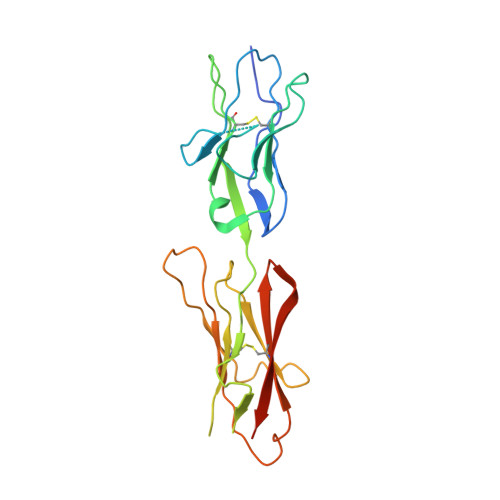
Crystal Structure of mouse Neph1 D1-D2


Experimental Data Snapshot

  • Method: X-RAY DIFFRACTION
  • Resolution: 3.94 Å
  • R-Value Free: 
    0.329 (Depositor), 0.349 (DCC) 
  • R-Value Work: 
    0.297 (Depositor), 0.308 (DCC) 
  • R-Value Observed: 
    0.299 (Depositor) 

Starting Models: experimental
View more details

wwPDB Validation 3D Report Full Report

Validation slider image for 4OFD

This is version 2.2 of the entry. See complete history

Literature

Extracellular Architecture of the SYG-1/SYG-2 Adhesion Complex Instructs Synaptogenesis.

Ozkan, E.Chia, P.H.Wang, R.R.Goriatcheva, N.Borek, D.Otwinowski, Z.Walz, T.Shen, K.Garcia, K.C.

(2014) Cell 156: 482-494

  • DOI: https://doi.org/10.1016/j.cell.2014.01.004
  • Primary Citation Related Structures: 
    4OF0, 4OF3, 4OF6, 4OF7, 4OF8, 4OFD, 4OFI, 4OFK, 4OFP, 4OFY

  • PubMed Abstract: 

    SYG-1 and SYG-2 are multipurpose cell adhesion molecules (CAMs) that have evolved across all major animal taxa to participate in diverse physiological functions, ranging from synapse formation to formation of the kidney filtration barrier. In the crystal structures of several SYG-1 and SYG-2 orthologs and their complexes, we find that SYG-1 orthologs homodimerize through a common, bispecific interface that similarly mediates an unusual orthogonal docking geometry in the heterophilic SYG-1/SYG-2 complex. C. elegans SYG-1's specification of proper synapse formation in vivo closely correlates with the heterophilic complex affinity, which appears to be tuned for optimal function. Furthermore, replacement of the interacting domains of SYG-1 and SYG-2 with those from CAM complexes that assume alternative docking geometries or the introduction of segmental flexibility compromised synaptic function. These results suggest that SYG extracellular complexes do not simply act as "molecular velcro" and that their distinct structural features are important in instructing synaptogenesis. PAPERFLICK:


  • Organizational Affiliation
    • Department of Molecular and Cellular Physiology and Department of Structural Biology, Stanford University School of Medicine, Stanford, CA 94305, USA; Howard Hughes Medical Institute, Stanford University School of Medicine, Stanford, CA 94305, USA.

Macromolecule Content 

  • Total Structure Weight: 47.89 kDa 
  • Atom Count: 3,007 
  • Modeled Residue Count: 388 
  • Deposited Residue Count: 428 
  • Unique protein chains: 1

Macromolecules

Find similar proteins by:|  3D Structure
Entity ID: 1
MoleculeChains  Sequence LengthOrganismDetailsImage
Kin of IRRE-like protein 1
A, B
214Mus musculusMutation(s): 0 
Gene Names: KirrelKirrel1Neph1Neph1 (Kirrel)
UniProt & NIH Common Fund Data Resources
Find proteins for Q80W68 (Mus musculus)
Explore Q80W68 
Go to UniProtKB:  Q80W68
IMPC:  MGI:1891396
Entity Groups
Sequence Clusters30% Identity50% Identity70% Identity90% Identity95% Identity100% Identity
UniProt GroupQ80W68
Glycosylation
Glycosylation Sites: 1Go to GlyGen: Q80W68-1
Sequence Annotations
Expand
Reference Sequence

Oligosaccharides

Help  
Entity ID: 2
MoleculeChains Length2D Diagram GlycosylationD Interactions
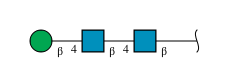
beta-D-mannopyranose-(1-4)-2-acetamido-2-deoxy-beta-D-glucopyranose-(1-4)-2-acetamido-2-deoxy-beta-D-glucopyranose
C
3N-Glycosylation
Glycosylation Resources
GlyTouCan: G15407YE
GlyCosmos: G15407YE
GlyGen: G15407YE
Entity ID: 3
MoleculeChains Length2D Diagram GlycosylationD Interactions
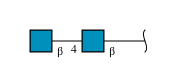
2-acetamido-2-deoxy-beta-D-glucopyranose-(1-4)-2-acetamido-2-deoxy-beta-D-glucopyranose
D
2N-Glycosylation
Glycosylation Resources
GlyTouCan: G42666HT
GlyCosmos: G42666HT
GlyGen: G42666HT

Experimental Data & Validation

Experimental Data

  • Method: X-RAY DIFFRACTION
  • Resolution: 3.94 Å
  • R-Value Free:  0.329 (Depositor), 0.349 (DCC) 
  • R-Value Work:  0.297 (Depositor), 0.308 (DCC) 
  • R-Value Observed: 0.299 (Depositor) 
Space Group: C 2 2 21
Unit Cell:
Length ( Å )Angle ( ˚ )
a = 118.962α = 90
b = 120.008β = 90
c = 119.912γ = 90
Software Package:
Software NamePurpose
BOSdata collection
PHASERphasing
PHENIXrefinement
HKL-2000data reduction
HKL-2000data scaling

Structure Validation

View Full Validation Report


Entry History 

Deposition Data

Revision History  (Full details and data files)

  • Version 1.0: 2014-02-19
    Type: Initial release
  • Version 2.0: 2020-07-29
    Type: Remediation
    Reason: Carbohydrate remediation
    Changes: Atomic model, Data collection, Database references, Derived calculations, Structure summary
  • Version 2.1: 2023-09-20
    Changes: Data collection, Database references, Refinement description, Structure summary
  • Version 2.2: 2024-10-30
    Changes: Structure summary