4OEO | pdb_00004oeo

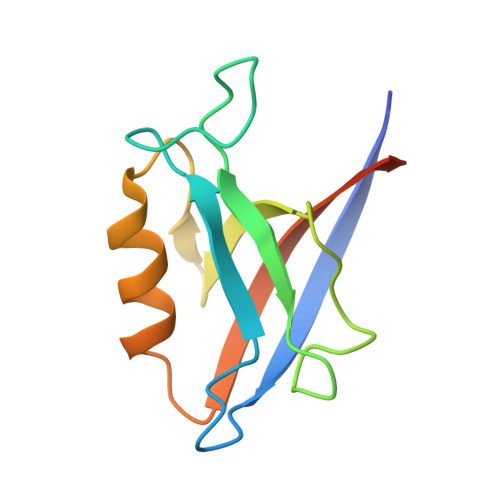
High resolution crystal structure of the unliganded ZO-1 PDZ1 domain


Experimental Data Snapshot

  • Method: X-RAY DIFFRACTION
  • Resolution: 1.90 Å
  • R-Value Free: 
    0.243 (Depositor), 0.251 (DCC) 
  • R-Value Work: 
    0.195 (Depositor), 0.208 (DCC) 
  • R-Value Observed: 
    0.198 (Depositor) 

wwPDB Validation 3D Report Full Report

Validation slider image for 4OEO

This is version 1.3 of the entry. See complete history

Literature

Structural Basis of a Key Factor Regulating the Affinity between the Zonula Occludens First PDZ Domain and Claudins.

Nomme, J.Antanasijevic, A.Caffrey, M.Van Itallie, C.M.Anderson, J.M.Fanning, A.S.Lavie, A.

(2015) J Biological Chem 290: 16595-16606

  • DOI: https://doi.org/10.1074/jbc.M115.646695
  • Primary Citation Related Structures: 
    4OEO, 4OEP, 4YYX

  • PubMed Abstract: 

    The molecular seal between epithelial cells, called the tight junction (TJ), is built by several membrane proteins, with claudins playing the most prominent role. The scaffold proteins of the zonula occludens family are required for the correct localization of claudins and hence formation of the TJ. The intracellular C terminus of claudins binds to the N-terminal PDZ domain of zonula occludens proteins (PDZ1). Of the 23 identified human claudin proteins, nine possess a tyrosine at the -6 position. Here we show that the claudin affinity for PDZ1 is dependent on the presence or absence of this tyrosine and that the affinity is reduced if the tyrosine is modified by phosphorylation. The PDZ1 β2-β3 loop undergoes a significant conformational change to accommodate this tyrosine. Cell culture experiments support a regulatory role for this tyrosine. Plasticity has been recognized as a critical property of TJs that allow cell remodeling and migration. Our work provides a molecular framework for how TJ plasticity may be regulated.


  • Organizational Affiliation
    • From the Department of Biochemistry and Molecular Genetics, University of Illinois, Chicago, Illinois 60607.

Macromolecule Content 

  • Total Structure Weight: 35.92 kDa 
  • Atom Count: 2,218 
  • Modeled Residue Count: 282 
  • Deposited Residue Count: 321 
  • Unique protein chains: 1

Macromolecules

Find similar proteins by:|  3D Structure
Entity ID: 1
MoleculeChains  Sequence LengthOrganismDetailsImage
Tight junction protein ZO-1
A, B, C
107Homo sapiensMutation(s): 0 
Gene Names: TJP1ZO1
UniProt & NIH Common Fund Data Resources
Find proteins for Q07157 (Homo sapiens)
Explore Q07157 
Go to UniProtKB:  Q07157
PHAROS:  Q07157
GTEx:  ENSG00000104067 
Entity Groups
Sequence Clusters30% Identity50% Identity70% Identity90% Identity95% Identity100% Identity
UniProt GroupQ07157
Sequence Annotations
Expand
Reference Sequence

Small Molecules

Ligands 3 Unique
IDChains Name / Formula / InChI Key2D Diagram3D Interactions
12P

Query on 12P


Download:Ideal Coordinates CCD File
H [auth B],
J [auth C]
DODECAETHYLENE GLYCOL
C24 H50 O13
WRZXKWFJEFFURH-UHFFFAOYSA-N
SO4

Query on SO4


Download:Ideal Coordinates CCD File
E [auth A],
I [auth B]
SULFATE ION
O4 S
QAOWNCQODCNURD-UHFFFAOYSA-L
ACT

Query on ACT


Download:Ideal Coordinates CCD File
D [auth A],
F [auth B],
G [auth B]
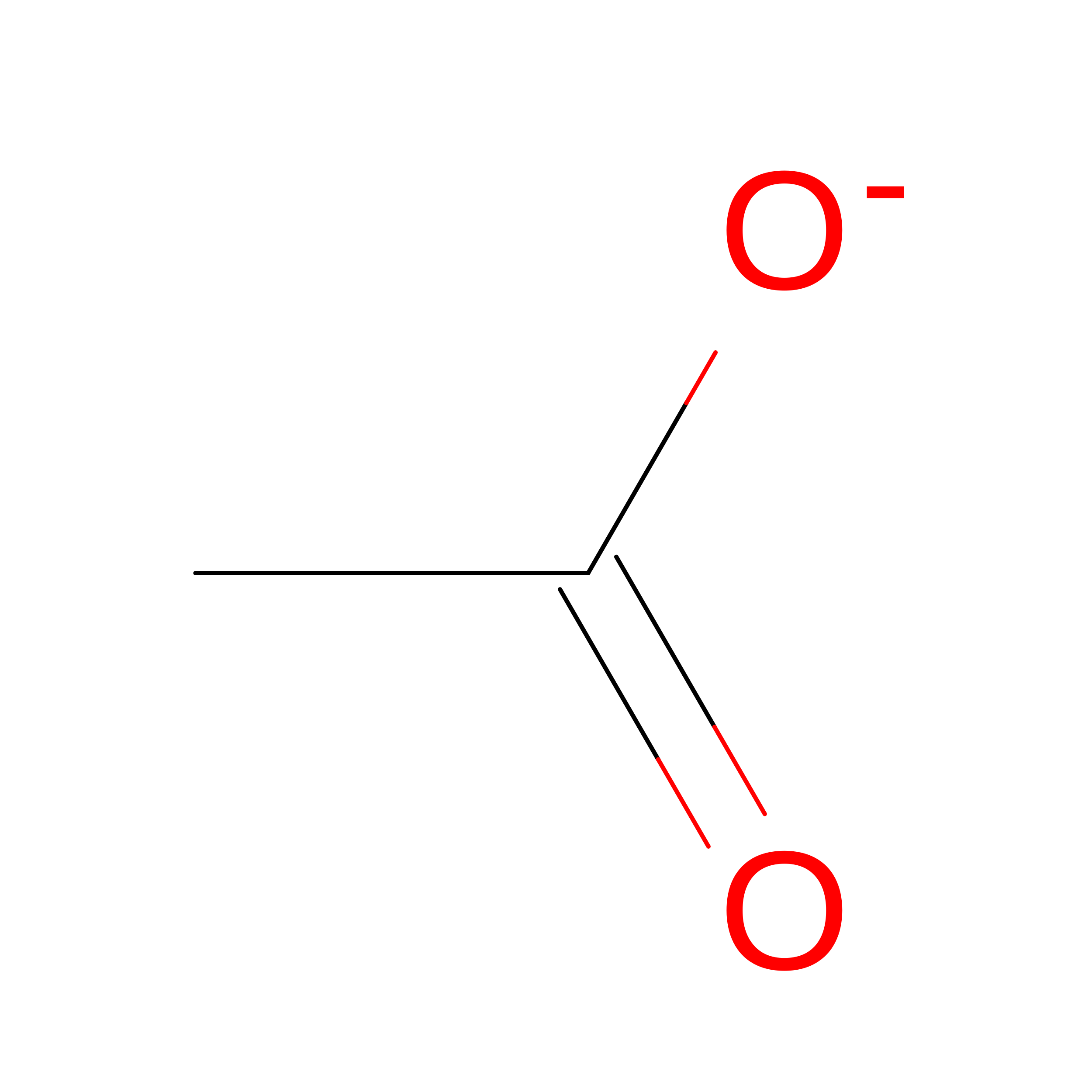
ACETATE ION
C2 H3 O2
QTBSBXVTEAMEQO-UHFFFAOYSA-M

Experimental Data & Validation

Experimental Data

  • Method: X-RAY DIFFRACTION
  • Resolution: 1.90 Å
  • R-Value Free:  0.243 (Depositor), 0.251 (DCC) 
  • R-Value Work:  0.195 (Depositor), 0.208 (DCC) 
  • R-Value Observed: 0.198 (Depositor) 
Space Group: C 1 2 1
Unit Cell:
Length ( Å )Angle ( ˚ )
a = 104.993α = 90
b = 60.473β = 124.26
c = 62.217γ = 90
Software Package:
Software NamePurpose
CrystalCleardata collection
MOLREPphasing
REFMACrefinement
XDSdata reduction
XDSdata scaling

Structure Validation

View Full Validation Report


Entry History 

Deposition Data

Revision History  (Full details and data files)

  • Version 1.0: 2015-01-14
    Type: Initial release
  • Version 1.1: 2015-07-01
    Changes: Database references
  • Version 1.2: 2015-07-22
    Changes: Database references
  • Version 1.3: 2024-02-28
    Changes: Data collection, Database references, Derived calculations