4OCC | pdb_00004occ

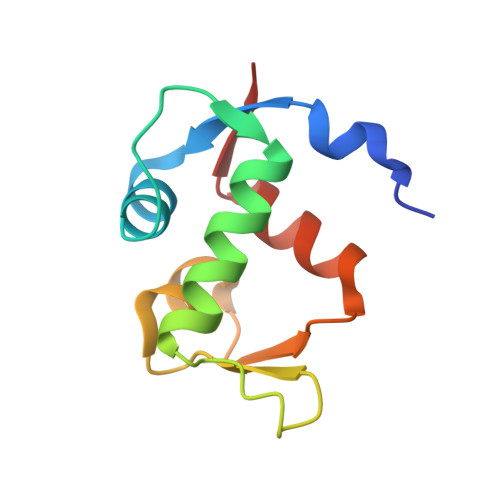
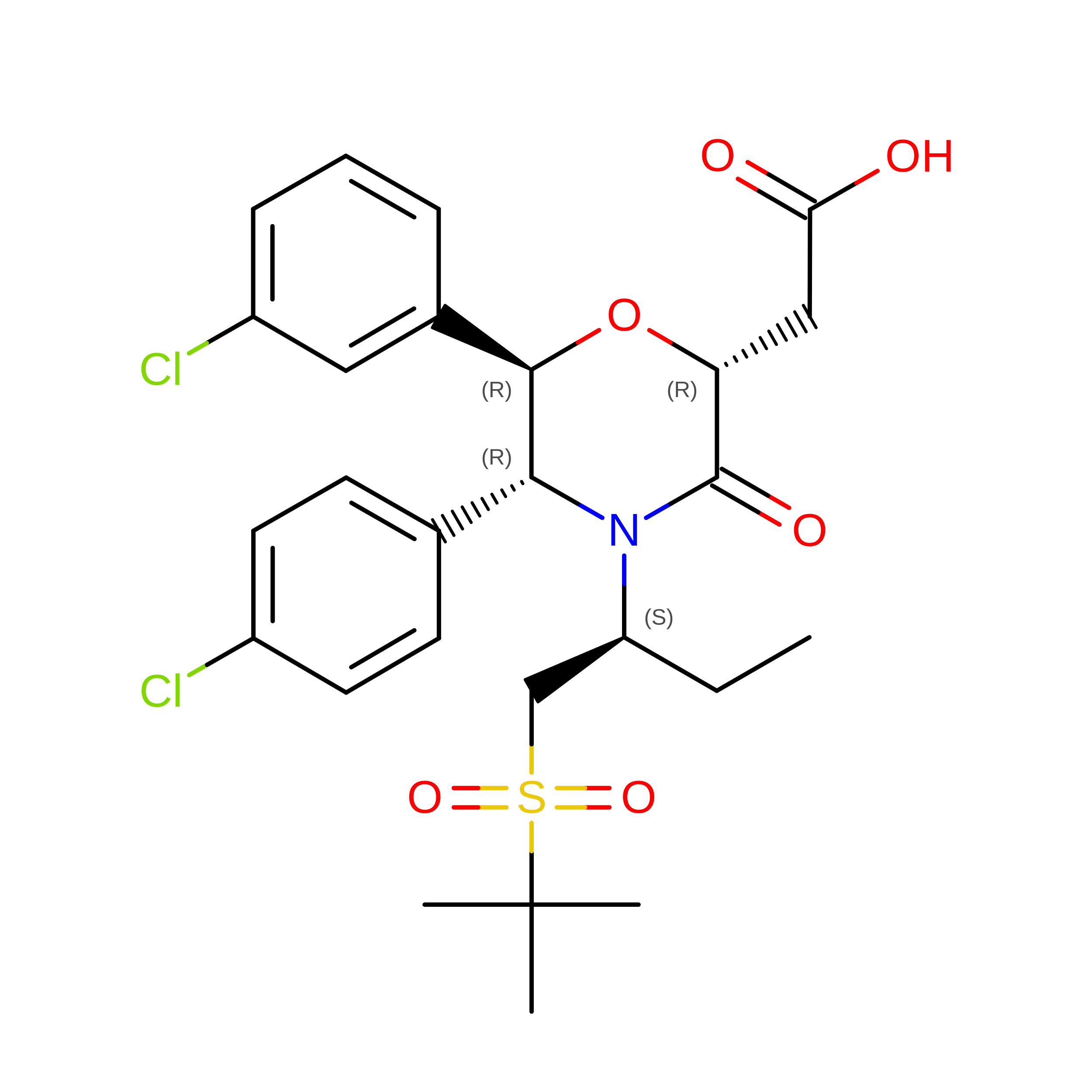
co-crystal structure of MDM2(17-111) in complex with compound 48


Experimental Data Snapshot

  • Method: X-RAY DIFFRACTION
  • Resolution: 1.80 Å
  • R-Value Free: 
    0.216 (Depositor), 0.218 (DCC) 
  • R-Value Work: 
    0.206 (Depositor), 0.210 (DCC) 

wwPDB Validation 3D Report Full Report

Validation slider image for 4OCC

Ligand Structure Quality Assessment 


This is version 1.2 of the entry. See complete history

Literature

Novel Inhibitors of the MDM2-p53 Interaction Featuring Hydrogen Bond Acceptors as Carboxylic Acid Isosteres.

Gonzalez, A.Z.Li, Z.Beck, H.P.Canon, J.Chen, A.Chow, D.Duquette, J.Eksterowicz, J.Fox, B.M.Fu, J.Huang, X.Houze, J.Jin, L.Li, Y.Ling, Y.Lo, M.C.Long, A.M.McGee, L.R.McIntosh, J.Oliner, J.D.Osgood, T.Rew, Y.Saiki, A.Y.Shaffer, P.Wortman, S.Yakowec, P.Yan, X.Ye, Q.Yu, D.Zhao, X.Zhou, J.Olson, S.H.Sun, D.Medina, J.C.

(2014) J Med Chem 57: 2963-2988

  • DOI: https://doi.org/10.1021/jm401911v
  • Primary Citation Related Structures: 
    4OCC, 4ODE, 4ODF, 4OGN, 4OGT, 4OGV

  • PubMed Abstract: 

    We previously reported the discovery of potent and selective morpholinone and piperidinone inhibitors of the MDM2-p53 interaction. These inhibitors have in common a carboxylic acid moiety that engages in an electrostatic interaction with MDM2-His96. Our continued search for potent and diverse inhibitors led to the discovery of novel replacements for these acids uncovering new interactions with the MDM2 protein. In particular, using pyridine or thiazole as isosteres of the carboxylic acid moiety resulted in very potent analogues. From these, AM-6761 (4) emerged as a potent inhibitor with remarkable biochemical (HTRF IC50 = 0.1 nM) and cellular potency (SJSA-1 EdU IC50 = 16 nM), as well as favorable pharmacokinetic properties. Compound 4 also shows excellent antitumor activity in the SJSA-1 osteosarcoma xenograft model with an ED50 of 11 mg/kg. Optimization efforts toward the discovery of these inhibitors as well as the new interactions observed with the MDM2 protein are described herein.


  • Organizational Affiliation
    • Departments of Therapeutic Discovery, ‡Pharmaceutics, and §Pharmacokinetics and Drug Metabolism, Amgen Inc. , 1120 Veterans Boulevard, South San Francisco, California 94080, United States.

Macromolecule Content 

  • Total Structure Weight: 35.14 kDa 
  • Atom Count: 2,682 
  • Modeled Residue Count: 278 
  • Deposited Residue Count: 288 
  • Unique protein chains: 1

Macromolecules

Find similar proteins by:|  3D Structure
Entity ID: 1
MoleculeChains  Sequence LengthOrganismDetailsImage
E3 ubiquitin-protein ligase Mdm2A,
B [auth C],
C [auth E]
96Homo sapiensMutation(s): 0 
Gene Names: MDM2
EC: 6.3.2 (PDB Primary Data), 2.3.2.27 (UniProt)
UniProt & NIH Common Fund Data Resources
Find proteins for Q00987 (Homo sapiens)
Explore Q00987 
Go to UniProtKB:  Q00987
PHAROS:  Q00987
GTEx:  ENSG00000135679 
Entity Groups
Sequence Clusters30% Identity50% Identity70% Identity90% Identity95% Identity100% Identity
UniProt GroupQ00987
Sequence Annotations
Expand
Reference Sequence

Small Molecules

Binding Affinity Annotations 
IDSourceBinding Affinity
2TZ BindingDB:  4OCC Kd: 0.39 (nM) from 1 assay(s)
IC50: min: 0.5, max: 240 (nM) from 3 assay(s)

Experimental Data & Validation

Experimental Data

  • Method: X-RAY DIFFRACTION
  • Resolution: 1.80 Å
  • R-Value Free:  0.216 (Depositor), 0.218 (DCC) 
  • R-Value Work:  0.206 (Depositor), 0.210 (DCC) 
Space Group: C 2 2 21
Unit Cell:
Length ( Å )Angle ( ˚ )
a = 56.584α = 90
b = 98.785β = 90
c = 106.819γ = 90
Software Package:
Software NamePurpose
HKL-2000data collection
AMoREphasing
CNSrefinement
HKL-2000data reduction
HKL-2000data scaling

Structure Validation

View Full Validation Report


Ligand Structure Quality Assessment 


Entry History 

Deposition Data

  • Released Date: 2014-04-02 
  • Deposition Author(s): Huang, X.

Revision History  (Full details and data files)

  • Version 1.0: 2014-04-02
    Type: Initial release
  • Version 1.1: 2014-06-18
    Changes: Database references
  • Version 1.2: 2024-02-28
    Changes: Data collection, Database references, Derived calculations