4O1T | pdb_00004o1t

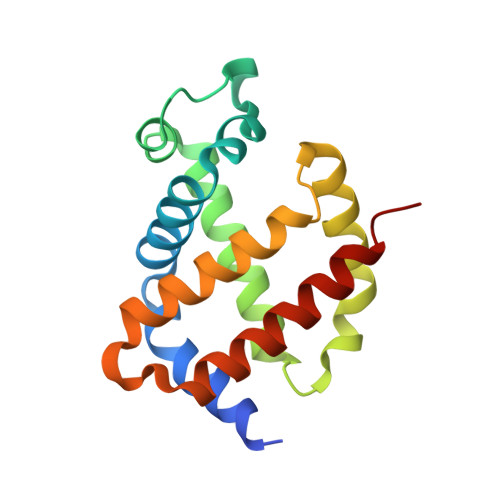
Crystal structure of murine neuroglobin mutant F106W


Experimental Data Snapshot

  • Method: X-RAY DIFFRACTION
  • Resolution: 1.60 Å
  • R-Value Free: 
    0.195 (Depositor), 0.196 (DCC) 
  • R-Value Work: 
    0.168 (Depositor) 
  • R-Value Observed: 
    0.171 (Depositor) 

wwPDB Validation 3D Report Full Report

Validation slider image for 4O1T

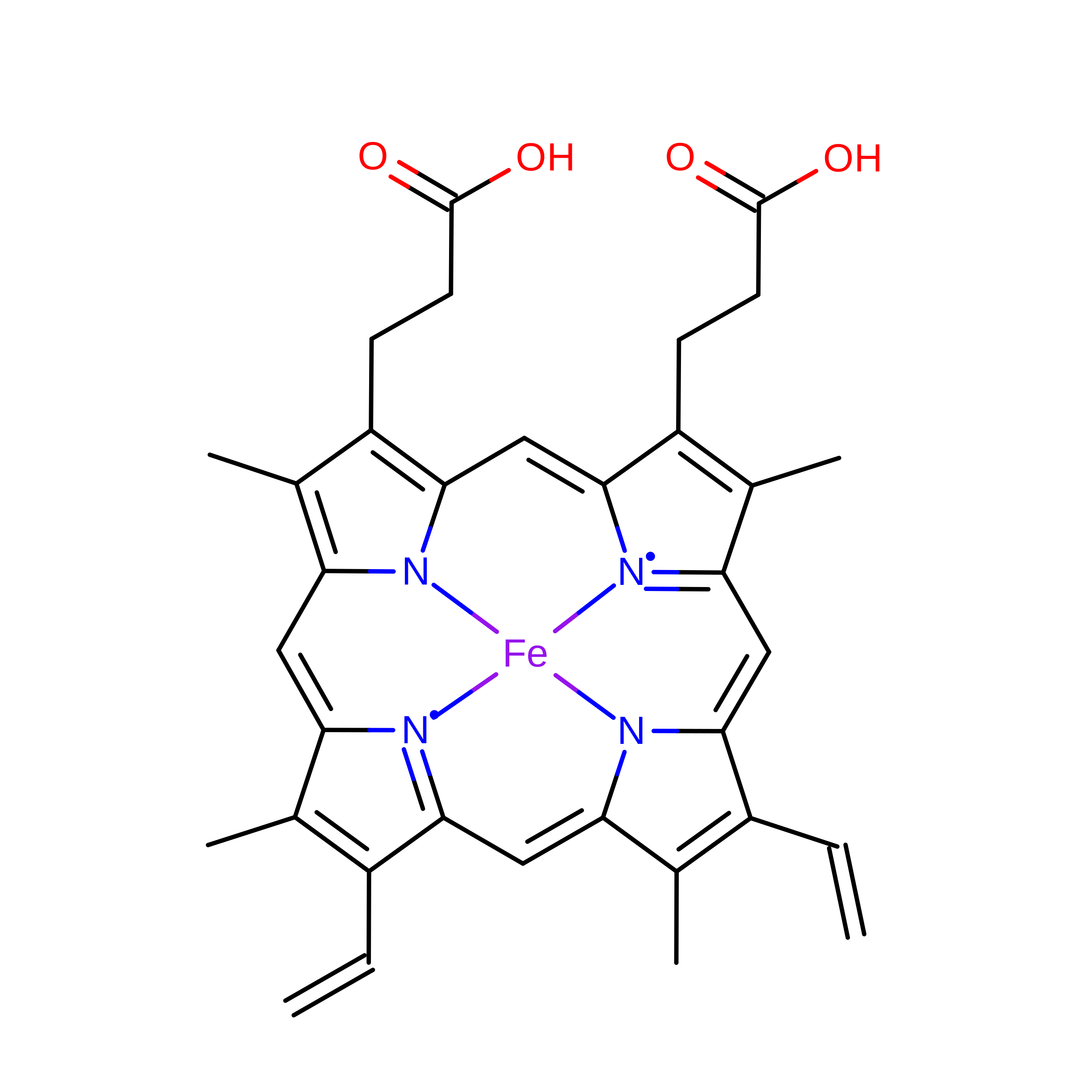
Ligand Structure Quality Assessment 


This is version 1.2 of the entry. See complete history

Literature

Engineering the internal cavity of neuroglobin demonstrates the role of the haem-sliding mechanism.

Avella, G.Ardiccioni, C.Scaglione, A.Moschetti, T.Rondinelli, C.Montemiglio, L.C.Savino, C.Giuffre, A.Brunori, M.Vallone, B.

(2014) Acta Crystallogr D Biol Crystallogr 70: 1640-1648

  • DOI: https://doi.org/10.1107/S1399004714007032
  • Primary Citation Related Structures: 
    4MU5, 4NZI, 4O1T, 4O2G, 4O35

  • PubMed Abstract: 

    Neuroglobin is a member of the globin family involved in neuroprotection; it is primarily expressed in the brain and retina of vertebrates. Neuroglobin belongs to the heterogeneous group of hexacoordinate globins that have evolved in animals, plants and bacteria, endowed with the capability of reversible intramolecular coordination, allowing the binding of small gaseous ligands (O2, NO and CO). In a unique fashion among haemoproteins, ligand-binding events in neuroglobin are dependent on the sliding of the haem itself within a preformed internal cavity, as revealed by the crystal structure of its CO-bound derivative. Point mutants of the neuroglobin internal cavity have been engineered and their functional and structural characterization shows that hindering the haem displacement leads to a decrease in CO affinity, whereas reducing the cavity volume without interfering with haem sliding has negligible functional effects.


  • Organizational Affiliation
    • Istituto Pasteur-Fondazione Cenci Bolognetti and Istituto di Biologia e Patologia Molecolari del CNR, Dipartimento di Scienze Biochimiche `A. Rossi Fanelli', Sapienza Università di Roma, Piazzale A. Moro 5, 00185 Rome, Italy.

Macromolecule Content 

  • Total Structure Weight: 18.06 kDa 
  • Atom Count: 1,608 
  • Modeled Residue Count: 148 
  • Deposited Residue Count: 154 
  • Unique protein chains: 1

Macromolecules

Find similar proteins by:|  3D Structure
Entity ID: 1
MoleculeChains  Sequence LengthOrganismDetailsImage
Neuroglobin154Mus musculusMutation(s): 3 
Gene Names: Ngb
EC: 1.7
UniProt
Find proteins for Q9ER97 (Mus musculus)
Explore Q9ER97 
Go to UniProtKB:  Q9ER97
Entity Groups
Sequence Clusters30% Identity50% Identity70% Identity90% Identity95% Identity100% Identity
UniProt GroupQ9ER97
Sequence Annotations
Expand
Reference Sequence

Small Molecules

Experimental Data & Validation

Experimental Data

  • Method: X-RAY DIFFRACTION
  • Resolution: 1.60 Å
  • R-Value Free:  0.195 (Depositor), 0.196 (DCC) 
  • R-Value Work:  0.168 (Depositor) 
  • R-Value Observed: 0.171 (Depositor) 
Space Group: H 3 2
Unit Cell:
Length ( Å )Angle ( ˚ )
a = 87.936α = 90
b = 87.936β = 90
c = 114.139γ = 120
Software Package:
Software NamePurpose
PHENIXrefinement
PDB_EXTRACTdata extraction
DNAdata collection
HKL-2000data reduction
SCALEPACKdata scaling
PHASERphasing

Structure Validation

View Full Validation Report


Ligand Structure Quality Assessment 


Entry History 

Deposition Data

Revision History  (Full details and data files)

  • Version 1.0: 2014-06-18
    Type: Initial release
  • Version 1.1: 2014-09-24
    Changes: Database references
  • Version 1.2: 2024-02-28
    Changes: Data collection, Database references, Derived calculations